Category
page 1Japanese writing system

hiragana
is a Japanese syllabary, part of the Japanese writing system, along with katakana as well as kanji (Chinese characters).

kanji
Kanji (; , hiragana: かんじ, Katakana: カンジ, , ) are logographic Chinese characters, historically adapted from Chinese writing scripts, used in the writing of Japanese. They comprised a major part of the Japanese writing system during the time of Old Japanese and are still used today, along with the subsequently derived syllabic (phonographic) scripts of and . Most Kanji characters have two pronunciations: ''kun'yomi, based on the sounds of vernacular Japanese, where the Kanji is often phonetically transcribed with furigana; and on'yomi, based on the imitation of the original Middle Chinese sound

katakana
is a Japanese syllabary, one component of the Japanese writing system along with hiragana, kanji and in some cases the Latin script (known as rōmaji).

emoji
thumb|Each of the most popular emoji from the 9 major emoji categories according to the Unicode Emoji Frequency study from 2021, rendered in the Noto Color Emoji font

kana
are syllabaries used to write Japanese phonological units, morae. In current usage, kana most commonly refers to hiragana and katakana. It can also refer to their ancestor , which were Chinese characters used phonetically to transcribe Japanese (e.g. ''man'yōgana); and hentaigana'', which are historical variants of the now-standard hiragana.
Japanese writing system
various writing systems used Japanese, using or mixing Hiragana, Katakana and Kanji characters, inherited or derived from Chinese ideographic characters

romanization of Japanese
Japanese language written in Latin script

Hepburn romanization
system of Japanese romanization

man'yōgana
is an ancient writing system that uses Chinese characters to represent the Japanese language. It was the first known kana system to be developed as a means to represent the Japanese language phonetically. The date of the earliest usage of this type of kana is not clear, but it was in use since at least the mid-7th century. The name "man'yōgana" derives from the ''Man'yōshū, a Japanese poetry anthology from the Nara period written with man'yōgana.''

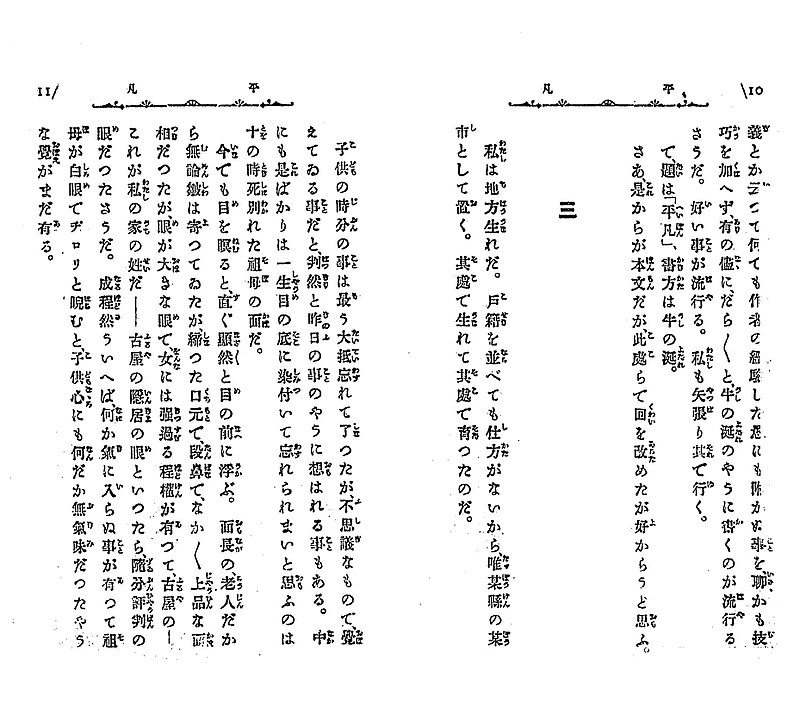
furigana
is a Japanese reading aid consisting of smaller kana (syllabic characters) printed either above or next to kanji (logographic characters) or other characters to indicate their pronunciation. It is one type of ruby text. Furigana is also known as and in Japanese. In modern Japanese, it is usually used to gloss rare kanji, to clarify rare, nonstandard or ambiguous kanji readings, or in children's or learners' materials. Before the post-World War II script reforms, it was more widespread.
jōyō kanji
set of common kanji taught in schools and allowed in government documents
Iroha
The is a Japanese poem. Originally the poem was attributed to Kūkai, the founder of Shingon Buddhism, but more modern research has found the date of composition to be later in the Heian period (794–1179). The first record of its existence dates from 1079. It is famous because it is a perfect pangram, containing each character of the Japanese syllabary exactly once. Because of this, it is also used as an ordering for the syllabary, in the same way as the A, B, C, D... sequence of the Latin alphabet.
Kunrei-shiki romanization
, also known as the Monbusho system (named after the endonym for the Ministry of Education, Culture, Sports, Science and Technology) or MEXT system, is a romanization system for transcribing the Japanese language into the Latin alphabet. Its name is rendered in the system itself. It is taught in the Monbushō-approved elementary school curriculum. The ISO has standardized under ISO 3602.
okurigana
are kana suffixes following kanji stems in Japanese written words. They serve two purposes: to inflect adjectives and verbs, and to force a particular kanji to have a specific meaning and be read a certain way. For example, the plain verb form (miru, "see") inflects to past tense (mita, "saw"), where is the kanji stem, and る and た are okurigana, written in hiragana script. With very few exceptions, okurigana are used only with kun'yomi (native Japanese readings), not with on'yomi (Chinese readings), as Chinese morphemes do not inflect in Japanese, and their pronunciation is inferred from conte

hentaigana
In the Japanese writing system, are variant forms of hiragana.
ruby characters
small characters placed aside a Chinese or Japanese characters to precise their pronunciation or to transliterate them into another script
Nihon-shiki romanization
is a romanization system for transliterating the Japanese language into the Latin alphabet. Among the major romanization systems for Japanese, it is the most regular one and has an almost one-to-one relation to the kana writing system. Its name is rendered Nihonsiki in the system itself.
stroke order
conventional order in which CJKV characters should be written

kokuji
thumb|The kanji for Tasuki (sash)|tasuki, a kokuji, with [[furigana above.]]
In Japanese, or are kanji created in Japan rather than borrowed from China. Like most Chinese characters, they are primarily formed by combining existing characters—though using combinations that are not used in Chinese.

kanbun
Kanbun ( 'Han writing') is a system for writing Literary Chinese used in Japan from the Nara period until the 20th century. Much of Japanese literature was written in this style and it was the general writing style for official and intellectual works throughout the period. As a result, Sino-Japanese vocabulary makes up a large portion of the Japanese lexicon and much classical Chinese literature is accessible to Japanese readers in some resemblance of the original.
list of jōyō kanji
Wikimedia list article
Polivanov system
system of transcription of the Japanese language into Russian Cyrillic script
vertical or horizontal
writing conventions
ヶ
Katakana letter small Ke (U+30F6); abbreviation for the Kanji character 箇 or 個, pronounced /ka/ as a counter, or /ga/ as a conjunction
reference mark
typographic mark used in Chinese, Japanese, and Korean writing
Kaidā glyphs
set of pictograms once used in the Yaeyama Islands of southwestern Japan

jindai moji
“characters [moji] of the Age [dai] of the Gods [jin]”, scripts claimed to be from Japanese antiquity, but considered by epigraphic scholars to be mythological forgeries and beliefs

yotsugana
thumb|right|350px|Different regions distinguish different sets of sounds. Using [[Nihon-shiki romanization:

ryakuji
thumb|upright|Sign reading "umbrella stand" (, kasa-oki, standard form , showing ryakuji form of : ( + ), with inner omitted. Compare simplified Chinese .
thumb|240px|Price tag reading ¥400, (bargain item), showing ryakuji form of , with bottom squares connected
character amnesia
loss of character memory in Chinese speakers
Gyaru-moji
or is a style of obfuscated (cant) Japanese writing popular amongst urban Japanese youth. As the name suggests ( meaning "gal"), this writing system was created by and remains primarily employed by young women.
Japanese input method
method used to input Japanese characters on a computer

pseudo-Chinese
is a form of Japanese Internet slang which first appeared around 2009.
ATOK
ATOK (; ) is a Japanese input method editor (IME) produced by JustSystems, a Japanese software company.
Edomoji
(or '''''' are Japanese typefaces invented for advertising during the Edo period. The main styles of are , found on paper lanterns outside restaurants; , used to label and drinks like and ; , literally "cage letters"; , a thick and rectangular seal script; , often used on flyers for performances such as kabuki and ; and , a mix of and .
wāpuro rōmaji
romanization of Japanese originally devised for entering Japanese into word processors (wāpuro)

Japanese punctuation
non-alphanumeric marks in Japanese
cyrillization of Japanese
application of the Cyrillic script to write the Japanese language
sōgana
thumb|Chart showing various Japanese characters in their ''man'yōgana, sogana (red) and hiragana'' forms.
Jōdai Tokushu Kanazukai
archaic kana orthography system used to write Japanese during the Nara period
Okinawan scripts
Historical orthography of the Okinawan language
Japanese language and computers
Anthy
thumb|Ibus anthy on gedit
Anthy () is a package for an input method editor backend for Unix-like systems for the Japanese language. It can convert Hiragana to Kanji as per the language rules. As a preconversion stage, Latin characters (Romaji) can be used to input Hiragana. Anthy is commonly used with an input method framework such as ibus, fcitx or SCIM.
wakan konkō-bun
Japanese written language
list of Chinese–Japanese false friends
Wikimedia list article
Japanese typographic symbols
Wikimedia list article
warazan
thumb|right|250px|Example of warazan at the Museum of Science, Tokyo University of Science
thumb|right|250px|Instruction to use warazan to record the level of tax assessed, in the Yaeyama-jima Kuramoto Kujichō (1873 copy of the 1857 original); the fourth to sixth characters in the fifth line from the right read「わら算」(University of the Ryukyus Library)
was a system of record-keeping using knotted straw at the time of the Ryūkyū Kingdom. In the Southern Ryukyuan languages of the Sakishima Islands it was known as barazan and on Okinawa Island as warazani or warazai. Formerly used in particular in