Category
page 1JPL Small-Body Database ID same as Wikidata

Halley's Comet
short-period comet visible from Earth every 75–76 years

Comet Hale-Bopp
long-period comet
67P/Churyumov–Gerasimenko
67P/Churyumov–Gerasimenko (abbreviated as 67P or 67P/C–G) is a Jupiter-family comet. It is originally from the Kuiper belt and has an orbital period of 6.45 years as of 2012, a rotation period of approximately 12.4 hours, and a maximum velocity of . Churyumov–Gerasimenko is approximately at its longest and widest dimensions. It was first observed on photographic plates in 1969 by Soviet astronomers Klim Ivanovych Churyumov and Svetlana Ivanovna Gerasimenko, after whom it is named. It most recently came to perihelion (closest approach to the Sun) on 2 November 2021, and will next come to perihe

C/2020 F3 (NEOWISE)
comet discovered in 2020 by the WISE space telescope

3I/ATLAS
3I/ATLAS, also known as C/2025 N1 (ATLAS) and previously as A11pl3Z, is an interstellar comet discovered on 1 July 2025 by the Asteroid Terrestrial-impact Last Alert System (ATLAS) station. The comet follows an unbound, hyperbolic trajectory past the Sun, and passed by Earth at 1.8 AU, posing no threat. The prefix "3I" designates it as the third confirmed interstellar object passing through the Solar System, after 1I/Oumuamua and 2I/Borisov.
Comet Hyakutake
bright comet discovered in 1996

Comet Encke
periodic comet
Tempel 1
short-period comet
Comet Swift–Tuttle
periodic comet and parent body of the Perseid meteor shower
2I/Borisov
2I/Borisov, originally designated C/2019 Q4 (Borisov), is the first observed rogue comet and the second observed interstellar interloper, after ʻOumuamua. It was discovered by the Crimean amateur astronomer and telescope maker Gennadiy Borisov on 29 August 2019 UTC (30 August local time) in MARGO Observatory.
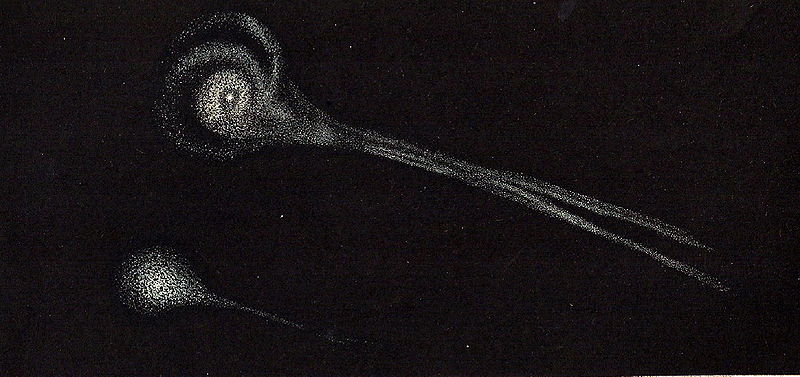
Biela's Comet
Comet that dissolved and assumed as gone

4015 Wilson–Harrington
small body of the Solar System considered both an asteroid and a comet

C/2022 E3 (ZTF)
long period comet

Comet Holmes
comet
C/2006 P1
comet

19P/Borrelly
{| class=wikitable style="text-align:center; font-size:11px; float:right; margin:2px"
|- bgcolor= style="font-size: smaller;"
| colspan="8" style="text-align:center;"|Perihelion distanceat recent epochs
|-
! Epoch !! Perihelion(AU)
|-
| 2028 || 1.310
|-
| 2022 || 1.306
|-
| 2015 || 1.349
|-
| 2008 || 1.355
|}
C/2023 A3 (Tsuchinshan–ATLAS)
long period comet
Comet Lulin
astronomical object
2024 YR₄
near-Earth asteroid
21P/Giacobini–Zinner
{| class=wikitable style="text-align:center; font-size:11px; float:right; margin:2px"
|- bgcolor= style="font-size: smaller;"
| colspan="8" style="text-align:center;"|Perihelion distanceat different epochs
|-
! Epoch !! Perihelion(AU)
|-
| 1894 || 1.23
|-
| 1900 || 0.93
|-
| 1985 || 1.03
|-
| 2031 || 1.07
|-
| 2078 || 0.97
|}
C/2011 L4
non-periodic comet

81P/Wild
Comet 81P/Wild, also known as Wild 2 (pronounced "vilt two") ( ), is a comet with a period of 6.4 years named after Swiss astronomer Paul Wild, who discovered it on January 6, 1978, using a 40-cm Schmidt telescope at Zimmerwald, Switzerland.
Comet West
Comet with the highest orbiting period
(52768) 1998 OR2
large near-Earth asteroid
C/2019 Y4 (ATLAS)
comet

103P/Hartley
Comet Hartley 2, designated as 103P/Hartley by the Minor Planet Center, is a small periodic comet with an orbital period of 6.48 years. It was discovered by Malcolm Hartley in 1986 at the Schmidt Telescope Unit, Siding Spring Observatory, Australia. Its diameter is estimated to be
5D/Brorsen
5D/Brorsen (also known as '''Brorsen's Comet or Comet Brorsen''') was a periodic Jupiter-family comet discovered on February 26, 1846, by Danish astronomer Theodor Brorsen. The comet was last seen in 1879 and is now considered lost.
Great Comet of 1680
comet

46P/Wirtanen
{| class=wikitable style="text-align:center; font-size:11px; float:right; margin:2px"
|- bgcolor= style="font-size: smaller;"
| colspan="8" style="text-align:center;"|Perihelion distanceat different epochs
|-
! Epoch !! Perihelion(AU)
|-
| 1967 || 1.61
|-
| 1974 || 1.26
|-
| 1986 || 1.08
|-
| 2013 || 1.05
|-
| 2035 || 1.08
|-
| 2046 || 1.22
|-
| 2059 || 1.98
|-
| 2095 || 2.01
|}
Great Comet of 1811
astronomical object

55P/Tempel–Tuttle
55P/Tempel–Tuttle (commonly known as Comet Tempel–Tuttle) is a retrograde periodic comet with an orbital period of 33 years. It fits the classical definition of a Halley-type comet with a period of between 20 and 200 years. It was independently discovered by Wilhelm Tempel on 19 December 1865, and by Horace Parnell Tuttle on 6 January 1866. It is the parent body of the Leonid meteor shower.
4P/Faye
{| class=wikitable style="text-align:center; font-size:11px; float:right; margin:2px"
|- bgcolor= style="font-size: smaller;"
| colspan="8" style="text-align:center;"|Perihelion distanceat different epochs
|-
! Epoch !! Perihelion(AU)
|-
| 1806 || 1.74
|-
| 1843 || 1.69
|-
| 1984 || 1.59
|-
| 2102 || 1.51
|}

8P/Tuttle
8P/Tuttle (also known as '''Tuttle's Comet or Comet Tuttle''') is a periodic comet with a 13.6-year orbit. It fits the classical definition of a Jupiter-family comet with an orbital period of less than 20 years, but does not fit the modern definition of (2 Jupiter< 3). Its last perihelion passage was 27 August 2021 when it had a solar elongation of 26 degrees at approximately apparent magnitude 9. Two weeks later, on September 12, 2021, it was about from Earth which is about as far from Earth as the comet can get when the comet is near perihelion.

6P/d'Arrest
'''6P/d'Arrest (also known as d'Arrest's Comet or Comet d'Arrest''') is a periodic comet orbiting between Mars and Jupiter once every 6.54 years. It is the second of three comets discovered by German astronomer, Heinrich Ludwig d'Arrest. It next comes to perihelion 1.35 AU from the Sun on March 31, 2028, when it is expected to brighten to around apparent magnitude 11.
C/2011 W3
Kreutz Sungrazer comet discovered in November 2011 by Terry Lovejoy
Great Comet of 1577
comet
26P/Grigg–Skjellerup
Comet Grigg–Skjellerup (formally designated 26P/Grigg–Skjellerup) is a periodic comet. It was visited by the Giotto probe in July 1992. The spacecraft came as close as 200 km, but could not take pictures because some instruments were damaged from its encounter with Halley's Comet. The comet last came to perihelion (closest approach to the Sun) on 25 December 2023, but was 1.8 AU from Earth and only 31 degrees from the Sun.

1998 WW31
double Kuiper belt object

7P/Pons–Winnecke
7P/Pons–Winnecke (also known as Comet Pons–Winnecke) is a periodic Jupiter-family comet with a six-year orbit around the Sun.
Comet Donati
comet discovered in 1858
11P/Tempel–Swift–LINEAR
11P/Tempel–Swift–LINEAR is a periodic comet with a 5.95-year orbit around the Sun.
C/2014 Q2
long-period comet

2006 RH120
asteroid
Great Comet of 1882
Kreutz sungrazing comet

10P/Tempel
10P/Tempel, also known as Tempel 2, is a Jupiter-family comet with a 5.36-year orbit around the Sun. It was discovered on 4 July 1873 by Wilhelm Tempel. At the perihelion passage on 2 August 2026 the solar elongation is calculated at 164 degrees, with apparent magnitude approximately 8, with closest approach to Earth on 3 August 2026 at a distance of .
Great January comet of 1910
comet
Comet Arend–Roland
solar system comet

153P/Ikeya–Zhang
Comet Ikeya–Zhang (Japanese, Chinese: 池谷-張彗星, officially designated 153P/Ikeya–Zhang) is a long-period comet discovered independently by two astronomers from Japan and China in 2002. It has by far the longest orbital period of the numbered periodic comets. It was last observed in October 2002 when it was about from the Sun.

29P/Schwassmann–Wachmann
Comet 29P/Schwassmann–Wachmann, also known as Schwassmann–Wachmann 1, was discovered on November 15, 1927, by Arnold Schwassmann and Arno Arthur Wachmann at the Hamburg Observatory in Bergedorf, Germany. It is well known for being observable throughout the whole orbit and having frequent outbursts. The most recent outbursts were in May 2025, December 2025, and February 2026. The comet came to opposition on 11 March 2026, and will come to aphelion on 30 September 2026. It crossed the celestial equator in late 2025 and is headed further into southern skies until April 2029 when it will have a de
Great Comet of 1843
long-period comet visible in March 1843

13P/Olbers
13P/Olbers is a periodic comet with an orbital period of 69 years. It fits the classical definition of a Halley-type comet with a period between 20 and 200 years. The comet last passed perihelion 30 June 2024 and it was previously seen in 1956. The next perihelion is in 2094. It is the third of three comets discovered by German astronomer, Heinrich Olbers.
C/2010 X1 (Elenin)
comet
C/2021 A1 (Leonard)
hyperbolic comet
14P/Wolf
14P/Wolf is a periodic comet with an 8.78-year orbit around the Sun. It is the first of three comets discovered by German astronomer, Max Wolf.
Great Comet of 1744
non-periodic comet
2018 AG37
trans-Neptunian object
27P/Crommelin
Comet Crommelin, also known as Comet Pons-Coggia-Winnecke-Forbes, is a periodic comet with an orbital period of almost 28 years. It fits the classical definition of a Halley-type comet with (20 years < period < 200 years). It is named after the British astronomer Andrew C. D. Crommelin who calculated its orbit in 1930. It is one of only five known comets that are not named after their discoverer(s) It next comes to perihelion (closest approach to the Sun) around 27 May 2039 when it will be near a maximum near-perihelion distance from Earth.

22P/Kopff
Comet Kopff or 22P/Kopff is a Jupiter-family comet with a 6.36-year orbit around the Sun. Discovered on 23 August 1906, it was named after its discoverer, August Kopff. The comet was missed on its November 1912 return, but was recovered on June 1919 and has been seen at every apparition since. Close approaches to Jupiter in 1938 and 1943 decreased the perihelion distance and orbital period. 22P/Kopff’s last perihelion passage was 18 March 2022.
32P/Comas Solà
comet
Comet Bennett
one of two brilliant comets to grace the 1970s