Category
page 1Laboratory equipment
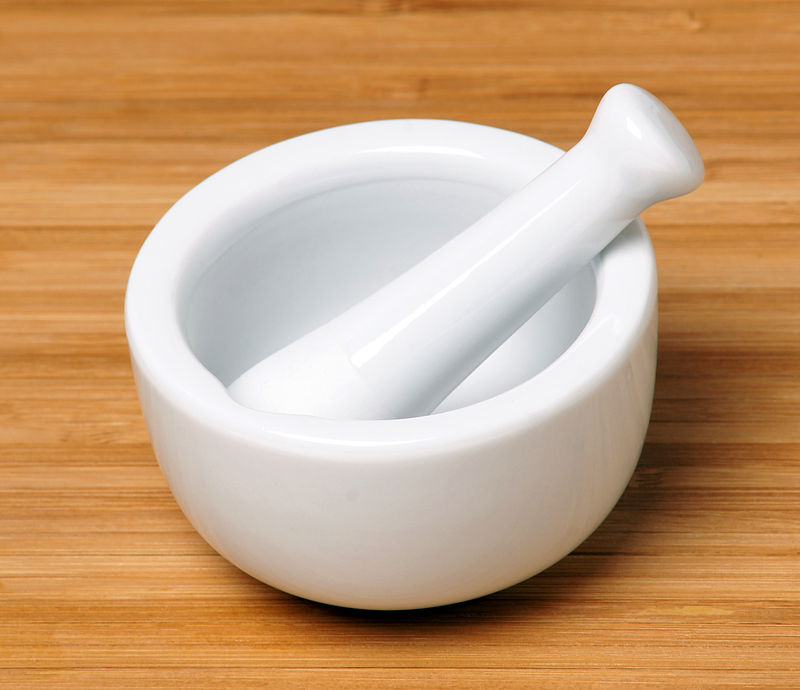
mortar and pestle
equipment consisting of a bowl in which substances are ground using a pestle

oscilloscope
thumb|A Tektronix model 475A portable analog oscilloscope, a typical instrument of the late 1970s
thumb|Oscilloscope cathode-ray tube, the left square-shaped end would be the blue screen in the upper device when built in.
thumb|Typical display of an analog oscilloscope measuring a sine wave signal with 10 kHz. From the grid inherent to the screen together with the user-set parameters of the device shown at the upper display rim, the user may calculate the frequency and the voltage of the measured signal. Modern digital oscilloscopes set the measurement parameters and calculate/display the

Geiger counter
instrument used for measuring ionizing radiation

hydrometer
thumb|upright=0.65|Schematic drawing of a hydrometer. The lower the density of the fluid, the deeper the weighted float B sinks. The depth is read off the scale A.

calorimeter
thumb|upright|The world's first ice-calorimeter, used in the winter of 1782–83, by Antoine Lavoisier and [[Pierre-Simon Laplace, to determine the heat involved in various chemical changes; calculations were based on Joseph Black's prior discovery of latent heat. These experiments mark the foundation of thermochemistry.]]
A calorimeter is a device used for calorimetry, or the process of measuring the heat of chemical reactions or physical changes as well as heat capacity. Differential scanning calorimeters, isothermal micro calorimeters, titration calorimeters and accelerated rate calorimeters

Bunsen burner
piece of laboratory equipment that produces a single open gas flame

blender
thumb|An electric blender

crucible
thumb| A modern crucible used in the production of silicon ingots via the [[Czochralski process|400x400px]]
thumb|Smaller clay graphite crucibles for copper alloy melting|300x300px
A crucible is a container in which metals or other substances may be melted or subjected to very high temperatures. Although crucibles have historically tended to be made out of clay, they can be made from any material that withstands temperatures high enough to melt or otherwise alter its contents.

burette
thumb|right|50px
A burette (also spelled buret) is a graduated glass tube with a tap at one end, for delivering known volumes of a liquid, especially in titrations. It is a long, graduated glass tube, with a stopcock at its lower end and a tapered capillary tube at the stopcock's outlet. The flow of liquid from the tube to the burette tip is controlled by the stopcock valve.

pipette
A pipette (also spelled pipet) is a type of laboratory tool commonly used in chemistry and biology to transport a measured volume of liquid, often as a media dispenser. Pipettes come in several designs for various purposes with differing levels of accuracy and precision, from single piece glass pipettes to more complex adjustable or electronic pipettes. Many pipette types work by creating a partial vacuum above the liquid-holding chamber and selectively releasing this vacuum to draw up and dispense liquid. Measurement accuracy varies greatly depending on the instrument.

autoclave
thumb|Cutaway illustration of a cylindrical-chamber autoclave
An autoclave is a machine used to carry out industrial and scientific processes requiring elevated temperature and pressure in relation to ambient pressure and temperature. Autoclaves are found in many medical settings, laboratories, and other places that need to ensure the sterility of an object.

goniometer
thumb|Goniometer made by Develey le Jeune in Lausanne, late 18th–early 19th century
separatory funnel
laboratory glassware
spectrum analyzer
Instrument that measures the magnitude of an input signal versus frequency within the full frequency range of the instrument
optical spectrometer
spectrometer for visible light
fume hood
laboratory negative-pressure ventilation device
Kipp's apparatus
laboratory device for preparing gases
Soxhlet extractor
piece of laboratory apparatus
aspirator
type of ejector-jet pump
electronic nose
sensor
filter paper
semi-permeable paper barrier
white coat
lightweight white smock or coat traditionally worn over street dress or scrubs by doctors, technicians, and scientists
salt bridge
laboratory device in electrochemistry
magnetic stirrer
laboratory device
Dewar flask
type of laboratory equipment
colorimeter
measurement device for objective color measurements
signal generator
electronic devices or components that generate electrical voltages with a characteristic time course
operant conditioning chamber
laboratory apparatus used to study animal behavior
Inductively coupled plasma mass spectrometry
type of mass spectrometry that uses an inductively coupled plasma to ionize the sample
rotary evaporator
device used in chemical laboratories
incubator
device used to grow and maintain microbiological cultures or cell cultures

glovebox
A glovebox (or glove box) is a sealed container that is designed to allow one to manipulate objects where a separate atmosphere is desired. Built into the sides of the glovebox are gloves arranged in such a way that the user can place their hands into the gloves and perform tasks inside the box without breaking containment. Part or all of the box is usually transparent to allow the user to see what is being manipulated. A smaller antechamber compartment is used to transport items into or out of the main chamber without compromising the internal environment. Antechambers are much smaller than t
Wire chamber
proportional counter that detects charged particles and photons
alcohol burner
equipment for producing a flame from alcohol
network analyzer
Instrument for microwave characteristics measurements (such as VSWR,Power, Frequency,etc).

still
thumb|upright=1.25|Swan-necked copper pot stills in the [[Glenfiddich distillery]]
250px|thumbnail|right|A still at Mackmyra Whisky|Mackmyra Whisky Distillery
thumb|upright|Column still from [[Kilbeggan Distillery in County Westmeath in Ireland.]]
A still is an apparatus used to distill liquid mixtures by heating to selectively boil and then cooling to condense the vapor. A still uses the same concepts as a basic distillation apparatus, but on a much larger scale. Stills have been used to produce perfume and medicine, water for injection (WFI) for pharmaceutical use, generally to separate and
Marx generator
high-voltage pulse generator
vacuum chamber
rigid enclosure from which air and other gases are removed by a vacuum pump
heating mantle
laboratory equipment
hot plate
portable self-contained tabletop small appliance

hemocytometer
thumb|A hemocytometer. The two semi-reflective rectangles are the counting chambers.
thumb|right|Loading a chamber
thumb|Hemocytometer grid (see table)
retort stand
laboratory equipment
analytical balance
shrouded weighing scale for measuring precise masses
lock-in amplifier
amplifier type which can extract a signal with a known carrier wave from an extremely noisy environment

microtiter plate
thumb|300px|Microtiter plates with 96, 384 and 1536 wells
vortex mixer
laboratory device used to mix vials of liquid
laminar flow cabinet
laboratory equipment
Dean-Stark apparatus
Laboratory equipment
microchannel plate detector
detection single parties and photons
Liebig condenser
laboratory glassware used for cooling gases into liquids
bung
conical closure that fits into a container's opening to seal it
heated bath
laboratory equipment for indirect, even heating of a reaction vessel by partial immersion
Meker-Fisher burner
gas burner
Teclu burner
variant of the Bunsen burner
Inductively coupled plasma atomic emission spectroscopy
Analytical technique used for the spectrophotometric detection of chemical elements
Syringe driver
medical device
rubber bulb
Chemistry equipment

ebullioscope
thumb|Vidal ebullioscope
biosafety cabinet
specialized type of fume hood used for biocontainment
hot air oven
electrical devices which use dry heat to sterilize