Category
page 1Lizard genera

Iguana
thumb|A male green iguana

Basiliscus
genus of reptiles

Draco
genus of reptiles

Lacerta
genus of reptiles

Agama
genus of reptiles

Hemidactylus
Hemidactylus (from Ancient Greek ἡμι- (hēmi-), meaning 'half', and δάκτυλος (dáktulos), meaning 'finger') is a genus of the common gecko family, Gekkonidae. It has 199 described species, newfound ones being described every few years. These geckos are found in all the tropical regions of the world, extending into the subtropical parts of Africa and Europe. They excel in colonizing oceanic islands by rafting on flotsam, and are for example found across most of Polynesia. In some archipelagoes, cryptic species complexes are found. Geckos like to live in and out of houses. They have been introduce

bearded dragons
Pogona is a genus of reptiles containing eight lizard species, which are often known by the common name bearded dragons or informally (especially in Australia) beardies. The name "bearded dragon" refers to the underside of the throat (or "beard") of the lizard, which can turn black and become inflated for a number of reasons, most often as a result of stress, if they feel threatened, or are trying to entice a mate. They are a semiarboreal species, spending significant amounts of time on branches, in bushes, and near human habitation. Pogona species bask on rocks and exposed branches in the mor

Gekko
Gekko is a genus of Southeast Asian geckos, commonly known as true geckos or calling geckos, in the family Gekkonidae. Although species such as Gekko gecko (tokay gecko) are very widespread and common, some species in the same genus have a very small range and are considered rare or endangered.

Anguis
Slow worms (also called blindworms and hazelworms) are a small genus (Anguis) of snake-like legless lizards in the family Anguidae. The genus contains five extant living species, including the common slow worm (A. fragilis), the eastern slow worm (A. colchica), the Greek slow worm (A. graeca), the Peloponnese slow worm (A. cephalonnica), and the Italian slow worm (A. veronensis). There are also known fossil species.

Uromastyx
Uromastyx is a genus of lizards in the family Agamidae. The genus is native to Africa and the Middle East (West Asia). Members of the species are commonly called spiny-tailed lizards, uromastyces, mastigures, or dabb lizards.
.jpg)
Phelsuma
Phelsuma is a large genus of geckos in the family Gekkonidae. Species in the genus Phelsuma are commonly referred to as day geckos.

Chamaeleo
thumb|250px|Chamaeleo dilepis, flap-necked chameleon
Chamaeleo is a genus of chameleons in the family Chamaeleonidae. Most species of the genus Chamaeleo are found in sub-Saharan Africa, but a few species are also present in northern Africa, southern Europe, and southern Asia east to India and Sri Lanka.

Heloderma
Heloderma is a genus of toxicoferan lizards that contains five species, all of which are venomous. It is the only extant genus of the family Helodermatidae.

Podarcis
Podarcis is a genus of lizards, known colloquially as wall lizards, in the family Lacertidae. Its members look very similar to lizards of the genus Lacerta, to which they were considered to belong until the 1970s. While similar externally and ecologically, Podarcis form a distinct group differing from Lacerta by the construction of the skull and the hemipenis, and by the processes of the caudal vertebrae. Wall lizards are native to Europe and northern Africa, and most species are restricted to the Mediterranean region. Wall lizards diversified and hybridized during the Messinian salinity crisi

Ablepharus
Ablepharus is a genus of skinks that contains the common snake-eyed skinks. Both their scientific and common names refer to the fact that their eyelids have fused to a translucent capsule; as in snakes, they thus are physically incapable of blinking. They are small lizards and prefer to live in the leaf litter of dry fields and hills. Their scales give them a very shiny, bronze appearance with a characteristically dark stripe down the sides of their bodies. They prey on small insects and other small mollusks.

Brookesia
Brookesia is a genus of chameleons, lizards in the family Chamaeleonidae. The genus is endemic to Madagascar. Member species range from small to very small in size, and are known collectively as leaf chameleons (though this common name is also used for species in the genera Rieppeleon and Rhampholeon). Brookesia includes species considered to be the world's smallest chameleons, and are also among the smallest reptiles. Members of the genus Brookesia are largely brown, and most are essentially terrestrial.

Cyclura
Cyclura is a genus of lizards in the family Iguanidae. Member species of this genus are commonly known as "cycluras" (or more commonly as rock iguanas) and only occur on islands in the West Indies. Rock iguanas have a high degree of endemism, with (in most cases) a single species or subspecies originating on an individual island.
.JPG)
Eremias
Eremias is a genus of lizards in the family Lacertidae, the wall lizards. They are native to Asia and southeastern Europe, where they live in desert and steppe regions.

Uroplatus
Uroplatus (from Ancient Greek οὐρά (ourá), meaning "tail", and πλατύς (platús), meaning "flat") is a genus of geckos, commonly referred to as leaf-tail geckos or flat-tailed geckos, which are endemic to Madagascar and its coastal islands, such as Nosy Be. They are nocturnal, insectivorous lizards found exclusively in primary and secondary forest.
%2C%20Ambon.png)
Hydrosaurus
Hydrosaurus, commonly known as the sailfin dragons or sailfin lizards, is a genus in the family Agamidae. These relatively large lizards are named after the sail-like structure on their tails. They are native to Indonesia (four species) and the Philippines (one species), where they are generally found near water, such as rivers and mangrove swamps. Sailfin lizards are semiaquatic and able to run short distances across water using both their feet and tail for support, similar to the basilisks. They are threatened by both habitat loss and overcollection for the wild-animal trade.
Cyrtodactylus
Cyrtodactylus (Greek κυρτος kurtos "curved", from κυπτω kuptō "to stoop"; δακτυλος daktulos "finger, toe") is a diverse genus of Asian geckos, commonly known as bent-toed geckos, bow-fingered geckos, and forest geckos. The genus has 361 described species , which makes it the largest of all gecko genera.
.jpg)
Furcifer
Furcifer is a genus of chameleons whose member species are mostly endemic to Madagascar, but F. cephalolepis and F. polleni are endemic to the Comoros. Additionally, F. pardalis has been introduced to Réunion, Mauritius and Florida, while F. oustaleti has been introduced to Kenya and Florida.
Gallotia
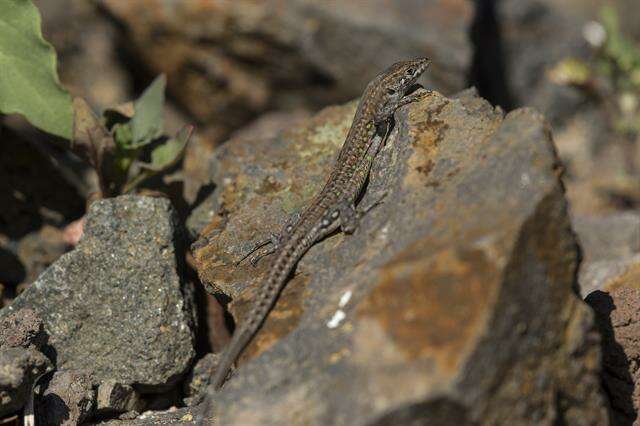
The genus Gallotia are the lacertids (wall lizards) of the Canary Islands. This genus consists of a group that has been evolving there ever since the first islands emerged from the sea over 20 million years ago. The endemic species and subspecies of this group have a number of characteristics that make them quite special within their family (Lacertidae); their only close relatives are the sandrunner lizards (Psammodromus) of the western Mediterranean region. Gallotia are characteristic for eating significant quantities of plants, and several lineages are often presented as classic examples for

Ophisops
thumb|right|Unidentified Ophisops species (O. beddomei ?) from Bhimashankar hills, Maharashtra
Cnemidophorus
Cnemidophorus is a genus of lizards in the family Teiidae. Species in the genus Cnemidophorus are commonly referred to as whiptail lizards or racerunners. The genus is native to South America, Central America, and the West Indies.

Anolis
Anolis is a genus of anoles, iguanian lizards in the family Dactyloidae, native to the Americas. With more than 425 species, it represents the world's most species-rich amniote tetrapod genus, although many of these have been proposed to be moved to other genera, in which case only about 45 Anolis species remain. Previously, it was classified under the family Polychrotidae that contained all the anoles, as well as Polychrus, but recent studies place it in the Dactyloidae.

toad agama
Phrynocephalus is a genus which includes 36 species of small and medium-sized agamid lizards, commonly called toadhead agamas or toad-headed agamas, that inhabit open arid and semiarid environments of Asia and Eastern Europe. The systematics of this genus are very complicated with many controversial points of view about the unclear phylogeny of this group. All representatives of this genus have adopted the so-called "sit and wait" hunting strategy, and they actively use visual orientation when watching for food. In general, the ecological niche and role of Phrynocephalus species in lizard comm

Blanus
Blanus, also known as worm lizards, are a genus of amphisbaenians found in the Mediterranean region of Europe and North Africa. Like other amphisbaenians, Blanus species are specialized for a subterranean existence, with long, slender bodies, reduced limbs, and rudimentary eyes. Their skulls are powerfully constructed, allowing them to push through soil to create a burrow. Their jaws are well-developed, with large, recurved teeth and a pair of canine-like teeth in the upper jaw.

Acanthodactylus
Acanthodactylus is a genus of lacertid lizards, commonly referred to as fringe-fingered lizards, fringe-toed lizards (though the latter common name is also used for the New World lizard genus Uma), and spiny-toed lizards.
%20male%20breeding%20(cropped).jpg)
Calotes
Calotes is a genus of lizards in the draconine clade of the family Agamidae. The genus contains 29 species. Some species are known as forest lizards, others as "bloodsuckers" due to their red heads, and yet others (namely C. versicolor) as garden lizards. The genus name Calotes has been derived from the Greek word Καλότης (Kalótës), meaning ‘beauty’, referring to the beautiful pattern of this genus.

Ameiva
Ameiva, commonly called jungle-runners, is a genus of whiptail lizards that belongs to the family Teiidae.

Eublepharis
Eublepharis is a genus of terrestrial geckos native to eastern and southwestern Asia. The genus was first described by the British zoologist John Edward Gray in 1827. The etymology of their name is 'eu' = good (=true) |'blephar' = eyelid, and all have fully functional eyelids. Members of this genus are found in eastern and southwestern Asia. These geckos are sturdily built. Their tail is shorter than their snout–vent length, and their body is covered with numerous wart-like bumps. The toes do not have adhesive lamellae or membranes (Eublepharis cannot climb like their other gecko cousins). Lik

Lygosoma
Lygosoma is a genus of lizards, commonly known as supple skinks or writhing skinks, which are members of the family Scincidae. Lygosoma is the type genus of the subfamily Lygosominae. The common name, writhing skinks, refers to the way these stubby-legged animals move, snake-like but more slowly and more awkwardly.
Darevskia
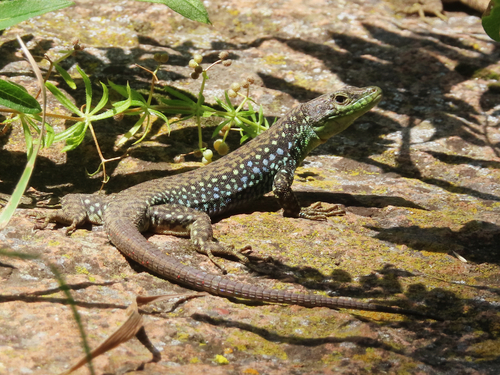
Darevskia is a genus of lizards of the family Lacertidae known colloquially as rock lizards or meadow lizards. Member species are native to the Caucasus, Iran and Turkey, living in forest and grassy habitats with numerous rock outcrops. Among rock lizards, seven parthenogenetic species are known.

Trachylepis
thumb|Trachylepis striata, African striped skink, [[Kruger Park]]
thumb|Trachylepis albilabris, [[Gabon]]

Brachylophus
The genus Brachylophus consists of four extant iguanid species native to the islands of Fiji and a giant extinct species from Tonga in the South West Pacific. One of the extant species, B. fasciatus, is also present on Tonga, where it has apparently been introduced by humans.
%20Ranomafana.jpg)
Calumma
thumb|Glaw's chameleon (Calumma glawi)
Calumma is a genus of chameleons, highly adapted and specialised lizards, in the family Chamaeleonidae. The genus is endemic to the island of Madagascar. One species, formerly known as Calumma tigris (the Seychelles tiger chameleon), was transferred to the genus Archaius in 2010, upon the discovery of its closer relation to Rieppeleon—one of several genera referred to collectively as "leaf" or "pygmy" chameleons—rather than to Calumma. The earliest known fossil of the genus is of Calumma benovskyi, from early Miocene Kenya, showing that the genus likely o

Ctenosaura
thumb|Ctenosaura similis, Costa Rica
Ctenosaura is a lizard genus commonly known as spinytail iguanas or ctenosaurs. The genus is part of the large lizard family Iguanidae and is native to Mexico and Central America. The name is derived from two Greek words: (), meaning "comb" (referring to the comblike spines on the lizard's back and tail), and (), meaning "lizard".
.jpg)
Conolophus
Conolophus is a genus of lizards, also known commonly as Galápagos land iguanas, in the family Iguanidae. The genus is endemic to the Galápagos Islands of Ecuador. The number of species of this variable genus has always been disputed; the most current taxonomic surveys suggest that three species exist.
Mabuya
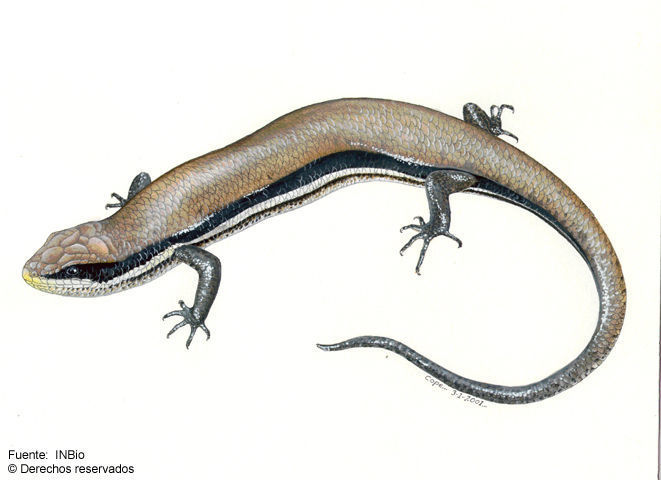
Mabuya is a genus of long-tailed skinks, lizards in the family Scincidae. The genus is restricted to species from various Caribbean islands. Out of 26 recognized species, six species are only found in Caribbean islands. Species in the genus Mabuya are primarily carnivorous, though many are omnivorous. The genus is viviparous, having a highly evolved placenta that resembles that of eutherian mammals. Formerly, many Old World species were placed here, as Mabuya was a kind of "wastebasket taxon". These Old World species are now placed in the genera Chioninia, Eutropis, and Trachylepis. Under the

Tarentola
Tarentola is a genus of geckos, commonly known as wall geckos.
Sphaerodactylus
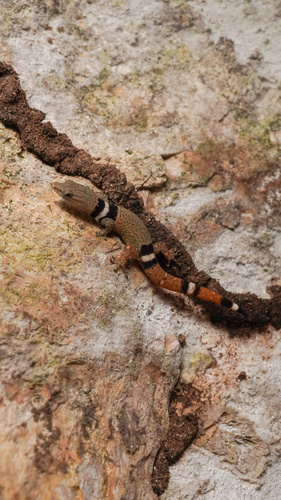
Sphaerodactylus is a genus of geckos from the Americas that are distinguished from other Gekkota by their small size, by their round, rather than vertical, eye pupils, and by each digit terminating in a single, round adhesive pad or scale, from which their name (Sphaero = round, dactylus = finger) is derived. All species in this genus are rather small, but two species, S. ariasae and S. parthenopion, are tiny, and – with a snout-vent length of about – the smallest reptiles in the world.

Rhacodactylus
Rhacodactylus is a genus of medium to large geckos of the family Diplodactylidae. All species in this genus are found on the islands that make up New Caledonia.
Chalcides
Chalcides is a genus of skinks (family Scincidae).

Takydromus
Takydromus is a genus of lizards, commonly called grass lizards or oriental racers. Species of the genus Takydromus are endemic to a large part of Asia. Members of this genus are noticeable because of their slender appearance and their agile movements. The word takydromus derives from Greek ταχυδρόμος (takhudromos), "fast-running", from ταχύς (takhus), "swift" + δρόμος (dromos), "course, race".

Bradypodion
Bradypodion (meaning "slow-footed" in Greek) is a genus of chameleons in the family Chamaeleonidae, collectively called South African dwarf chameleons. All species are found in South Africa and most are endemic to this country, but a few can also be found in Eswatini, Lesotho, southernmost Namibia and possibly southernmost Mozambique. They are quite small chameleons where the different species often can be difficult to separate by appearance, although exact location (each species tends to have a rather small distribution) and the intense breeding colours of males are useful for their identific
Iberolacerta
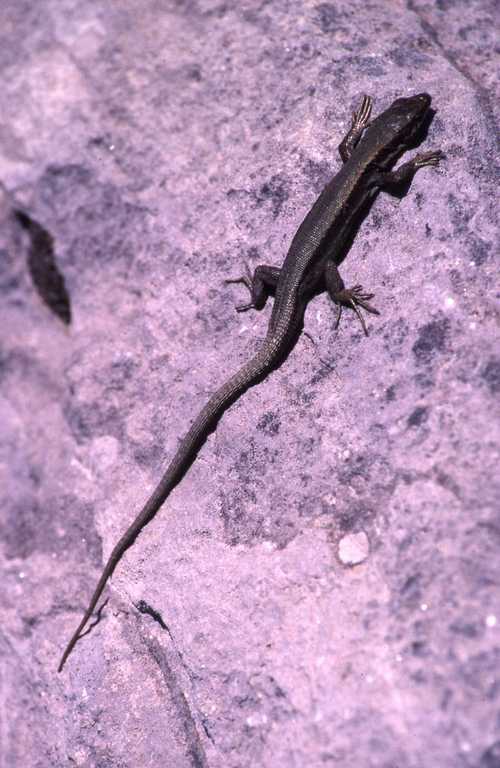
Iberolacerta is a genus of lizards in the family Lacertidae. The genus contains at least eight described species, which are mainly found in Spain and France. I. horvathi (Horvath's rock lizard) has a wider geographic range, being distributed in Central Europe.

Bipes
genus of reptiles

Laudakia
Laudakia is a genus of lizards, commonly known as Asian rock agamas, in the family Agamidae. The genus is found mostly in Asia, with some species in Southern Europe.

Afroedura
Afroedura is a genus of African geckos, lizards in the family Gekkonidae. Member species are collectively known as rock geckos or flat geckos.

Glass Snake
thumb|upright|Slender glass lizard (Ophisaurus attenuatus)
.jpg)
Scincus
Scincus is a genus of skinks, lizards in the family Scincidae. The genus contains four or five species, all of which are typical desert inhabitants, living in sandy and dune-like areas with a hot and dry climate. Species in the genus Scincus can be found from Arabia to the Sahara desert.
Plestiodon
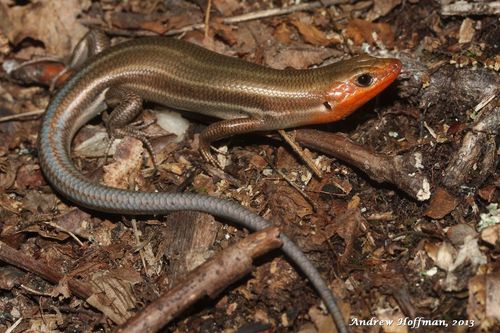
Plestiodon is a genus of lizards in the family Scincidae (skinks). The genus contains many species formerly classified under the genus Eumeces, except those now placed in Mesoscincus. They are secretive, agile animals with a cylindrical body covered with smooth, shiny scales. They are distributed from East Asia to throughout North America from southern Canada south to Mexico, including oceanic islands such as Bermuda.

Acanthocercus
Acanthocercus is a genus of lizards in the family Agamidae. The genus is endemic to Africa and the Arabian Peninsula.

curly-tailed lizard
genus of reptiles
Ptyodactylus
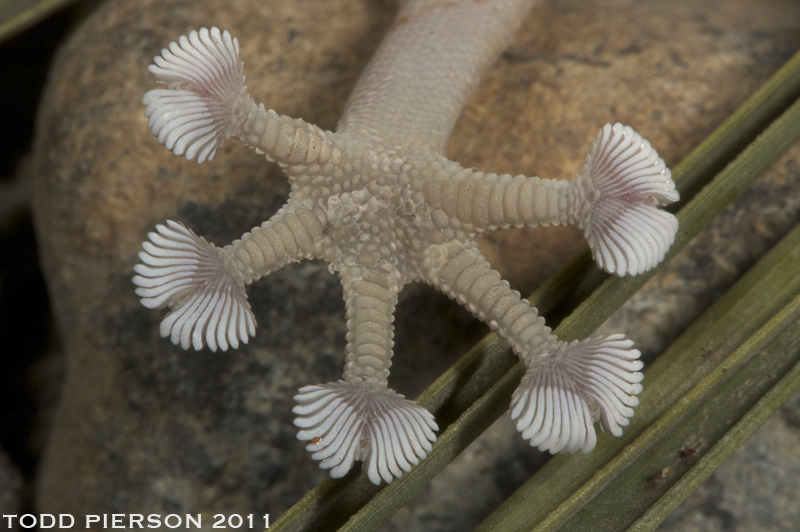
Ptyodactylus is a genus of geckos, which are commonly known as fan-fingered geckos.
The genus has 12 described species.

Cordylus
The genus Cordylus (Sauria: Cordylidae) includes a wide variety of species of small to medium spiny lizards from Africa, collectively called girdle-tailed lizards or girdled lizards. All are diurnal and ovoviviparous (live-bearing, without shelled eggs). Most species are rupicolous (rock-dwelling), while a few species are arboreal or live in burrows. They defend themselves with osteoderms (flat bony plates in the skin) and by quickly retreating into rock crevices or burrows. Many species live in groups, and males defend territories.
Oligosoma
Oligosoma is a genus of small to medium-sized skinks (family Scincidae) found only in New Zealand, Norfolk Island and Lord Howe Island. Oligosoma had previously been found to belong to the Eugongylus group of genera in the subfamily Lygosominae; the Australian genus Bassiana appears to be fairly closely related.

Psammodromus
Psammodromus is a small genus of sand lizards of the family Lacertidae. It has six described species, which are found in European and North African countries next to the Mediterranean.

Adolfus
thumb|Male of Adolfus jacksoni
thumb|Male of Adolfus africanus
Adolfus is a genus of lizards of the family Lacertidae. The genus is endemic to subsaharan Africa.