Category
page 1Magnetism

magnet
thumb|upright=1.5|A magnetite rock is being pulled by a [[neodymium magnet on top.]]

magnetic field
spatial distribution of vectors allowing the calculation of the magnetic force on a test particle
.jpg)
magnetism
thumb|300px|The shape of a bar magnet's [[magnetic field is revealed by the orientation of iron filings sprinkled on the table around it.]]
magnetic flux
surface integral of the magnetic flux density

diamagnetism
thumb|Pyrolytic carbon has one of the largest diamagnetic constants of any room temperature material. Here a pyrolytic carbon sheet is levitated by its repulsion from the strong magnetic field of [[neodymium magnets]]
magnetic moment
product of the electric current through a loop, the area enclosed by the loop and the unit vector perpendicular to the loop

paramagnetism
thumb|Liquid oxygen (blue) can be suspended between the poles of a strong magnet as a result of its paramagnetism.
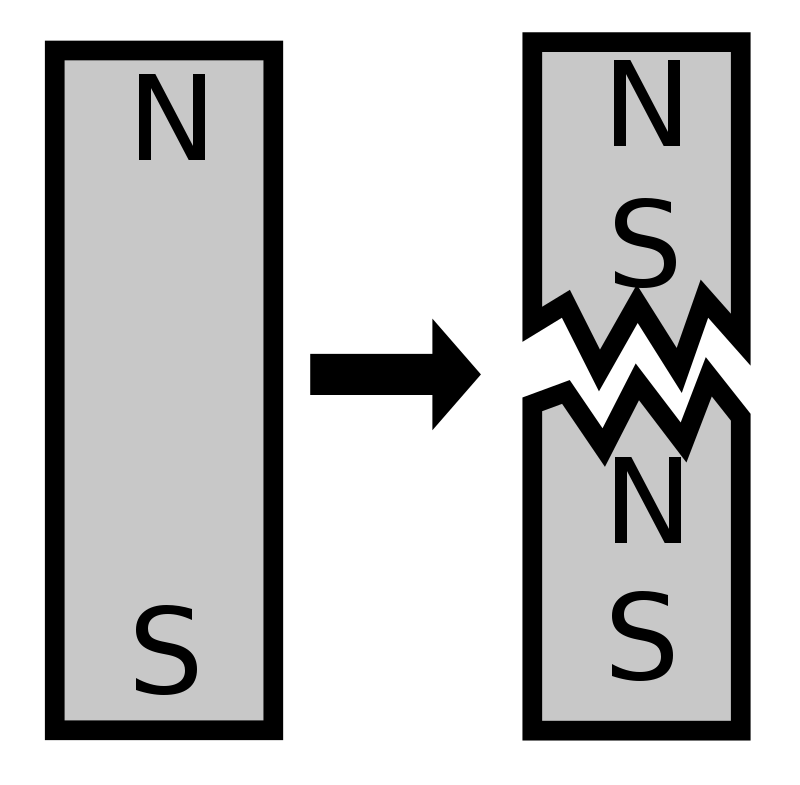
magnetic monopole
hypothetical particle with one magnetic pole
magnetic susceptibility
measure of how much a material will become magnetized in an applied magnetic field
magnetic levitation
method by which an object is suspended with no support other than magnetic fields
electron paramagnetic resonance
technique to study materials with unpaired electrons
magnetomotive force
a quantity representing the sum of magnetizing forces along a circuit

ferrofluid
thumb|upright=1.3|Ferrofluid on glass, with a neodymium magnet underneath
thumb|Steve Papell invented ferrofluid for NASA in 1963
magnet therapy
pseudoscientific alternative medicine practice
Gauss's law for magnetism
foundational law of classical magnetism
nuclear magneton
physical constant of magnetic moment

magnetoreception
thumb|upright=1.35|Experiments on European robins, which are migratory, suggest their magnetic sense makes use of the quantum [[radical pair mechanism. ]]
magnetic dipole
a magnetic dipole is the limit of either a closed loop of electric current
magnetic refrigeration
cooling technology based on the magnetocaloric effect
negative temperature
temperature of a physical system with a bounded phase space that is hotter than one at infinite temperature (𝛽=0)
Néel temperature
critical temperature of an antiferromagnet
magnetic vector potential
vector field whose curl is the magnetic flux density
spin–orbit interaction
relativistic interaction of a particle's spin with its motion inside a potential

magnetochemistry
Magnetochemistry is concerned with the magnetic properties of chemical compounds and elements. Magnetic properties arise from the spin and orbital angular momentum of the electrons contained in a compound. Compounds are diamagnetic when they contain no unpaired electrons. Molecular compounds that contain one or more unpaired electrons are paramagnetic. The magnitude of the paramagnetism is expressed as an effective magnetic moment, μeff. For first-row transition metals the magnitude of μeff is, to a first approximation, a simple function of the number of unpaired electrons, the spin-only formu
history of electromagnetic theory
aspect of history
magnet fishing
searching outdoor waters for ferromagnetic objects using a magnet tied to a rope
magnetic separation
process of separating components of mixtures by using magnets
ampere-turn
The ampere-turn (symbol A⋅t) is the MKS (metre–kilogram–second) unit of magnetomotive force (MMF), represented by a direct current of one ampere flowing in a single-turn loop. Turns refers to the winding number of an electrical conductor composing an electromagnetic coil.
For example, a current of flowing through a coil of 10 turns produces an MMF of .
The corresponding physical quantity is , the product of the number of turns, , and the current, ; it has been used in industry, specifically, US-based coil-making industries.
Einstein–De Haas effect
physical phenomenon in which a change in the magnetic moment of a free body causes this body to rotate
heliospheric current sheet
surface which separates the heliosphere into positively and negatively charged components
gilbert
unit of magnetomotive force
Barnett effect
magnetization of an uncharged body when spun on its axis
De Haas–Van Alphen effect
quantum mechanical magnetic effect
magnetic energy
energy carried by a magnetic field
magnetic scalar potential
scalar potential whose negative gradient is the magnetic field strength
neutron magnetic dipole moment
intrinsic magnetic dipole moment of neutrons

magnetite nanoparticle
synthesized magnetic particle of diameter under 100 nanometers with biomedical applications

Brillouin and Langevin functions
mathematical function, used to describe magnetization
excitation
process of generating a magnetic field by means of an electric current
human magnetism
People claimed to have ability to attract metallic and non-metallic things to their body.
multiferroics
Multiferroics are defined as materials that exhibit more than one of the primary ferroic properties in the same phase:
ferromagnetism – a magnetisation that is switchable by an applied magnetic field
ferroelectricity – an electric polarisation that is switchable by an applied electric field
ferroelasticity – a deformation that is switchable by an applied stress
While ferroelectric, ferroelastics, and ferromagnetics are formally multiferroics, these days the term is usually used to describe the magnetoelectric multiferroics that are simultaneously ferromagnetic and ferroelectric. Sometimes
nuclear magnetic moment
magnetic moment of an atomic nucleus
type-I superconductor
type of superconductivity
Hanle effect
reduction in the polarisation of light caused by a magnetic field, named after Wilhelm Hanle
1-butyl-3-methylimidazolium tetrachloroferrate
chemical compound
magnetic resonance
excitation of a quantum system via magnetism
Shubnikov–de Haas effect
magnetotransport phenomenon occurring in metals in an intense magnetic field
Biomagnetism
Biomagnetism is the phenomenon of magnetic fields produced by living organisms; it is a subset of bioelectromagnetism. In contrast, organisms' use of magnetism in navigation is magnetoception and the study of the magnetic fields' effects on organisms is magnetobiology. (The word biomagnetism has also been used loosely to include magnetobiology, further encompassing almost any combination of the words magnetism, cosmology, and biology, such as "magnetoastrobiology".)
Bethe ansatz
an ansatz method for finding the exact solutions of certain one-dimensional quantum many-body models
strongly correlated material
materials with electrical properties that cannot be explained by non-interacting entities
nanomagnet
In magnetism, a nanomagnet is a nanoscopic scale system that presents spontaneous magnetic order (magnetization) at zero applied magnetic field (remanence).
Arago's rotations
magnetic phenomenon
diradical
In chemistry, a diradical is a molecular species with two electrons occupying molecular orbitals (MOs) which are degenerate. The term "diradical" is mainly used to describe organic compounds, where most diradicals are extremely reactive and non-Kekulé molecules that are rarely isolated. Diradicals are even-electron molecules but have one fewer bond than the number permitted by the octet rule.
Zeeman energy
Potential energy of a magnetised body in an external magnetic field
inverse magnetostrictive effect
physical phenomenon
force between magnets
Effects and reasons of magnetic force, applied by one magnet to another. The main focus being the magnetic dipole-dipole interaction.