File:CuttingABarMagnet.svg · Wikimedia Commons · See Wikimedia Commons
magnetic monopole
Sign in to savehypothetical particle with one magnetic pole
Wikidata facts
- Subclass of
- monopole
- Image
- CuttingABarMagnet.svg
Show 4 more facts
- topic's main category
- Category:Magnetic monopoles
- interaction
- electromagnetic interaction
- Stack Exchange tag
- physics.stackexchange.com/tags/magnetic-monopoles
- Commons category
- Magnetic monopoles
via Wikidata · CC0
~40 min read
Encyclopedic overview
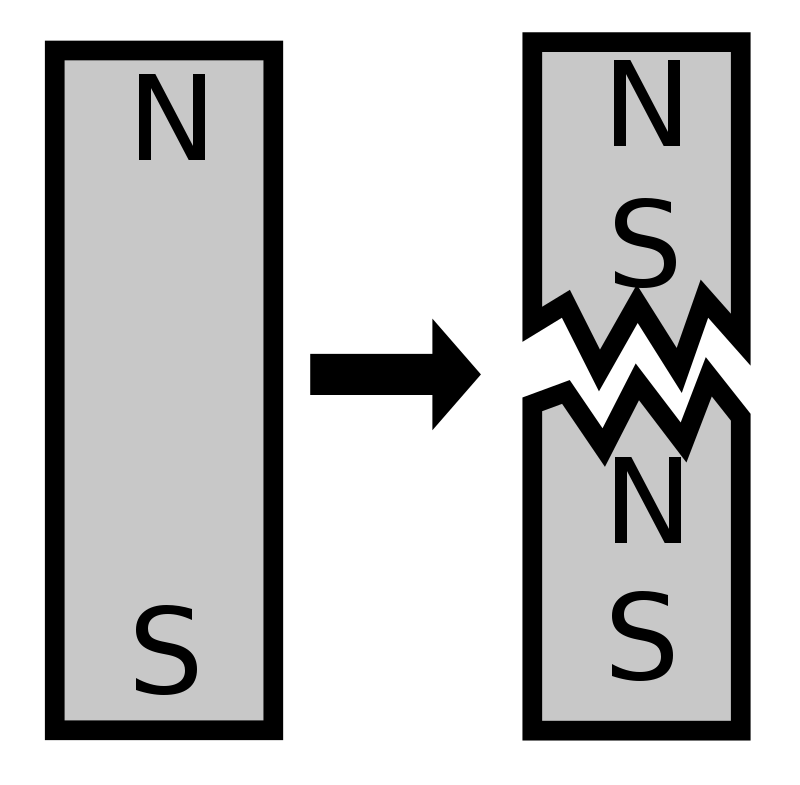
It is impossible to make magnetic monopoles from a bar magnet. If a bar magnet is cut in half, it is not the case that one half has the north pole and the other half has the south pole. Instead, each piece has its own north and south poles. A magnetic monopole cannot be created from normal matter such as atoms and electrons, but would instead be a new particle.
In particle physics, a magnetic monopole is a hypothetical particle that is an isolated magnet with only one magnetic pole (a north pole without a south pole or vice versa). A magnetic monopole would have a net north or south "magnetic charge". Modern interest in the concept stems from particle theories, notably grand unified and superstring theories, which predict their existence. The known elementary particles that have electric charge are electric monopoles.
Excerpted from Wikipedia’s “magnetic monopole” article, available under the CC BY-SA 4.0 licence.