Category
page 1Moment (physics)

mass
Mass is an intrinsic property of a body. In modern physics, it is generally defined as the strength of an object's gravitational attraction to other bodies - as measured by an observer moving along at the same speed.

momentum
In Newtonian mechanics, momentum (: momenta or momentums; more specifically linear momentum or translational momentum) is the product of the mass and velocity of an object. It is a vector quantity, possessing a magnitude and a direction. If is an object's mass and is its velocity (also a vector quantity), then the object's momentum (from Latin pellere "push, drive") is: \mathbf{p} = m \mathbf{v}.
In the International System of Units (SI), the unit of measurement of momentum is the kilogram metre per second (kg⋅m/s), which is dimensionally equivalent to the newton-second.

torque
In physics and mechanics, torque is the rotational correspondent of linear force. It is also referred to as the moment of force, or simply the moment. Just as a linear force is a push or a pull applied to a body, a torque can be thought of as a twist applied to an object with respect to a chosen axis. For example, driving a screw uses torque to force it into an object. The torque is applied by the screwdriver, rotating around its axis, to the drive on the head of the screw.
angular momentum
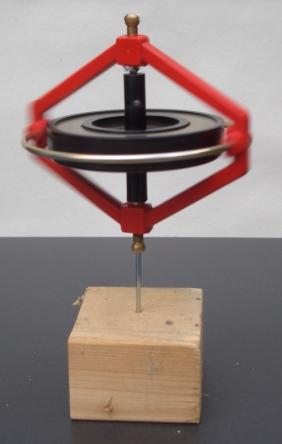
measure of the extent to which an object will continue to rotate in the absence of an applied torque

moment of inertia
scalar measure of the rotational inertia with respect to a fixed axis of rotation

center of mass
unique point where the weighted relative position of a distributed mass sums to zero

magnetic moment
product of the electric current through a loop, the area enclosed by the loop and the unit vector perpendicular to the loop
torsion
twisting of an object due to an applied torque
moment
in mathematics, a quantitative measure of the shape of a set of points
parallel axis theorem
theorem in planar dynamics
moment
product of a distance and a physical quantity
second moment of area
mathematical construct in engineering

quadrupole
A quadrupole or quadrapole is one of a sequence of configurations of things like electric charge or current, magnetic fields, or gravitational mass that can exist in ideal form, but it is usually just part of a multipole expansion of a more complex structure reflecting various orders of complexity.
bending moment of force
moment that results in the bending of a structural element
first moment of area
property of an object related to its resistance to shear stress
seismic moment
product of the shear modulus, area of rupture along the fault, and the average slip
list of moments of inertia
Wikimedia list article
multipole expansion
mathematical series approximating an angle-dependent function
Varignon's theorem (mechanics)
theorem
Canonical coordinates
sets of coordinates which can be used to describe a physical system at any given point in time
second polar moment of area
moment
Crystal momentum
momentum-like vector describing motion of electrons in crystals; conserved up-to a discrete symmetry

perpendicular axis theorem
Mathematical theorem
image moment
weighted average/moment of some pixel intensities
shear and moment diagram
structural design tool
Vlasov equation
partial differential equation describing the time evolution of plasma
moment of inertia factor
Distribution of mass in a celestial body
list of second moments of area
Wikimedia list article
Stretch rule
classical mechanics rule