Category
page 1Mother goddesses

Venus
Roman goddess of love, sexuality, procreation and pleasure

Demeter
In ancient Greek religion and mythology, Demeter (; Attic: Dēmḗtēr ; Doric: Dāmā́tēr) is the Olympian goddess of the harvest and agriculture, presiding over crops, grains, food, and the fertility of the earth. Although Demeter is mostly known as a grain goddess, she also appeared as a goddess of health, birth, and marriage, and had connections to the Underworld. She is also called Deo ( Dēṓ).

Isis
thumb|Isis wall painting in the tomb of Seti I (KV17)

Kālī
Kali (; , ), also called Kalika, is a major goddess in Hinduism, primarily associated with time, death, and destruction. Kali is also connected with transcendental knowledge and is the first of the ten Mahavidyas, a group of goddesses who provide liberating knowledge. Of the numerous Hindu goddesses, Kali is held as the most famous. She is the preeminent deity in the Hindu tantric and the Kalikula worship traditions, and is a central figure in the goddess-centric sects of Hinduism as well as in Shaivism. Kali is chiefly worshipped as the Divine Mother, Mother of the Universe, and Divine femini
%20(6843511981).jpg)
Lakshmi
Lakshmi (; , , sometimes spelled Laxmi), also known as Shri (, ), is one of the principal goddesses in Hinduism, revered as the goddess of happiness, fortune, wealth, prosperity, beauty, fertility, sovereignty, and abundance. She, Parvati, and Sarasvati form the trinity of goddesses called the Tridevi.

Parvati
Parvati (, ), also known as Uma (, ) and Gauri (, ), is one of the principal goddesses in Hinduism, revered as the goddess of power, energy, nourishment, harmony, love, beauty, devotion, and motherhood. Along with Lakshmi and Sarasvati, she forms the trinity, known as the Tridevi.

Gaia
In Greek mythology, Gaia (; , a poetic form of (''''), meaning 'land' or 'earth'), also spelled Gaea (), is the personification of Earth. She is the mother of Uranus (Sky), with whom she conceived the Titans (themselves parents of many of the Olympian gods), the Cyclopes, and the Giants, as well as of Pontus (Sea), from whose union she bore the primordial sea gods. Her equivalent in the Roman pantheon was Terra.

Durga
Durga (; , ), also known as Mahādevī (; , , [mɐɦaːd̪eːʋiː]), and Ādiśakti(; , , [aːd̪ɪ ʃɐkt̪i]), is one of the most important deities in Hinduism. She is regarded as the principal aspect of Adi Parashakti, the Ultimate Reality in Shaktism and widely worshipped by the followers of this goddess-centric sect, and has importance in other denominations like Shaivism and Vaishnavism.

matriarchy
Matriarchy is a social system in which positions of power and privilege are held by women. In a broader sense it can also extend to moral authority, social privilege, and control of property. While those definitions apply in general English, definitions specific to anthropology and feminism differ in some respects.

Rhea
female Titan in Greek mythology, mother of Zeus and mother of Hera

Hathor
thumb|right|Hathor as a cow
Hathor (, , , Meroitic: '''') was a major goddess in ancient Egyptian religion who played a wide variety of roles. As a sky deity, she was the mother or consort of the sky god Horus and the sun god Ra, both of whom were connected with kingship, and thus she was the symbolic mother of their earthly representatives, the pharaohs. She was one of several goddesses who acted as the Eye of Ra, Ra's feminine counterpart, and in this form, she had a vengeful aspect that protected him from his enemies. Her beneficent side represented beauty, music, dance, joy, love, sexualit
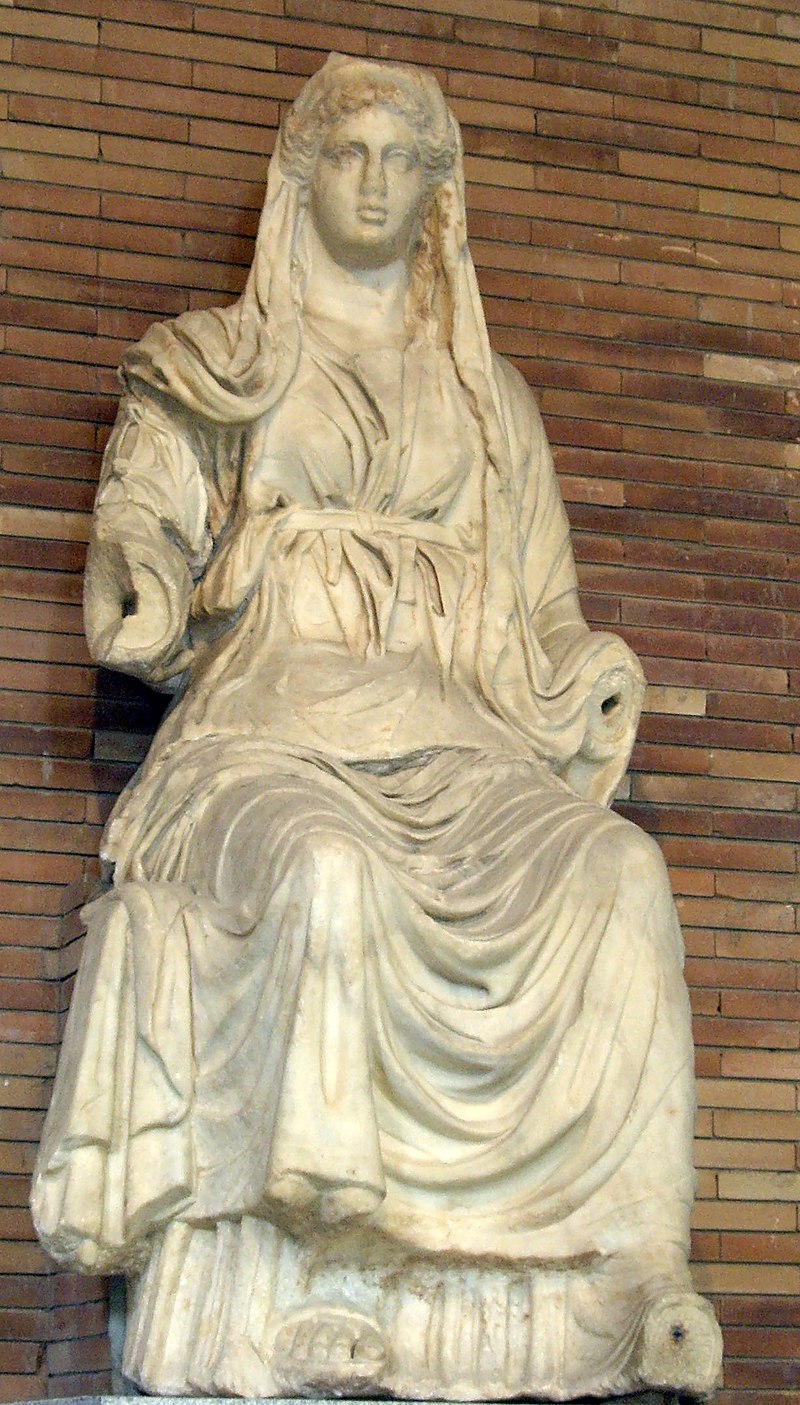
Ceres
Roman goddess of agriculture

Frigg
thumb|Frigg sits enthroned and facing the spear-wielding goddess Gná, flanked by two goddesses, one of whom ([[Fulla) carries her eski, a wooden box. Illustrated (1882) by Carl Emil Doepler.]]
Frigg (, , , Old Swedish: Frigg, genitive: Friggiar, etc, Early Modern Swedish: etc; ; ; ; ; ) is a goddess, one of the Æsir, in Germanic mythology. In Norse mythology, the source of most surviving information about her, she is associated with marriage, prophecy, clairvoyance and motherhood, and dwells in the wetland halls of Fensalir. The names ultimately stem from the Proto-Germanic theonym *Frijjō. Ne

Leto
In ancient Greek mythology and religion, Leto (; ) is a childhood goddess, the daughter of the Titans Coeus and Phoebe, the sister of Asteria, and the mother of Apollo and Artemis.

Sita
Sita (; ), also known as Siya, Jānaki and Maithili, is a Hindu goddess and the female protagonist of the Hindu epic Ramayana. Sita is the consort of Rama, the avatar of god Vishnu, and is regarded as an avatar of goddess Lakshmi. She is the chief goddess of the Ramanandi Sampradaya and is the goddess of beauty and devotion. Sita's birthday is celebrated every year on the occasion of Sita Navami.

Nephthys
Nephthys or Nebet-Het in ancient Egyptian () was a goddess in ancient Egyptian religion. A member of the Great Ennead of Heliopolis in Egyptian mythology, she was a daughter of Nut and Geb. Nephthys was typically paired with her sister Isis in funerary rites because of their role as protectors of the mummy, with her brother Osiris, and as the sister-wife of Set.

Nut
goddess of the sky in the Ennead of Egyptian mythology

Mut
thumb|Mut nursing the pharaoh, Seti I, in relief from the second hypostyle hall of Seti's mortuary temple in Abydos.

Shakti
thumb|Shakti, the feminine power, is often personified as an aspect of Devi

Rādhā
Radha (, ), also called Radhika, is a Hindu goddess and the chief consort of the god Krishna. She is the goddess of love, tenderness, compassion, and devotion. In scriptures, Radha is mentioned as the avatar of Lakshmi and also as the Mūlaprakriti, the Supreme goddess, who is the feminine counterpart and internal potency (hladini shakti) of Krishna. Radha accompanies Krishna in all his incarnations. Radha's birthday is celebrated every year on the occasion of Radhashtami.

mother goddess
goddess who represents or is a personification of nature, motherhood, fertility, creation

Cybele
Cybele ( ; 'Kubeleya Mother', perhaps 'Mountain Mother'; ; Kybélē, Kybēbē, Kybelis) is an Anatolian mother goddess; she may have a possible forerunner in the earliest Neolithic at Çatalhöyük. Greek colonists in Asia Minor adopted and adapted her Phrygian cult and spread it to mainland Greece and to the more distant western Greek colonies around the sixth century BC.

Metis
Oceanid of Greek mythology, goddess of wisdom, daughter of Oceanid and Tethys

Devi
thumb|A sculpture of the goddess Lakshmi
Devī (; ) is the Sanskrit word for 'goddess'; the masculine form is Deva. Devi and Deva mean 'heavenly, divine, anything of excellence', and are gender-specific terms for deity in Indian religions.

Nüwa
Nüwa, also read Nügua, is a mother goddess, culture hero, and/or member of the Three Sovereigns of Chinese mythology. She is a goddess in Chinese folk religion, Chinese Buddhism, Confucianism and Taoism. She is credited with creating humanity and repairing the Pillar of Heaven.
Terra
personification of the Earth in ancient Roman religion and mythology

Mazu
Mazu or Matsu is a sea goddess in Chinese folk religion, Chinese Buddhism, Confucianism, and Taoism. She is also known by several other names and titles. Mazu is the deified form of Lin Moniang (), a shamaness from Fujian who is said to have lived in the late 10th century. After her death, she became revered as a tutelary deity of Chinese seafarers, including fishermen and sailors.
.jpg)
Guan Yin
Guanyin () is a common Chinese name of the Bodhisattva associated with compassion known as Avalokiteśvara (). Guanyin is short for Guanshiyin, which means "[The One Who] Perceives the Sounds of the World". Originally regarded as male in Indian Buddhism, Guanyin has been more commonly depicted as female in China and most of East Asia since about the 12th century. Due to sociogeographical factors, Guanyin may also be historically depicted as genderless or androgynous. On the 19th day of the sixth lunar month, Guanyin's attainment of Buddhahood is celebrated. Guanyin has been incorporated in othe

Prithvi
Prithvi (Sanskrit: पृथ्वी, ', also पृथिवी, ', "the Vast One", also rendered Pṛthvī Mātā), is the Sanskrit name for the Earth, as well as the name of the goddess-personification of it in Hinduism. The goddess Prithvi is an archetypal Mother Goddess, and one of the most important goddesses in the historical Vedic religion.

Pachamama
Pachamama () or Mama Pacha () is the Andean deity representing space-time, revered by the peoples of the Andes. In Inca mythology and religion, she is a "mother goddess" type deity, representing the universal energy that connects everything. She is considered an omnipresent deity with creative power, capable of sustaining life in the cosmos. Her shrines are hallowed rocks, or the boles of legendary trees, and her artists envision her as a woman bearing harvests of potatoes or coca leaves. The four cosmological Quechua principlesWater, Earth, Sun, and Moonclaim Pachamama as their prime origin.
Bhārat Mātā
national personification of India as a mother goddess

Ninhursag
Ninḫursaĝ (; ), sometimes transcribed Ninursag, Ninḫarsag, or Ninḫursaĝa, also known as Damgalnuna or Ninmah, was the ancient Sumerian mother goddess of the mountains, and one of the seven great deities of Sumer. She is known earliest as a nurturing or fertility goddess. She is the tutelary deity to several Sumerian leaders.

Asherah
Asherah (; ; ; ; Qatabanian: '') was a goddess in ancient Semitic religions. She also appears in Hittite writings as Ašerdu(š) or Ašertu(š)'' (), and as Athirat in Ugarit as the consort of ʾEl. Asherah was a major goddess in ancient Northwest Semitic cultures, often associated with fertility, motherhood, and sacred trees. Asherah was the goddess of the sea while "her husband El" was the god of 'heaven.'

Tanit
Tanit or Tinnit (Punic: 𐤕𐤍𐤕 Tīnnīt) was a chief deity of Ancient Carthage. She is the consort of Baal Hammon. As Ammon is a local Libyan deity, so is Tanit, who represents the matriarchal aspect of Numidian society, and whom the Egyptians identify as Neith and the Greeks identify as Athena. She was the goddess of wisdom, civilization and the crafts; she is the defender of towns and homes where she is worshipped. Ancient North Africans used to put her sign on tombstones and homes to ask for protection. Her main temples were in Thinissut (Bir Bouregba, Tunisia), Cirta (Constantine, Algeria),

Izanami
, formally referred to with the honorific , is the creator of both creation and death in Japanese mythology, as well as the Shinto mother goddess. She and her brother-husband Izanagi are the last of the seven generations of primordial deities that manifested after the formation of heaven and earth. Izanami and Izanagi are held to be the creators of the Japanese archipelago and the progenitors of many deities, which include the sun goddess Amaterasu, the moon deity Tsukuyomi and the storm god Susanoo. In mythology, she is the direct ancestor of the Japanese imperial family. In Shinto and Japane
Coatlicue
Coatlicue (; , , "skirt of snakes"), wife of Mixcōhuātl, also known as '''''' (, "mother of the gods") is the Aztec goddess who gave birth to the moon, stars, and Huītzilōpōchtli, the god of the sun and war. The goddesses Toci "our grandmother" and Cihuacōātl "snake woman", the patron of women who die in childbirth, were also seen as aspects of Cōātlīcue.
%20Flanked%20by%20Shiva%20(left)%20and%20Ganesha%20(right).jpg)
Matrikas
thumb|9th-century sculpture depicting the Seven Mother Goddesses (Matrikas) flanked by Shiva (left) and Ganesha (right)
Danu
deity in Celtic mythology

Mariamman
Mariamman, often abbreviated to Amman (), is a Hindu Tamil folk religion goddess of weather, predominantly venerated in the rural areas of South India. Her festivals are held during the late summer/early autumn season of Ādi throughout Tamil Nadu and the Deccan region, the largest being the Ādi Thiruviḻa. Her worship mainly focuses on bringing rains and curing such serious diseases as cholera, smallpox, and chicken pox.

Śītalā
Shitala (, IAST: ) , also spelled as Sheetala, śītalā and Seetla, is a Hindu goddess venerated primarily in North India. She is regarded to be an incarnation of the goddess Parvati. She is believed to cure poxes, sores, ghouls, pustules, and diseases, and most directly linked with the disease smallpox. Shitala is worshipped on Tuesday Saptami and Ashtami (the seventh and eighth day of a Hindu month), especially after Holi during the month of Chaitra. The celebration of the goddess Shitala on the seventh and eighth day of the Hindu month is referred to as the Sheetala Saptami and Sheetala Astha
Annapoorna
Hindu Goddess of Food and Nourishment
Živa
Slavic goddess
%20Nat.jpg)
Chandi
Chandi (, ) or Chandika () is a Hindu deity. Chandika is a form of goddess Durga. She shares similarities with the Goddess Chamunda, not only in name but also in attributes and iconography. Due to these similarities, some consider them to be the same deity, while others view them as different manifestations of Mahadevi. Both are often associated with other powerful goddesses like Durga, Katyayani, Kali and Kalaratri. The Goddess is particularly revered in Gujarat.
Queen Mother of the West
mother goddess in Chinese religion and mythology
Anahit
Anahit () was the goddess of fertility and healing, wisdom and water in Armenian mythology. In the early periods, she was the goddess of war. By the 5th century BCE, she was the main deity in Armenia along with Aramazd. The Armenian goddess Anahit is related to the similar Iranian goddess Anahita. Artaxias I erected statues of Anahit, and promulgated orders to worship them.
Mama Quilla
deity

Yemaja
Yemọja (also: Yemaja, Yemanjá, Yemoyá, Yemayá; there are many different transliterations in other languages) is a major water deity in the Yoruba religion. She is an oriṣa, and the patron spirit of rivers, particularly the Ogun River in Nigeria, and of oceans in Cuban and Brazilian Orisha religions. She is often syncretized with either Our Lady of Regla in the Afro-Cuban diaspora or various other Virgin Mary figures of the Catholic Church, a practice that emerged during the era of the Trans-Atlantic slave trade. Yemọja is said to be motherly and strongly protective, and to care deeply for all
Snake Goddess
Minoan goddess figurine
Kishar
In the Babylonian epic Enuma Elish, Kishar () is the daughter of Lahamu and Lahmu, the first children of Tiamat and Abzu. She is the female principle, sister and wife of Anshar, the male principle, and the mother of Anu. Kishar may represent the earth as a counterpart to Anshar, the sky, and can be seen as an earth mother goddess. Her name also means "Whole Earth".
Karni Mata
Hindu folk deitie
Triple Goddess
concept in Neopaganism
Mama Ocllo
deity
Mami Wata
pagan water spirit

Mahakali
Mahakali () is a deity common to Hinduism and Buddhism. In Hinduism, she is the goddess of time and death in the goddess-centric tradition of Shaktism, and a Yakshini in both the Svetambara and Digambara traditions of Jainism. She is also known as the supreme being in various Hindu tantras and Puranas.
Matronae
deities of fertility in Celtic and Germanic mythologies under Roman rule

Vārāhī
Varahi (, IAST:) is one of the Matrikas, a group of seven mother goddesses in the Hindu religion who has the face of a sow. In Nepal, she is called Barahi. In Rajasthan and Gujarat, she is venerated as Dandini.

Chaxiraxi
thumb|150x150px|Image of the Virgin of Candelaria (Patron of Canary Islands) in the [[Basilica of Candelaria (Tenerife)]]
Chaxiraxi is a goddess, known as the Sun Mother, in the religion of the aboriginal Guanche inhabitants of the Canary Islands. Chaxiraxi was one of the principal goddesses of the Guanche pantheon. She was associated with the star Canopus.
triple deity
three deities that are worshipped as one
Brahmani
one of the seven Mother Goddesses in Hinduism
Bau
Mesopotamian goddess