Category
page 1Periodic comets

Halley's Comet
short-period comet visible from Earth every 75–76 years
67P/Churyumov–Gerasimenko
67P/Churyumov–Gerasimenko (abbreviated as 67P or 67P/C–G) is a Jupiter-family comet. It is originally from the Kuiper belt and has an orbital period of 6.45 years as of 2012, a rotation period of approximately 12.4 hours, and a maximum velocity of . Churyumov–Gerasimenko is approximately at its longest and widest dimensions. It was first observed on photographic plates in 1969 by Soviet astronomers Klim Ivanovych Churyumov and Svetlana Ivanovna Gerasimenko, after whom it is named. It most recently came to perihelion (closest approach to the Sun) on 2 November 2021, and will next come to perihe

2060 Chiron
minor planet in the outer Solar System

Comet Encke
periodic comet
Tempel 1
short-period comet
Comet Swift–Tuttle
periodic comet and parent body of the Perseid meteor shower
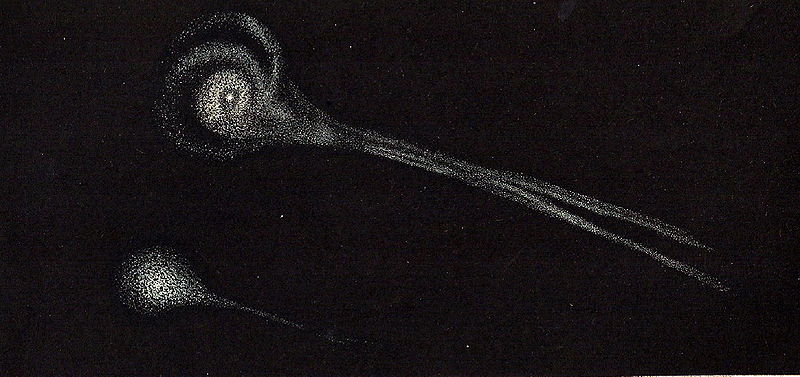
Biela's Comet
Comet that dissolved and assumed as gone

Comet Holmes
comet

4015 Wilson–Harrington
small body of the Solar System considered both an asteroid and a comet

19P/Borrelly
{| class=wikitable style="text-align:center; font-size:11px; float:right; margin:2px"
|- bgcolor= style="font-size: smaller;"
| colspan="8" style="text-align:center;"|Perihelion distanceat recent epochs
|-
! Epoch !! Perihelion(AU)
|-
| 2028 || 1.310
|-
| 2022 || 1.306
|-
| 2015 || 1.349
|-
| 2008 || 1.355
|}

7968 Elst–Pizarro
asteroid
21P/Giacobini–Zinner
{| class=wikitable style="text-align:center; font-size:11px; float:right; margin:2px"
|- bgcolor= style="font-size: smaller;"
| colspan="8" style="text-align:center;"|Perihelion distanceat different epochs
|-
! Epoch !! Perihelion(AU)
|-
| 1894 || 1.23
|-
| 1900 || 0.93
|-
| 1985 || 1.03
|-
| 2031 || 1.07
|-
| 2078 || 0.97
|}

81P/Wild
Comet 81P/Wild, also known as Wild 2 (pronounced "vilt two") ( ), is a comet with a period of 6.4 years named after Swiss astronomer Paul Wild, who discovered it on January 6, 1978, using a 40-cm Schmidt telescope at Zimmerwald, Switzerland.
60558 Echeclus
active centaur

103P/Hartley
Comet Hartley 2, designated as 103P/Hartley by the Minor Planet Center, is a small periodic comet with an orbital period of 6.48 years. It was discovered by Malcolm Hartley in 1986 at the Schmidt Telescope Unit, Siding Spring Observatory, Australia. Its diameter is estimated to be

73P/Schwassmann–Wachmann
73P/Schwassmann–Wachmann, also known as Schwassmann–Wachmann 3 or SW3 for short, is a periodic comet that has a 5.4 year orbital period and that has been actively disintegrating since 1995. When it came to perihelion (closest approach to the Sun) in March 2017, fragment 73P-BT was separating from the main fragment 73P-C. Fragments 73P-BU and 73P-BV were detected in July 2022. The main comet came to perihelion on 25 August 2022, when the comet was 0.97 AU from the Sun and 1 AU from Earth. It will be less than 80 degrees from the Sun from 25 May 2022 until August 2023. On 3 April 2025 it made a

46P/Wirtanen
{| class=wikitable style="text-align:center; font-size:11px; float:right; margin:2px"
|- bgcolor= style="font-size: smaller;"
| colspan="8" style="text-align:center;"|Perihelion distanceat different epochs
|-
! Epoch !! Perihelion(AU)
|-
| 1967 || 1.61
|-
| 1974 || 1.26
|-
| 1986 || 1.08
|-
| 2013 || 1.05
|-
| 2035 || 1.08
|-
| 2046 || 1.22
|-
| 2059 || 1.98
|-
| 2095 || 2.01
|}
5D/Brorsen
5D/Brorsen (also known as '''Brorsen's Comet or Comet Brorsen''') was a periodic Jupiter-family comet discovered on February 26, 1846, by Danish astronomer Theodor Brorsen. The comet was last seen in 1879 and is now considered lost.

8P/Tuttle
8P/Tuttle (also known as '''Tuttle's Comet or Comet Tuttle''') is a periodic comet with a 13.6-year orbit. It fits the classical definition of a Jupiter-family comet with an orbital period of less than 20 years, but does not fit the modern definition of (2 Jupiter< 3). Its last perihelion passage was 27 August 2021 when it had a solar elongation of 26 degrees at approximately apparent magnitude 9. Two weeks later, on September 12, 2021, it was about from Earth which is about as far from Earth as the comet can get when the comet is near perihelion.

55P/Tempel–Tuttle
55P/Tempel–Tuttle (commonly known as Comet Tempel–Tuttle) is a retrograde periodic comet with an orbital period of 33 years. It fits the classical definition of a Halley-type comet with a period of between 20 and 200 years. It was independently discovered by Wilhelm Tempel on 19 December 1865, and by Horace Parnell Tuttle on 6 January 1866. It is the parent body of the Leonid meteor shower.
4P/Faye
{| class=wikitable style="text-align:center; font-size:11px; float:right; margin:2px"
|- bgcolor= style="font-size: smaller;"
| colspan="8" style="text-align:center;"|Perihelion distanceat different epochs
|-
! Epoch !! Perihelion(AU)
|-
| 1806 || 1.74
|-
| 1843 || 1.69
|-
| 1984 || 1.59
|-
| 2102 || 1.51
|}

6P/d'Arrest
'''6P/d'Arrest (also known as d'Arrest's Comet or Comet d'Arrest''') is a periodic comet orbiting between Mars and Jupiter once every 6.54 years. It is the second of three comets discovered by German astronomer, Heinrich Ludwig d'Arrest. It next comes to perihelion 1.35 AU from the Sun on March 31, 2028, when it is expected to brighten to around apparent magnitude 11.

12P/Pons–Brooks
Comet Pons–Brooks is a periodic comet with an orbital period of 71 years. Comets with an orbital period of 20–200 years are referred to as Halley-type comets. It is one of the brightest known periodic comets, reaching an absolute visual magnitude of about 5 in its approach to perihelion. Comet Pons–Brooks was conclusively discovered at Marseilles Observatory in July 1812 by Jean-Louis Pons, and on its next appearance in 1883 by William Robert Brooks. However it has been confirmed 12P/Pons–Brooks was observed before the 19th century.
26P/Grigg–Skjellerup
Comet Grigg–Skjellerup (formally designated 26P/Grigg–Skjellerup) is a periodic comet. It was visited by the Giotto probe in July 1992. The spacecraft came as close as 200 km, but could not take pictures because some instruments were damaged from its encounter with Halley's Comet. The comet last came to perihelion (closest approach to the Sun) on 25 December 2023, but was 1.8 AU from Earth and only 31 degrees from the Sun.

7P/Pons–Winnecke
7P/Pons–Winnecke (also known as Comet Pons–Winnecke) is a periodic Jupiter-family comet with a six-year orbit around the Sun.
11P/Tempel–Swift–LINEAR
11P/Tempel–Swift–LINEAR is a periodic comet with a 5.95-year orbit around the Sun.

10P/Tempel
10P/Tempel, also known as Tempel 2, is a Jupiter-family comet with a 5.36-year orbit around the Sun. It was discovered on 4 July 1873 by Wilhelm Tempel. At the perihelion passage on 2 August 2026 the solar elongation is calculated at 164 degrees, with apparent magnitude approximately 8, with closest approach to Earth on 3 August 2026 at a distance of .

153P/Ikeya–Zhang
Comet Ikeya–Zhang (Japanese, Chinese: 池谷-張彗星, officially designated 153P/Ikeya–Zhang) is a long-period comet discovered independently by two astronomers from Japan and China in 2002. It has by far the longest orbital period of the numbered periodic comets. It was last observed in October 2002 when it was about from the Sun.
14P/Wolf
14P/Wolf is a periodic comet with an 8.78-year orbit around the Sun. It is the first of three comets discovered by German astronomer, Max Wolf.

13P/Olbers
13P/Olbers is a periodic comet with an orbital period of 69 years. It fits the classical definition of a Halley-type comet with a period between 20 and 200 years. The comet last passed perihelion 30 June 2024 and it was previously seen in 1956. The next perihelion is in 2094. It is the third of three comets discovered by German astronomer, Heinrich Olbers.

29P/Schwassmann–Wachmann
Comet 29P/Schwassmann–Wachmann, also known as Schwassmann–Wachmann 1, was discovered on November 15, 1927, by Arnold Schwassmann and Arno Arthur Wachmann at the Hamburg Observatory in Bergedorf, Germany. It is well known for being observable throughout the whole orbit and having frequent outbursts. The most recent outbursts were in May 2025, December 2025, and February 2026. The comet came to opposition on 11 March 2026, and will come to aphelion on 30 September 2026. It crossed the celestial equator in late 2025 and is headed further into southern skies until April 2029 when it will have a de
32P/Comas Solà
comet

118401 LINEAR
asteroid and main-belt comet

22P/Kopff
Comet Kopff or 22P/Kopff is a Jupiter-family comet with a 6.36-year orbit around the Sun. Discovered on 23 August 1906, it was named after its discoverer, August Kopff. The comet was missed on its November 1912 return, but was recovered on June 1919 and has been seen at every apparition since. Close approaches to Jupiter in 1938 and 1943 decreased the perihelion distance and orbital period. 22P/Kopff’s last perihelion passage was 18 March 2022.
27P/Crommelin
Comet Crommelin, also known as Comet Pons-Coggia-Winnecke-Forbes, is a periodic comet with an orbital period of almost 28 years. It fits the classical definition of a Halley-type comet with (20 years < period < 200 years). It is named after the British astronomer Andrew C. D. Crommelin who calculated its orbit in 1930. It is one of only five known comets that are not named after their discoverer(s) It next comes to perihelion (closest approach to the Sun) around 27 May 2039 when it will be near a maximum near-perihelion distance from Earth.
35P/Herschel–Rigollet
35P/Herschel–Rigollet is a Halley-type comet with an orbital period of 155 years and an orbital inclination of 64 degrees. It was first discovered by Caroline Herschel on 21 December 1788. Given that the comet has a 155-year orbit involving asymmetric outgassing, and astrometric observations in 1939 were not as precise as modern observations, predictions for the next perihelion passage in 2092 vary by about a month.
16P/Brooks
__NOTOC__
311P/PanSTARRS
311P/PanSTARRS, also known as P/2013 P5 (PanSTARRS), is an active asteroid and Encke-type comet discovered by Bryce T. Bolin using the Pan-STARRS telescope on 27 August 2013. Observations made by the Hubble Space Telescope revealed that it had six comet-like tails. The tails are suspected to be streams of material ejected by the asteroid as a result of a rubble pile asteroid spinning fast enough to remove material from it. This is similar to 331P/Gibbs, which was found to be a quickly-spinning rubble pile as well.

38P/Stephan–Oterma
38P/Stephan–Oterma (also known as Comet Stephan–Oterma) is a periodic comet with an orbital period of 38 years. It fits the classical definition of a Halley-type comet with (20 years < period < 200 years). It was discovered on 22.9 January 1867, by Jérôme Eugène Coggia at Marseilles Observatory, France. On 25.86 January Édouard Stephan confirmed it was a comet. It was recovered in 6 November 1942 by the Finnish astronomer Liisi Oterma.

45P/Honda–Mrkos–Pajdušáková
45P/Honda–Mrkos–Pajdušáková is a short-period comet discovered by Minoru Honda December 3, 1948. It is named after Minoru Honda, Antonín Mrkos, and Ľudmila Pajdušáková. The object revolves around the Sun on an elliptical orbit with a period of 5.25 years. The nucleus is 1.3 kilometers in diameter. On August 19 and 20, 2011, it became the fifteenth comet detected by ground radar telescope.
41P/Tuttle–Giacobini–Kresák
41P/Tuttle–Giacobini–Kresák is a Jupiter-family comet with a 5.43-year orbit around the Sun. Observations with the Hubble Space Telescope and dynamical modeling estimate an effective nucleus radius of , corresponding to a diameter of roughly , smaller than earlier ground-based estimates.
85D/Boethin
Comet Boethin (officially 85D/Boethin) was a periodic Jupiter-family comet discovered in 1975 by Leo Boethin. It appeared again in January 1986 as expected. Although the comet was next expected at perihelion in April 1997, no observations were reported, and the comet is thought to have disintegrated sometime after it was last observed in March 1986. The comet might have come to perihelion in late July 2020, but the uncertainty in the comet's position is hundreds of millions of km. The old orbit would have the comet next coming to perihelion around November 2031.
34D/Gale
Comet Gale is a periodic comet in the Solar System discovered by Walter Frederick Gale (Sydney, Australia) on June 7, 1927.
24P/Schaumasse
Comet Schaumasse is a Jupiter-family comet with an 8.2-year orbit around the Sun. It is the first of three comets discovered by French astronomer, Alexandre Schaumasse. It last came to perihelion on 8 January 2026 and will next come to perihelion on 16 March 2034.
144P/Kushida
144P/Kushida is a Jupiter-family comet discovered by Yoshio Kushida in January 1994. This was the first comet discovery of 1994 and his second discovery within a month. It last came to perihelion on 25 January 2024, and brightened to about magnitude 10.
23P/Brorsen–Metcalf
23P/Brorsen–Metcalf is a periodic comet with an orbital period of 70 years. It fits the classical definition of a Halley-type comet.
18D/Perrine–Mrkos
18D/Perrine–Mrkos is a periodic comet in the Solar System, originally discovered by the American-Argentine astronomer Charles Dillon Perrine (Lick Observatory, California, United States) on December 9, 1896. For some time it was thought to be a fragment of Biela's Comet.
20D/Westphal
20D/Westphal was a periodic comet with an orbital period of 61 years. It fits the classical definition of a Halley-type comet (20 years < period < 200 years). The comet appeared to disintegrate during the 1913 apparition and has not been observed since then.

74P/Smirnova–Chernykh
{| class=wikitable style="text-align:center; font-size:11px; float:right; margin:2px"
|- bgcolor= style="font-size: smaller;"
| colspan="8" style="text-align:center;"|Perihelion distanceat different epochs
|-
! Epoch !! Perihelion(AU)
|-
| 1929 || 5.68
|-
| 1967 || 3.55
|-
| 2026 || 4.84
|-
| 2034 || 3.84
|}
15P/Finlay
Comet Finlay, also known as 15P/Finlay, is a Jupiter-family comet with an orbital period of 6.58 years. It discovered by William Henry Finlay from the Royal Observatory at Cape of Good Hope, South Africa on 26 September 1886. Of the known numbered periodic comets, the orbit of 15P/Finlay has one of the smallest minimum orbit intersection distances with Earth's orbit (E-MOID). In October 2060, the comet will pass about from Earth.
30P/Reinmuth
Comet 30P/Reinmuth, also known as Comet Reinmuth 1, is a periodic comet in the Solar System. It was first discovered by Karl Reinmuth (Landessternwarte Heidelberg-Königstuhl, Germany) on February 22, 1928.
25D/Neujmin
25D/Neujmin, otherwise known as Comet Neujmin 2, is a periodic comet in the Solar System discovered by Grigory N. Neujmin (Simeis) on February 24, 1916. It was last observed on February 10, 1927.
289P/Blanpain
289P/Blanpain, formerly D/1819 W1 (Blanpain) is a short-period comet with an orbital period of 5.2 years. It was discovered by Jean-Jacques Blanpain on November 28, 1819 but was considered lost until it was recovered in 2013. It was last observed in 2020.

39P/Oterma
39P/Oterma is a currently inactive periodic comet with an orbital period of nearly 20 years that stays outside the orbit of Jupiter. The nucleus has a diameter around 4–5 km. It was last observed in August 2021 and came to perihelion in July 2023 while 1.2 AU from Jupiter. It made a moderately close approach to Jupiter in January 2025 and will next come to perihelion in July 2042 at distance of 5.9 AU from the Sun. Opposition has occurred on 11 November 2023.
28P/Neujmin
28P/Neujmin, also known as Neujmin 1, is a large periodic comet in the Solar System. With a perihelion distance (closest approach to the Sun) of , this comet does not make close approaches to the Earth.
42P/Neujmin
42P/Neujmin, also known as Neujmin 3, is a periodic comet 2 km in diameter. It will next come to perihelion on 14 January 2026 at magnitude 19.
31P/Schwassmann–Wachmann
31P/Schwassmann–Wachmann, also known as Schwassmann–Wachmann 2, is a periodic comet in the Solar System. It was discovered on 17 January 1929, at an apparent magnitude of 11. The comet has been seen at every apparition.
209P/LINEAR
209P/LINEAR is a periodic comet with an orbital period of 5.1 years. The comet has extremely low activity for its size and is probably in the process of evolving into an extinct comet.
111P/Helin–Roman–Crockett
111P/Helin–Roman–Crockett is an Encke-type comet with an 8.46-year orbit around the Sun. It was co-discovered by Eleanor and Ron Helin, Brian P. Roman and Randy L. Crockett on 5 January 1989 from images obtained about 1-2 days prior.
147P/Kushida–Muramatsu
147P/Kushida–Muramatsu is a quasi-Hilda comet discovered in 1993 by Japanese astronomers Yoshio Kushida and Osamu Muramatsu.