Category
page 1Phase transitions

melting point
temperature at which a solid turns liquid
boiling point
temperature at which a substance changes from liquid into vapor

Higgs boson
elementary particle transmitting the Higgs field giving particles mass

evaporation
thumb|right|Aerosol of microscopic water droplets suspended in the air above a cup of hot tea after the water vapor has sufficiently cooled and condensed. Water vapor is an invisible gas, but the clouds of condensed droplets refract and scatter the sunlight and are thus visible.
thumb|Droplets of water vapor in a pan.
thumb|right|280px|Demonstration of evaporative cooling. When the sensor is dipped in ethanol and then taken out to evaporate, the instrument shows progressively lower temperature as the ethanol evaporates.
thumb|Rain evaporating after falling on hot pavement

distillation
thumb|upright|300px|Laboratory model of a still.1: The heat source to boil the mixture2: round-bottom flask containing the mixture to be boiled3: the head of the still4: mixture boiling-point thermometer5: the condenser of the still6: the cooling-water inlet of the condenser7: the cooling-water outlet of the condenser8: the distillate-receiving flask9: vacuum pump and gas inlet10: the receiver of the still11: the heat control for heating the mixture12: stirring mechanism speed control13: stirring mechanism and heating plate14: heating bath (oil/sand) for the flask15: the stirring mechanism (no

boiling
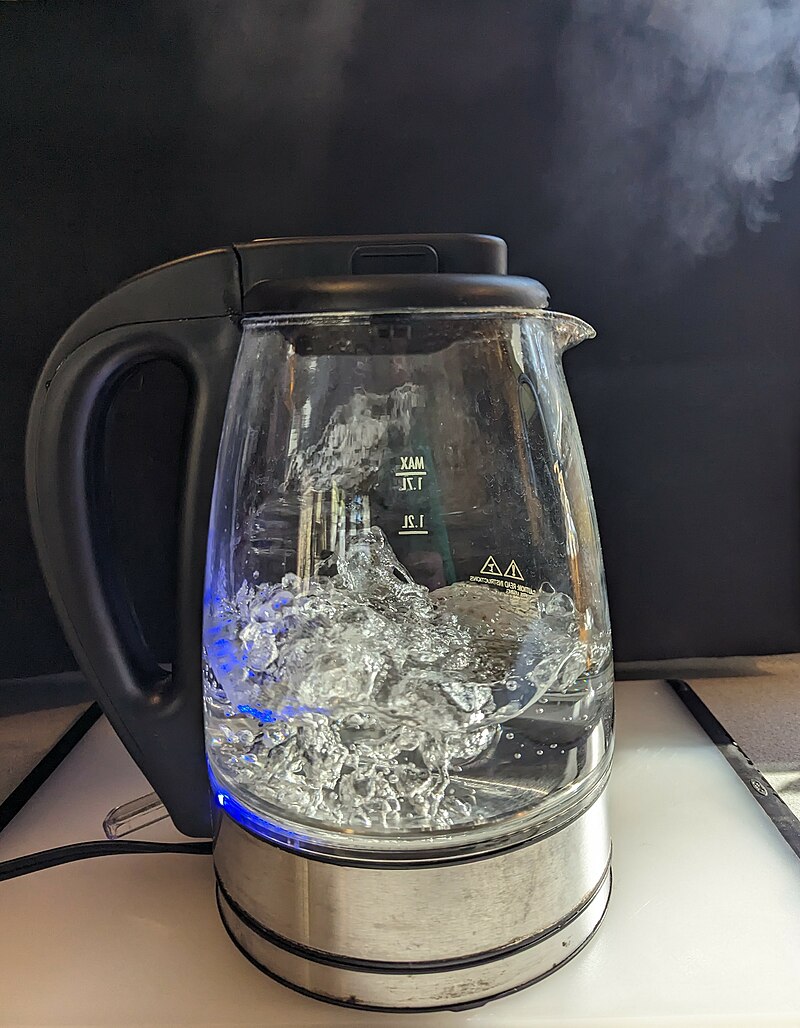
thumb|right|Rolling boil of water in an electric kettle

sublimation
transition of a substance directly from the solid to the gas state

superconductivity
thumb|A high-temperature superconductor levitating above a magnet. A persistent electric current flows on the surface of the superconductor, acting to exclude the magnetic field of the magnet (Meissner effect). This current effectively forms an electromagnet that repels the magnet.

condensation
thumb|right|Condensation forming in the low pressure zone above the wing of an aircraft during landing due to adiabatic process|adiabatic expansion

melting
thumb|Melting ice cubes illustrate the process of fusion.|321x321px

ionization
alt=The solar wind moving through the magnetosphere alters the movements of charged particles in the Earth's thermosphere or exosphere, and the resulting ionization of these particles causes them to emit light of varying colour, thus forming auroras near the polar regions.|thumb|201x201px|The solar wind moving through the [[magnetosphere alters the movements of charged particles in the Earth's thermosphere or exosphere, and the resulting ionization of these particles causes them to emit light of varying color, thus forming auroras near the polar regions.]]
Ionization or ionisation is the proce
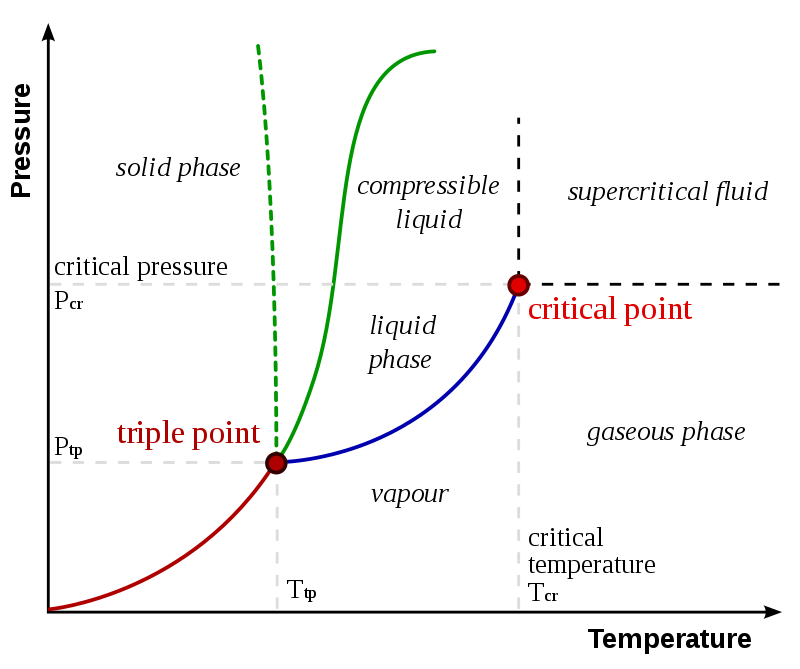
triple point
thermodynamic point where three matter phases exist

phase change
transitions between solid, liquid and gaseous states of matter, and, in rare cases, plasma

freezing
thumb|Water dripping from a slab of [[ice and then freezing, forming icicles]]
Freezing is a phase transition in which a liquid turns into a solid when its temperature is lowered below its freezing point.

critical point
temperature and pressure point where phase boundaries disappear
crystallization
Crystallization is a process that leads to solids with a uniform pattern of atoms or molecules, i.e. a crystal. The uniform nature of a crystalline solid can be contrasted with amorphous solids in which atoms or molecules lack regular organization. Crystallization can occur by various routes including precipitation from solution, freezing of a liquid, or deposition from a gas. Attributes of the resulting crystal can depend largely on factors such as temperature, air pressure, cooling rate, or solute concentration.

liquid crystal
state of matter with properties of both conventional liquids and crystals

phase diagram
chart used to show conditions at which physical phases of a substance occur

azeotrope
thumb|upright=1.5|Vapour-liquid equilibrium of 2-propanol/water showing positive azeotropic behaviour

Curie temperature
temperature above which certain materials lose their permanent magnetic properties

vaporization
Vaporization (vapourisation in British English) of an element or compound is a phase transition from the liquid phase to vapor. There are two types of vaporization: evaporation and boiling. Evaporation is a surface phenomenon, whereas boiling is a bulk phenomenon (a phenomenon in which the whole object or substance is involved in the process).
eutectic mixture
homogeneous mixture of substances that melts or solidifies at a single temperature that is lower than the melting point of either of the constituents

deposition
transition from a gas to a solid
Mpemba effect
the observation that, in some circumstances, warmer water can freeze faster than colder water
volatility
tendency of a substance to vaporize
cryobiology
Cryobiology is the branch of biology that studies the effects of low temperatures on living things within Earth's cryosphere or in science. The word cryobiology is derived from the Greek words κρῧος [kryos], "cold", βίος [bios], "life", and λόγος [logos], "word". In practice, cryobiology is the study of biological material or systems at temperatures below normal. Materials or systems studied may include proteins, cells, tissues, organs, or whole organisms. Temperatures may range from moderately hypothermic conditions to cryogenic temperatures.
Higgs mechanism
mechanism in quantum field theory in which spontaneous symmetry breaking causes gauge bosons to acquire mass
glass transition
reversible transition in amorphous materials at which amorphous polymers go from hard to viscous
freezing-point depression
process in which adding a solute to a solvent decreases the freezing point of the solvent
clathrate hydrate
crystalline solid containing molecules caged in a lattice of frozen water
vitrification
Vitrification (, via French '''') is the full or partial transformation of a substance into a glass, that is to say, a non-crystalline or amorphous solid. Glasses differ from liquids structurally and glasses possess a higher degree of connectivity with the same Hausdorff dimensionality of bonds as crystals: dimH = 3. In the production of ceramics, vitrification is responsible for their impermeability to water.
recrystallization
separation and purification process of crystalline solids
Pourbaix diagram
plot of thermodynamically stable phases of an aqueous electrochemical system
fractional crystallization
method of refining substances based on differences in solubility
recrystallization
process by which deformed grains are replaced by a new set of defect-free grains that nucleate and grow until the original grains have been entirely consumed
isothermal transformation diagram
plot of temperature versus time
Mott insulator
materials classically predicted to be conductors, that are actually insulators
cryoscopic constant
material property relating molality to freezing point depression
flash freezing
natural or industrial process whereby objects are frozen in a short time due to exposure to cryogenic temperatures
critical exponent
parameter describing physics near critical points
Wilson loop
gauge-invariant observable obtained from the holonomy of the gauge connection around a given loop
quantum phase transition
transition between different phases of matter at zero temperature
boiling chip
tiny uneven-shaped particles added to liquids to avoid superheating by providing nucleation sites; often made of porous material (e.g. alumina, silicon carbide, calcium carbonate, calcium sulfate, porcelain or carbon) with nonreactive PTFE coating
Kosterlitz–Thouless transition
phase transition in the two-dimensional (2-D) XY model
ebullioscopic constant
chemical and physical constant of materials
plasma recombination
process by which positive ions of a plasma capture a free (energetic) electron and combine with electrons or negative ions to form new neutral atoms (gas); exothermic reaction, meaning heat releasing
cooling curve
line graph used in physical science
lever rule
term in physics
Mesophase
In chemistry and chemical physics, a mesophase or mesomorphic phase is a phase of matter intermediate between solid and liquid. Gelatin is a common example of a partially ordered structure in a mesophase. Further, biological structures such as the lipid bilayers of cell membranes are examples of mesophases. Mobile ions in mesophases are either orientationally or rotationally disordered while their centers are located at the ordered sites in the crystal structure. Mesophases with long-range positional order but no orientational order are plastic crystals, whereas those with long-range orientati
critical opalescence
increase in photonic scattering during a phase transition
Landau theory
a theory that Lev Landau introduced in an attempt to formulate a general theory of continuous (i.e., second-order) phase transitions
list of boiling and freezing information of solvents
Wikimedia list article
cryophorus
thumb|300px|right|Wollaston's diagram of a cryophorus. When the empty ball on the right is immersed in a freezing mixture of snow and salt, the water in the ball on the left freezes in a few minutes.
diffusionless transformation
shift of atomic positions in a crystal structure
spinodal decomposition
mechanism of spontaneous phase separation
Bubble point
Temperature of a liquid at first bubbles
crystallization of polymers
partial alignment of polymer molecular chains, resulting in "semi-crystalline" structures
phase boundary
in thermal equilibrium, each phase of physical matter comes to an end at a transitional point, or spatial interface, called a phase boundary, due to the immiscibility of said matter with the matter on the other side of said boundary
dropping point
indication of the heat resistance of a lubricating grease and the temperature at which it passes from a semi-solid to a liquid state under specific test conditions
coffee ring effect
effect