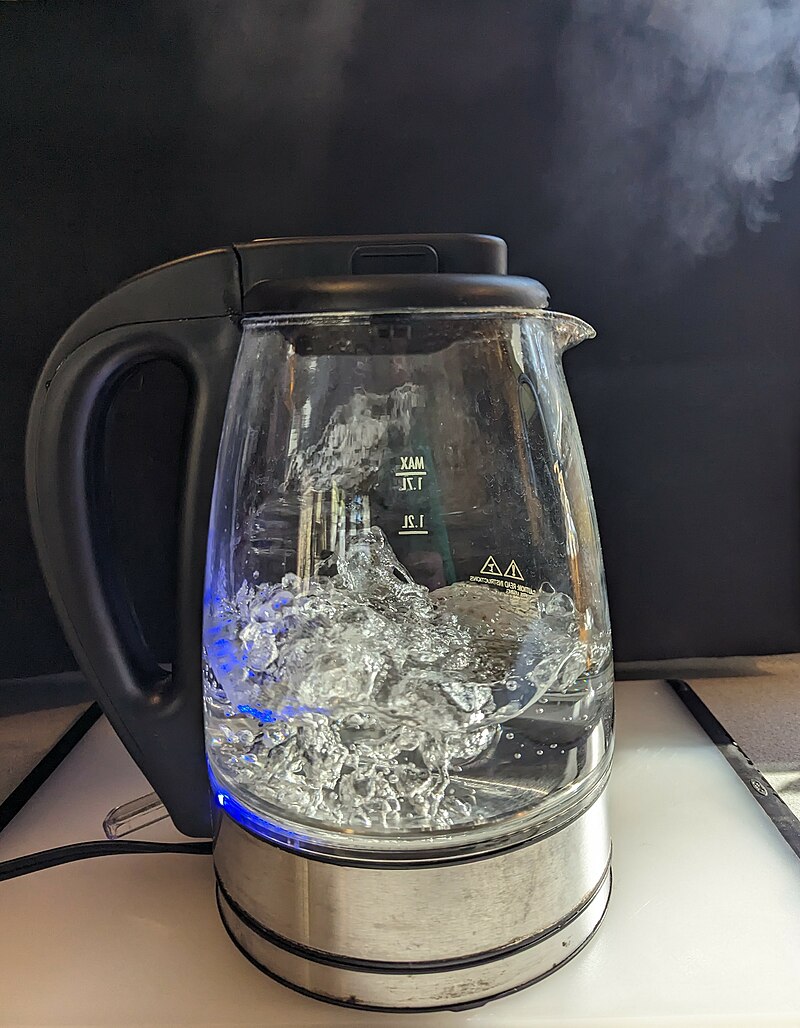
File:Boilingkettle.jpg · Wikimedia Commons · See Wikimedia Commons
boiling point
Sign in to saveAlso known as boiling temperature, b.p.
temperature at which a substance changes from liquid into vapor
A boiling point is the temperature at which a liquid turns into a gas or vapor. It matters because knowing when this happens helps us understand how substances behave, control cooking and industrial processes, and predict how materials will perform under different conditions.
AI-generated from the Wikipedia summary — may contain errors.
Wikidata facts
- Subclass of
- temperature
- Image
- Kochendes wasser02.jpg
Show 3 more facts
- different from
- condensation point
- greater than
- melting point
- on focus list of Wikimedia project
- Wikipedia:Vital articles/Level/4
via Wikidata · CC0
~14 min read
Encyclopedic overview
Water boiling at 99.3 °C (210.8 °F) at 215 m (705 ft) elevation The boiling point of a substance is the temperature at which the vapor pressure of a liquid equals the pressure surrounding the liquid and the liquid changes into a vapor.
The boiling point of a liquid varies depending upon the surrounding environmental pressure. A liquid in a partial vacuum, i.e., under a lower pressure, has a lower boiling point than when that liquid is at atmospheric pressure. Because of this, water boils at 100°C (or with scientific precision: 99.97 °C (211.95 °F)) under standard pressure at sea level, but at 93.4 °C (200.1 °F) at 1,905 metres (6,250 ft) altitude. For a given pressure, different liquids will boil at different temperatures.
Excerpted from Wikipedia’s “boiling point” article, available under the CC BY-SA 4.0 licence.
Gallery (9)
Available in 97 languages
- Español
- Français
- Deutsch
- 中文
- 日本語
- Русский
- Português
- Italiano
- العربية
- हिन्दी
- Afrikaans
- Albanian
- Albanian
- Aragonese
- Armenian
- Asturian
- Azerbaijani
- Bahasa Indonesia
Show 78 more
- Bangla
- Basque
- be_x_old
- Belarusian
- Bikol
- Bosnian
- Bulgarian
- Burmese
- Catalan
- Chuvash
- Croatian
- Czech
- Danish
- Esperanto
- Estonian
- Finnish
- Galician
- Georgian
- Greek
- Haitian Creole
- Hebrew
- Hungarian
- Iban
- Icelandic
- Interlingua
- Irish
- Kazakh
- Kurdish
- Kyrgyz
- Latin
- Latvian
- Lithuanian
- Lojban
- Lombard
- Low German
- Macedonian
- Malay
- Malayalam
- Manx
- Marathi
- Mongolian
- Nederlands
- Newari
- Norwegian
- Norwegian Nynorsk
- Occitan
- Oromo
- Pashto
- Polski
- Punjabi
- Quechua
- Romanian
- Serbian
- Serbian (Latin)
- simple
- Sindhi
- Sinhala
- Slovak
- Slovenian
- Sundanese
- Svenska
- Swahili
- Tamil
- Telugu
- Tiếng Việt
- Türkçe
- Ukrainian
- Urdu
- Uzbek
- Welsh
- Western Frisian
- Western Panjabi
- Wu Chinese
- zh_min_nan
- zh_yue
- فارسی
- ไทย
- 한국어
via Wikidata sitelinks · CC0