Category
page 1Photosynthesis
.png)
leaf
thumb|The diversity of leaves, including Bismarckia, [[Araucaria, Euphorbia, Nymphaea, Colocasia, Hildegardia, Picea, Melocactus, Cycas, Acer, Yucca, Ferocactus, and Ocimum.|401x401px]]
thumb|Leaf of Tilia tomentosa (silver linden tree)
thumb|Diagram of a simple leaf.
thumb|Top and right: staghorn sumac, Rhus typhina (compound leaf) Bottom: skunk cabbage, [[Symplocarpus foetidus (simple leaf) ]]

photosynthesis
thumb|upright=1.5|Schematic of photosynthesis in plants. The carbohydrates produced are stored in or used by the plant.
upright=1.5|thumb|right|Composite image showing the global distribution of photosynthesis, including both oceanic phytoplankton and terrestrial [[vegetation. Dark red and blue-green indicate regions of high photosynthetic activity in the ocean and on land, respectively.]]
.svg)
chloroplast
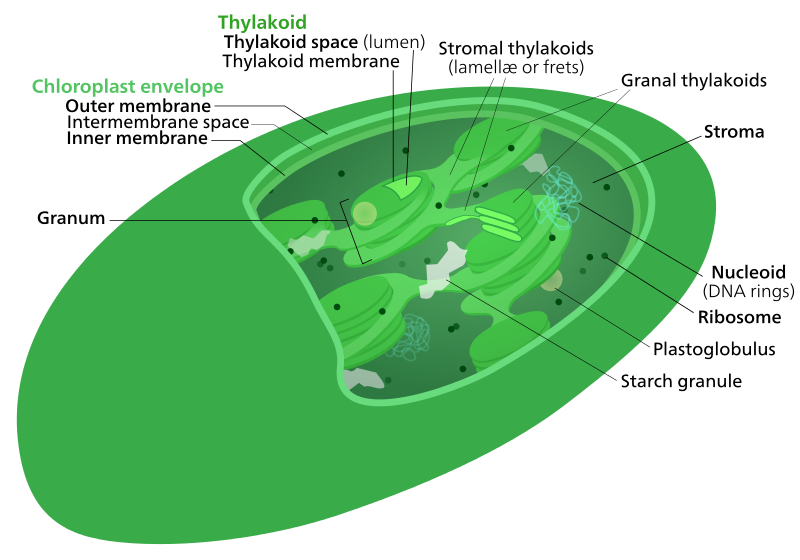
thumb|upright=1.35|Structure of a typical higher-plant chloroplast. The green chlorophyll is contained in stacks of disk-like [[thylakoids.]]
thumb|upright=1.35|Chloroplasts, containing thylakoids, visible in the cells of Rosulabryum capillare, a type of [[moss]]
A chloroplast ( ) is a type of organelle known as a plastid that conducts photosynthesis mostly in plant and algal cells. Chloroplasts have a high concentration of chlorophyll pigments which capture the energy from sunlight and convert it to chemical energy and release oxygen. The chemical energy created is then used to make sugar and

Cyanobacteria
Cyanobacteria ( ) are a group of autotrophic gram-negative bacteria of the phylum Cyanobacteriota that can obtain biological energy via oxygenic photosynthesis. Cyanobacteria apparently originated in a freshwater or terrestrial environment, and first appeared in the middle Archean eon. They are probably the most numerous taxon to have ever existed on Earth. The name "cyanobacteria" () refers to their bluish green (cyan) color, which forms the basis of cyanobacteria's informal common name, blue-green algae.

carbon cycle
biogeochemical cycle by which carbon is exchanged among the biosphere

plastid
thumb|Plant cells with visible chloroplasts

stomata
thumb|Stoma in a tomato leaf shown via colorized [[scanning electron microscope image]]
thumb|A stoma in horizontal cross section
thumb|The underside of a leaf. In this species (Tradescantia zebrina), the guard cells of the stomata are green because they contain chlorophyll while the epidermal cells are chlorophyll-free and contain red pigments.

carotenoid
thumb|class=skin-invert-image|Chemical structure of β-carotene, a common natural pigment|420px

nicotinamide adenine dinucleotide
coenzyme NAD in any of its oxidation states

proton-transporting ATP synthase complex
complex that catalyzes the phosphorylation of ADP to ATP, during oxidative phosphorylation
Calvin cycle
light-independent reactions in photosynthesis

phototroph
right|thumb|Terrestrial and aquatic phototrophs: plants grow on a fallen log floating in algae-rich water
photodissociation
Photodissociation, photolysis, photodecomposition, or photofragmentation is a chemical reaction in which molecules of a chemical compound are broken down by absorption of light (photons). It is defined as the interaction of one or more photons with one target molecule that dissociates into two fragments.

thylakoid
250px|thumb|Thylakoids (dark green) inside a chloroplast
Thylakoids are membrane-bound compartments inside chloroplasts and cyanobacteria. They are the site of the light-dependent reactions of photosynthesis. Thylakoids consist of a thylakoid membrane surrounding a thylakoid lumen. Chloroplast thylakoids frequently form stacks of disks referred to as grana (singular: granum). Grana are connected by intergranal or stromal thylakoids, which join granum stacks together as a single functional compartment.

RuBisCO
Ribulose-1,5-bisphosphate carboxylase/oxygenase, commonly known by the abbreviations RuBisCo, rubisco, RuBPCase, or RuBPco, is an enzyme () involved in the light-independent (or "dark") part of photosynthesis, including the carbon fixation by which atmospheric carbon dioxide is converted by plants and other photosynthetic organisms to energy-rich molecules such as glucose. It emerged approximately four billion years ago in primordial metabolism prior to the presence of oxygen on Earth. It is probably the most abundant enzyme on Earth. In chemical terms, it catalyzes the carboxylation of ribulo
CAM photosynthesis
metabolic process

photorespiration
class=skin-invert-image|thumb|upright=1.5|
class=skin-invert-image|thumb|upright=1.5|
3-phosphoglyceraldehyde
chemical compound
C4 carbon fixation
photosynthetic process used by some plants

photophosphorylation
thumb|300px|Photophosphorylation in the light-dependent reactions of [[photosynthesis, which occurs at the thylakoid membrane in chloroplasts and cyanobacteria.]] In the process of photosynthesis, the phosphorylation of ADP to form ATP using the energy of sunlight is called photophosphorylation. Cyclic photophosphorylation occurs in both aerobic and anaerobic conditions, driven by the main source of energy available to living organisms, which is sunlight. All organisms produce ATP, which is the universal energy currency of life. In photophosphorylation, light energy is used to pump protons acr
oxygen cycle
biogeochemical cycle of oxygen within its four main reservoirs: the atmosphere, the biosphere, the hydrosphere, and the lithosphere
dihydroxyacetone phosphate
chemical compound
(RS)-3-phosphoglyceric acid
group of stereoisomers
light-dependent reactions
chemical reactions involved in photosynthesis induced by light
carbon sink
natural or artificial process in which something absorbs more carbon from the atmosphere than it releases

bacteriorhodopsin
Bacteriorhodopsin (Bop) is a protein used by Archaea, most notably by Haloarchaea, a class of the Euryarchaeota. It acts as a proton pump; that is, it captures light energy and uses it to move protons across the membrane out of the cell. The resulting proton gradient is subsequently converted into chemical energy.
carbon fixation
conversion of carbon from CO2 to organic compounds
plastome
DNA located in cellular organelles called plastids
DL-glyceric acid 1,3-biphosphate
group of stereoisomers

photosystem
Photosystems are functional and structural units of protein complexes involved in photosynthesis. Together they carry out the primary photochemistry of photosynthesis: the absorption of light and the transfer of energy and electrons. Photosystems are found in the thylakoid membranes of plants, algae, and cyanobacteria. These membranes are located inside the chloroplasts of plants and algae, and in the cytoplasmic membrane of photosynthetic bacteria. There are two kinds of photosystems: PSI and PSII.
center|thumb|650x650px|Model of a photosystem and how it uses light energy to carry out process

ferredoxin
Ferredoxins (from Latin ferrum: iron + redox, often abbreviated "fd") are iron–sulfur proteins that mediate electron transfer in a range of metabolic reactions. They contain iron and sulfur atoms organized as iron–sulfur clusters. These biomolecules accept or discharge electrons, with the effect of a change in the oxidation state of the iron atoms between +2 and +3, letting them act as electron transfer agents in biological redox reactions.
C3 carbon fixation
metabolic pathway for carbon fixation in photosynthesis

plastoquinone
Plastoquinone (PQ) is a terpenoid-quinone (meroterpenoid) molecule involved in the electron transport chain in the light-dependent reactions of photosynthesis. The most common form of plastoquinone, known as PQ-A or PQ-9, is a 2,3-dimethyl-1,4-benzoquinone molecule with a side chain of nine isoprenyl units. There are other forms of plastoquinone, such as ones with shorter side chains like PQ-3 (which has 3 isoprenyl side units instead of 9) as well as analogs such as PQ-B, PQ-C, and PQ-D, which differ in their side chains. The benzoquinone and isoprenyl units are both nonpolar, anchoring the m
D-ribulose 1,5-bisphosphate
chemical compound
photosystem II
photosystem that contains a pheophytin-quinone reaction center with associated accessory pigments and electron carriers
carbon sequestration
process of long-term carbon capture

Plastocyanin
Plastocyanin is a copper-containing protein that mediates electron-transfer. It is found in a variety of plants, where it participates in photosynthesis. The protein is a prototype of the blue copper proteins, a family of intensely blue-colored metalloproteins. Specifically, it falls into the group of small type I blue copper proteins called "cupredoxins".
anoxygenic photosynthesis
process used by obligate anaerobes
photosynthetically active radiation
range of light usable for photosynthesis
photosynthetic reaction centre
molecular unit responsible for absorbing light in photosynthesis

transketolase
Transketolase (abbreviated as TK) is an enzyme that, in humans, is encoded by the TKT gene. It participates in both the pentose phosphate pathway in all organisms and the Calvin cycle of photosynthesis. Transketolase catalyzes two important reactions, which operate in opposite directions in these two pathways. In the first reaction of the non-oxidative pentose phosphate pathway, the cofactor thiamine diphosphate accepts a 2-carbon fragment from a 5-carbon ketose (D-xylulose-5-P), then transfers this fragment to a 5-carbon aldose (D-ribose-5-P) to form a 7-carbon ketose (sedoheptulose-7-P). The
photosystem I
class of protein complexes, the second protein complex in photosynthetic light reactions

photoautotroph
thumb|Winogradsky column showing Photoautotrophs in purple and green
Photoautotrophs are organisms that can utilize light energy from sunlight, and elements (such as carbon) from inorganic compounds, to produce organic materials needed to sustain their own metabolism (i.e. autotrophy). Such biological activities are known as photosynthesis, and examples of such organisms include plants, algae and cyanobacteria.
phycobilisome
Phycobilisomes are light-harvesting antennae that transmit the energy of harvested photons to photosystem II and photosystem I in cyanobacteria and in the chloroplasts of red algae and glaucophytes. They were lost during the evolution of the chloroplasts of green algae and plants.

Chlorosome
thumb|Schematic of the chlorosome (rod hypothesis)
gerontoplast
A gerontoplast is a type of organelle known as a plastid, which develops from a chloroplast during the senescing of plant foliage. Gerontoplast development is generally seen to be the process of grana being unstacked, loss of thylakoid membranes, and large accumulation of plastoglobuli.

photoinhibition
thumb|right|280px|Photoinhibition of Photosystem II (PSII) leads to loss of PSII electron transfer activity. PSII is continuously repaired via degradation and synthesis of the D1 protein. [[Lincomycin can be used to block protein synthesis]]

BOP clade
clade of grasses

light-harvesting complex
protein-pigment complex that may be closely or peripherally associated to photosynthetic reaction centers that participate in harvesting and transferring radiant energy to the reaction center
phosphoenolpyruvate carboxylase
class of enzymes
PACMAD clade
major clade in the grass family Poaceae
Compensation point
light point for photosynthesis
oxygen-evolving complex
site of water-splitting in photosynthesis
phytobenthos
thumb|upright=1.2|Cyanobacteria|Filamentous cyanobacteria growing on an underwater surface
photosynthetic efficiency
fraction of light energy converted into chemical energy during photosynthesis in plants and algae
red edge
region of rapid change in reflectance of vegetation in the near infrared range of the electromagnetic spectrum
evolution of photosynthesis
origin and subsequent evolution of the process by which light energy is used to synthesize sugars
Dole effect
oxygen evolution
the process of generating molecular oxygen through chemical reaction
accessory pigment
group of bioorganic compounds