Category
page 1Pigments

pigment
thumb|upright=1.35|Pigments for sale at a market stall in Goa, [[India]]
A pigment is a chemical compound that gives a substance or organism color, or is used by humans to add or alter color or change visual appearance. Pigments are nearly or completely insoluble and chemically unreactive in water or another medium; in contrast, dyes are colored substances which are soluble or go into solution at some stage in their use. Dyes are often organic compounds whereas pigments are often inorganic. Pigments of prehistoric and historic value include ochre, charcoal, and lapis lazuli. Biological pigment

Dactylopius coccus
The cochineal ( , ; Dactylopius coccus) is a scale insect in the suborder Sternorrhyncha, from which the natural dye carmine is derived. A primarily sessile parasite native to tropical and subtropical South America through North America (Mexico and the Southwest United States), this insect lives on cacti in the genus Opuntia, feeding on plant moisture and nutrients. The insects are found on the pads of prickly pear cacti, collected by brushing them off the plants, and dried.
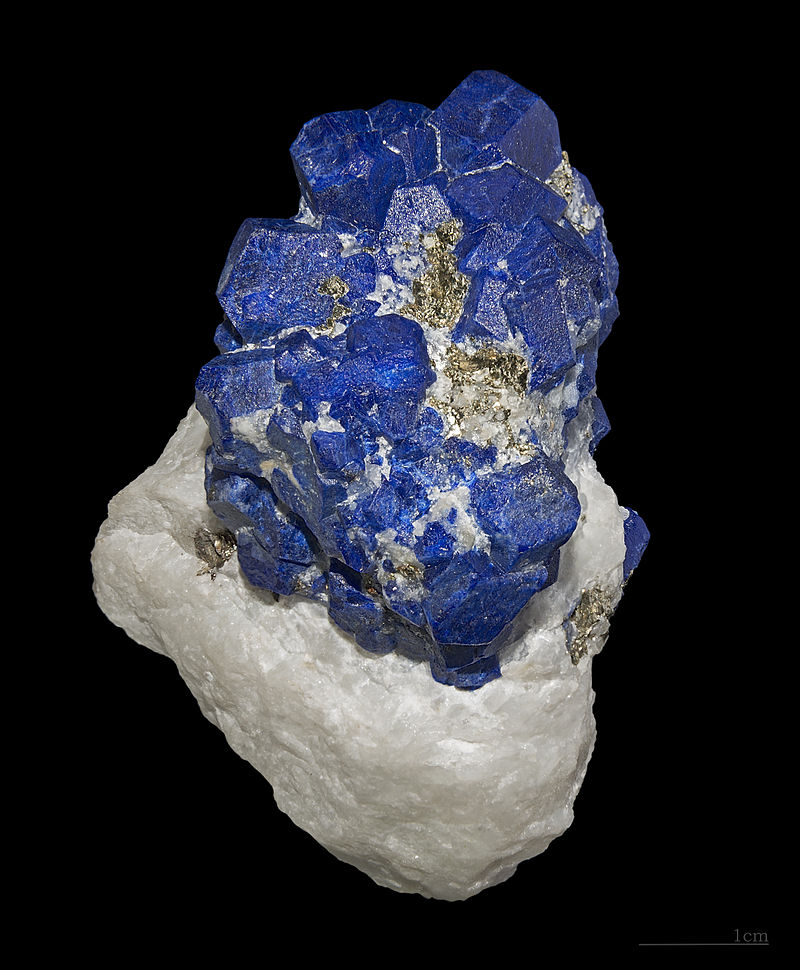
lazurite
Lazurite, old name Azure spar is a tectosilicate mineral with sulfate, sulfur and chloride with formula . It is a feldspathoid and a member of the sodalite group. Lazurite crystallizes in the isometric system although well‐formed crystals are rare. It is usually massive and forms the bulk of the gemstone lapis lazuli.
crimson
Crimson is a rich, deep red color, inclining to purple.

carbon black
chemical substance
sepia
reddish-brown color, named after the rich brown pigment derived from the ink sac of the common cuttlefish Sepia

verdigris
Verdigris () is a common name for any of a variety of somewhat toxic copper salts of acetic acid, which range in colour from green to a bluish-green depending on their chemical composition. Once used as a medicine and pharmaceutical preparation, verdigris occurs naturally, creating a patina on copper, bronze, and brass, and is the main component of a historic green pigment used for artistic purposes from antiquity until the late 20th century, including in easel painting, polychromatic sculptures, and illumination of maps. However, due to its instability, its popularity declined as other green

bister
thumb|upright=1.2| , a wash painting using bistre pigment by Jean-Honoré Fragonard (1732–1806)

staining
right|thumb|300px|A stained histological specimen, sandwiched between a glass [[microscope slide.]]
cerulean
{| align="right"
|+ Cerulean as a quaternary color on the RYB color wheel
|
|-
|
|-
|
|}
.jpg)
gamboge
Gamboge ( ) is a deep-yellow pigment derived from a species of tree that primarily grows in Cambodia. Popular in East Asian watercolor works, it has been used across a number of media dating back to the 8th century. Easy to transport and manipulate into a durable watercolor paint, gamboge is notable for its versatility as a pigment in how it has been used in paintings, printing of books, and garment dyes, including the robes of Buddhist monks. Gamboge is toxic to humans, and is potentially deadly in large doses. Due to its toxicity and poor lightfastness, gamboge is no longer used in paints, t
(Phthalocyaninato)copper
chemical compound
minium
naturally occurring mineral form of lead tetroxide
International Klein Blue
deep blue pigment first mixed by the French artist Yves Klein
mummy brown
brown paint made from white pitch, myrrh, and ground-up Egyptian mummies
eyespot apparatus
Small pigmented organelle used in single-celled organisms to detect light

lightfastness
thumb|Clay earth pigments such as [[burnt sienna often have a high lightfastness]]
hematin
Haematin (also known as hematin, ferriheme, hematosin, hydroxyhemin, oxyheme, phenodin, or oxyhemochromogen) is a dark bluish or brownish pigment containing iron in the ferric state, obtained by the oxidation of haem.
aureolin
Aureolin (sometimes called cobalt yellow) is a pigment sparingly used in oil and watercolor painting. Its color index name is PY40 (40th entry on list of yellow pigments). It was first made in 1831 by Nikolaus Wolfgang Fischer in Breslau characterizing it as "Doppelsalze" or double-salts and its chemical composition is potassium cobaltinitrite. He characterized it again and wrote more extensively about it in 1842, naming it "Salpetrichtsaures Kobaltoxydkali". In 1851–1852, Edouard Saint-Evre synthesized cobalt yellow independently. He is credited with the introduction of cobalt yellow as an ar
phthalocyanine green G
chemical compound
purple of Cassius
inorganic pigment
zinc white
white pigment
Naphthol Red
chemical compound
Pompeian red
color
Han purple and Han blue
artificial barium copper silicate pigments developed in ancient China during the Han dynasty

lake pigment
pigment made by precipitating a dye with an inert binder, or "mordant"
photopigment
Photopigments are unstable pigments that undergo a chemical change when they absorb light. The term is generally applied to the non-protein chromophore moiety of photosensitive chromoproteins, such as the pigments involved in photosynthesis and photoreception. In medical terminology, "photopigment" commonly refers to the photoreceptor proteins of the retina.
perinone
Perinone is a class of organic compounds. The parent compound has two isomers, each of which are useful pigments.
titanium white
white pigment invented in the 20th century
melanoblast
A melanoblast is a precursor cell of a melanocyte. These cells migrate from the trunk neural crest cells (in terms of axial level from neck to posterior end) dorsolaterally between the ectoderm and dorsal surface of the somites.
Caput mortuum
historical purple pigment
list of inorganic pigments
Wikimedia list article