Category
page 1Prussian cultural sites

Brandenburg Gate
triumphal arch in Berlin, Germany

Museum Island
northern part of Spree Island in the Spree river in central Berlin

Sanssouci Palace
Sanssouci () is a historical building in Potsdam, near Berlin. Built by Prussian King Frederick the Great as his summer palace, it is often counted among the German rivals of Versailles. While Sanssouci is in the more intimate Rococo style and is far smaller than its French Baroque counterpart, it is similarly notable for the numerous temples and follies in the surrounding park. The palace was designed and built by Georg Wenzeslaus von Knobelsdorff between 1745 and 1747 to meet Frederick's need for a private residence where he could escape the pomp and ceremony of the royal court. The palace's

Berlin Cathedral
main lutheran church in Berlin

Unter den Linden
street in Berlin, Germany

Charlottenburg Palace
Baroque palace in Berlin, Germany
Berlin Palace
former residence of the Prussian kings, seat of the Humboldt Forum
Berlin State Library
state library and heritage institution in Germany

Gendarmenmarkt
The is a square in Berlin and the site of an architectural ensemble that includes the Berlin concert hall, along with the French and German Churches. In the centre of the square stands a monumental statue of poet Friedrich Schiller. The square was created by Johann Arnold Nering at the end of the seventeenth century as the Linden-Markt and reconstructed by Georg Christian Unger in 1773. The Gendarmenmarkt is named after a Prussian cuirassier regiment called the , which had stables at the square until 1773.
Neue Wache
historical building in Berlin, Germany
Deutscher Dom
church building in Mitte, Germany
New Palace
Palace in Sanssouci, Potsdam, Brandenburg, Germany
Staatliche Museen zu Berlin
group of institutions in Berlin, Germany
Orangery Palace
Palace in the Sanssouci Park of Potsdam, Germany
Friedrichswerder Church
Neo-Gothic church in Berlin
Glienicke Palace
palace
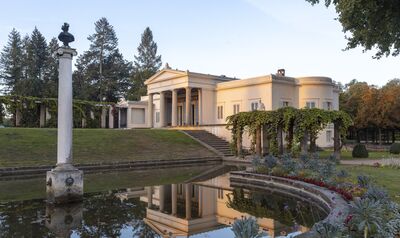
Charlottenhof Palace
palace in Sanssouci, Potsdam, Germany
Brandenburg Gate
triumphal arch in Potsdam, Germany

Kronprinzenpalais
The Kronprinzenpalais (English: ''Crown Prince's Palace'') is a former Royal Prussian residence on Unter den Linden boulevard in the historic centre of Berlin. It was built in 1663 and renovated in 1857 according to plans by Heinrich Strack in Neoclassical style. From 1919 to 1937, it was home to the modern art collection of the National Gallery. Damaged during the Allied bombing in World War II, the Kronprinzenpalais was rebuilt from 1968 to 1970 by Richard Paulick as part of the Forum Fridericianum. In 1990, the German Reunification Treaty was signed in the listed building. Since then, it ha
Sanssouci Park
park in Potsdam, Germany
Jagdschloss Grunewald
hunting lodge and art museum
Imperial Castle in Poznań
architectural structure
Chinese House
landmark in Germany
Garrison Church
church building in Potsdam, Germany
Church of Peace
church in Potsdam
Belvedere on the Pfingstberg
World Heritage Site in Germany

Bauakademie
thumb|Mock canvas reconstruction in 2005
The Bauakademie (Building Academy, also known as the Schinkelsche Bauakademie) in Berlin, Germany, was a higher education institution for the art of building to train master builders. Founded on 18 March 1799 by King Frederick William III, the institution originated from the construction department of the Academy of Fine Arts and Mechanical Sciences (from 1704), which emphasized the aesthetic elements of the art of building while ignoring the technical. Thus, the governmental Upper Building Department ("UBD") decided to establish an entirely new buildin
King's Gate
city gate and museum in Kaliningrad, Russia

Altes Palais
palace in Berlin, Germany
Friedrichsfelde Castle
château in Berlin, Germany
Ephraim-Palais
Rokoko building in Berlin. Location for special exhibitions by the Stadtmuseum Berlin on wide-ranging themes related to the history and culture of Berlin.
Wrocław Palace
palace
Prinzessinnenpalais
The Prinzessinnenpalais (English: ''Princesses' Palace'') is a former Royal Prussian residence on Unter den Linden boulevard in the historic centre of Berlin. It was built in 1733 according to plans by Friedrich Wilhelm Diterichs in Rococo style and extended from 1810 to 1811 by Heinrich Gentz in Neoclassical style. Damaged during the Allied bombing in World War II, the Prinzessinnenpalais was rebuilt from 1963 to 1964 by Richard Paulick as part of the Forum Fridericianum. Since 2018, it has been home to the PalaisPopulaire, an art collection of Deutsche Bank.
Jelenia Góra Valley
physiogeographic mesoregion in southwestern Poland in the Lower Silesian Voivodeship
Szczecin Bismarck tower
building in Szczecin, Poland
Roman Baths
North-east of Charlottenhof Palace in Sanssouci Park, Potsdam
Prussian Palaces and Gardens Foundation Berlin-Brandenburg
German foundation in Berlin-Brandenburg
Pfaueninsel Palace
palace in Berlin, Germany
Neuer Marstall
historic building in Berlin, Germany
Villa Massimo
building in Rome
Biesdorf Palace
château in Berlin, Germany
Prussian National Monument for the Liberation Wars
monument in Berlin, Germany
Palais am Festungsgraben
building in Berlin, Germany
Park Glienicke
English landscape garden in the southwestern outskirts of Berlin, Germany