Category
page 1Red wine grape varieties

Cabernet Sauvignon
red-wine variety of grape
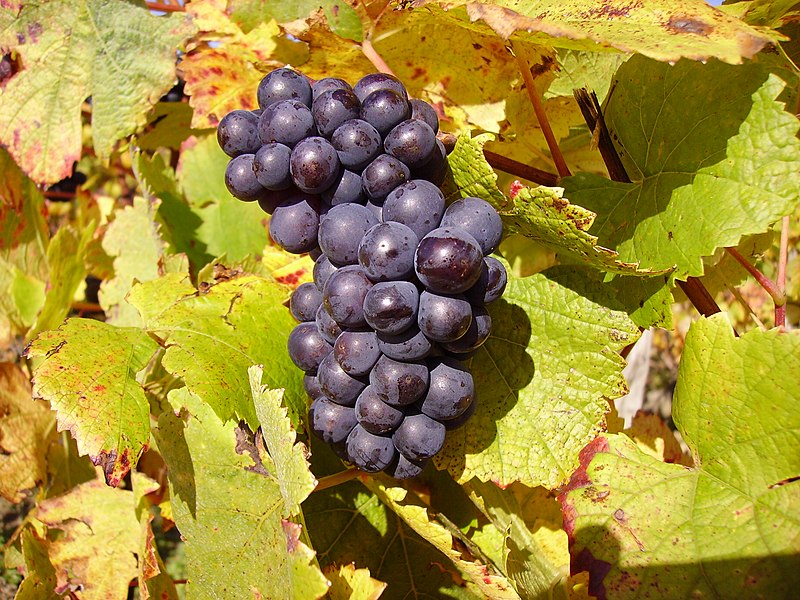
Pinot noir
Wine-making grape

Merlot
Merlot ( ) is a dark-blue-colored wine grape variety that is used as both a blending grape and for varietal wines. The name Merlot is thought to be a diminutive of , the French name for the blackbird, probably a reference to the color of the grape. Its softness and "fleshiness", combined with its earlier ripening, make Merlot a popular grape for blending with the sterner, later-ripening Cabernet Sauvignon, which tends to be higher in tannin.

Syrah
Syrah, also known as Shiraz, is a dark-skinned grape variety grown throughout the world and used primarily to produce red wine. In 1999, Syrah was found to be the offspring of two obscure grapes from southeastern France, Dureza and Mondeuse Blanche. Syrah should not be confused with Petite Sirah, a cross of Syrah with Peloursin dating from 1880.
Cabernet Franc
grapevine that yields black grapes used for wine

Grenache
thumb|Grenache noir grapes
Grenache (, ) or Garnacha () is one of the most widely planted red wine grape varieties in the world. It ripens late, so it needs hot, dry conditions such as those found in Spain, where the grape is believed to have originated. It is also grown in the Italian island of Sardinia, the south of France, Australia, and California's Monterey AVA, Paso Robles, Santa Barbara County and San Joaquin Valley.

Tempranillo
thumb|Ripening Tempranillo grapes
right|thumb|Tempranillo leaf

Zinfandel
Zinfandel, known as Primitivo in Italy and Crljenak Kaštelanski or Tribidrag in Croatia, and as Kratošija () in Montenegro, is a variety of black-skinned wine grape. The variety is grown in over 10 percent of California vineyards.

Nebbiolo
Nebbiolo (, ; ) is an Italian red wine grape variety predominantly associated with its native Piedmont region, where it makes the Denominazione di Origine Controllata e Garantita (DOCG) wines of Barolo, Barbaresco, Gattinara, Ghemme, and Roero, together with numerous DOC wines. Nebbiolo is thought to derive its name from the Italian or Piedmontese , meaning 'fog'. During harvest, which generally takes place late in October, a deep, intense fog sets into the Langhe region where many Nebbiolo vineyards are located. Alternative explanations refer to the fog-like glaucous veil that forms over the

Gamay
Gamay () is a purple-colored grape variety used to make red wines, most notably grown in Beaujolais and in the Loire Valley around Tours. Its full name is Gamay Noir à Jus Blanc. It is a very old cultivar, mentioned as long ago as the 15th century. It has been often cultivated because it makes for abundant production; however, it can produce wines of distinction when planted on acidic soils, which help to soften the grape's naturally high acidity.

Malbec
Malbec () is a purple grape variety used in making red wine. The grapes tend to have an inky dark color and robust tannins, and are known as one of the six grapes allowed in the blend of red Bordeaux wine. In France, plantations of Malbec are now found primarily in Cahors in South West France, though the grape is grown worldwide. It is also available as an Argentine varietal.

Sangiovese
Sangiovese is a red Italian wine grape variety that derives its name from the Latin , "blood of Jupiter".

Carménère
The Carménère grape is a wine grape variety originally planted in the Médoc region of Bordeaux, France, where it was used to produce deep red wines and occasionally used for blending purposes in the same manner as Petit Verdot.

Saperavi
Saperavi (; literally "paint, dye, give color") is an acidic, teinturier-type grape variety native to the country of Georgia, where it is used to make many of the region's most well-known wines. Saperavi spread from Georgia to other parts of the Black Sea region and is considered an important variety in countries such as Moldova, Ukraine, and Bulgaria. In recent decades, it has also made its way as far as the United States and Australia, where it began to gain foothold in the 1990s.

Carignan
Carignan (; also known as Mazuelo, Bovale Grande, Cariñena, Carinyena, Samsó, Carignane, and Carignano) is a red grape variety of Spanish origin that is more commonly found in French wine but is widely planted throughout the western Mediterranean and around the globe. Along with Aramon, it was considered one of the main grapes responsible for France's wine lake and was a substantial producer in jug wine production in California's Central Valley but in recent years, it has been reborn as a flagship wine for many cellars in the south of France as well as in Catalonia.
.jpg)
Lambrusco
thumb|A glass of Lambrusco (Grasparossa version)
Lambrusco (, ) is the name of both an Italian red wine grape and a wine made principally from the grape. The grapes and the wine originate from four zones in Emilia-Romagna and one in Lombardy―principally around the central provinces of Modena, Parma, Reggio-Emilia, and Mantua. The grape has a long winemaking history, with archaeological evidence indicating that the Etruscans cultivated the vine. In Roman times Lambrusco was highly valued for its productivity and high yields, with Cato the Elder stating that produce of two-thirds of an acre coul

Barbera
Barbera is a red Italian wine grape variety that, as of 2000, was the third most-planted red grape variety in Italy (after Sangiovese and Montepulciano). It produces good yields and is known for deep color, full body, low tannins and high levels of acidity.
Petit Verdot
varietal

Vitis rotundifolia
species of plant
Pinot meunier
wine making grape

Kadarka
right|thumb|100px|A bottle of Bulgarian "Rosenthaler Kadarka" wine

Mourvèdre
Mourvèdre (; also known as Mataro or Monastrell) is a red wine grape variety grown in many regions around the world. It is found in the Rhône and Provence regions of France, the Valencia, Alicante and Jumilla, Bullas and Yecla denominaciones de origen (DOs) of Spain, as well as the Balearic Islands, California and Washington and the Australian regions of South Australia and New South Wales, plus South Africa. In addition to making red varietal wines, Mourvèdre is a prominent component in "GSM" (Grenache, Syrah, and Mourvèdre) blends. The variety is also used to make rosé and port-style fortifi

Cinsaut
thumb|Cinsaut growing in the Côtes du Luberon

Corvina
Corvina is an Italian wine grape variety that is sometimes also referred to as Corvina Veronese or Cruina. The total global wine-growing area in 2010 was , all of which is grown in the Veneto region of northeast Italy, except for planted in Argentina. Corvina is used with several other grapes to create the light red regional wines Bardolino and Valpolicella that have a mild fruity flavor with hints of almond. These blends include Corvinone, Rondinella, and Molinara, and Rossignola for the latter wine. It is also used for the production of Amarone and Recioto.

Aglianico
Aglianico ( , ) is a black grape grown in the southern regions of Italy, mostly Basilicata and Campania. It is considered with Sangiovese and Nebbiolo to be one of the three greatest Italian varieties. Aglianico is sometimes called "The Barolo of the South" () due to its ability to produce highly refined, complex fine wines like the famous wine from Piedmont, Barolo.
Nero d'Avola
most important red wine grape in Sicily
Pinotage
Pinotage is a red wine grape that is South Africa's signature variety. It was cultivated there in 1925 as a cross between Pinot noir and Cinsaut (Cinsaut was known as "Hermitage" in South Africa at that time, hence the name). It typically produces deep red varietal wines with smoky, bramble and earthy flavours, sometimes with notes of bananas and tropical fruit. The grape is a viticultural intraspecific cross of two varieties of Vitis vinifera, not an interspecific hybrid.
Alicante Bouschet
variety of grape

Zweigelt
right|thumb|Zweigelt from Hungarian wine|Hungary

Vranec
right|thumb|A Vranec from North Macedonia
Vranac (), ; , Vranec) is a red grape variety that originates from Montenegro. It is the most planted grape variety in Montenegro. It is believed to be closely related to Kratosija. Vranac is considered the most important grape variety in Montenegro and one of the most important in North Macedonia. It is also grown in regions of Dalmatia (in Croatia), Herzegovina, Kosovo and south Serbia. It has been protected as a Montenegrin geographical indication of origin since 1977. The single largest producer is Plantaže, based in the Montenegrin capital Podgori

Blaufränkisch
Blaufränkisch (; German for blue Frankish) is a dark-skinned variety of grape used for red wine. Blaufränkisch, which is a late-ripening variety, produces red wines which are typically rich in tannin and may exhibit a pronounced spicy character.

Mavrud
thumb|Mavrud dry red wine from region of Brestovitsa, Plovdiv Province|Brestovitsa.
thumbnail|Mavrud wine on the shelves in a supermarket in Plovdiv, Bulgaria. This particular wine is from [[Perushtitsa.]]
Mavrud (, from Greek, μαυρό (mavró), "black") is a red wine grape that is used as both a blending grape and for varietal wines, indigenous to the Balkan region. It is grown in the Thrace region of Bulgaria, in some regions of Albania, as well as some regions of Greece and Romania.
Negroamaro
Negroamaro (seldom Negro amaro; meaning "black [and] bitter") is a red wine grape variety native to southern Italy. It is grown almost exclusively in Apulia and particularly in Salento, the peninsula which can be visualised as the "heel" of Italy. The grape can produce wines very deep in color. Wines made from Negroamaro tend to be very rustic in character, combining perfume with an earthy bitterness. The grape produces some of the best red wines of Apulia, particularly when blended with the highly scented Malvasia Nera, as in the case of Salice Salentino.

Dolcetto
Dolcetto ( , , ) is a black Italian wine grape variety widely grown in the Piedmont region of northwest Italy. The Italian word dolcetto means "little sweet one", but it is not certain that the name originally carried any reference to the grape’s sugar levels: it is possible that it derives from the name of the hills where the vine is cultivated. In any case the wines produced are nearly always dry. They can be tannic and fruity with moderate, or decidedly low, levels of acidity and are typically meant to be consumed within a few years after release.
Concord
grape variety
Blauer Portugieser
varietal

Tannat
Tannat is a red wine grape, historically grown in South West France in the Madiran AOC, and is now one of the most prominent grapes in Uruguay, where it is considered the "national grape".

Agiorgitiko
Agiorgitiko (; also known as Aghiorghitiko) is a red Greek wine grape variety that, as of 2012, was the most widely planted red grape variety in Greece, ahead of Xynomavro. The grape has traditionally been grown in the Nemea region of the Peloponnese but can be found throughout the country including Attikí (Attica) and Makedonía (Macedonia).

Xinomavro
thumb|250px|Vineyard in Naoussa, that produces the xinomavro grape.
Isabella
grape variety
Montepulciano d'Abruzzo
Italian wine made in Abruzzo from Montepulciano grapes
Bobal
Bobal is a variety of Vitis vinifera, a red grape used in winemaking. It is native to the Utiel-Requena region in Valencia, Spain. The presence of Bobal in Utiel-Requena was documented in the 15th century in "Espill o llibre de les dones" by Jaume Roig. The name derives from the Latin bovale, in reference to the shape of a bull's head.

Canaiolo
right|thumb|upright|Canaiolo was once the dominant grape in Chianti blends
Canaiolo (), also called Canaiolo nero or Uva Canina, is a red Italian wine grape grown through Central Italy but is most noted in Tuscany. Other regions with plantings of Canaiolo include Lazio, Marche and Sardegna. In Umbria a white berried mutation known as Canaiolo bianco exists. Together with Sangiovese and Colorino it is often used to create Chianti wine and is an important but secondary component of Vino Nobile di Montepulciano. In the history of Chianti it has been a key component blend and during the 18th centu
Plavac Mali
variety of grape
Rondinella
Rondinella is an Italian wine grape variety. Almost all of the total global growing area of is in the Veneto region of northern Italy, and the grapes are used in wines from the Valpolicella and Bardolino wine regions. Rondinella always appears in these wines blended with Corvina (which DNA evidence has shown to be a parent variety), as a secondary constituent along with Corvinone and Molinara. The grape has rather neutral flavors but is favored by growers due to its prolific yields. The vine is very resistant to grape disease and produces grapes that, while they do not necessarily have high su
St. Laurent
varietal
Băbească Neagră
varietal
Mencia
grape variety
Montepulciano
grape variety

Mavrodafni
thumb|Old advertising for Mavrodaphne in Germany
Mavrodaphni, Mavrodaphne, or Mavrodafni (Greek: Μαυροδάφνη lit. 'black laurel') is both a black wine grape indigenous to the Achaea region in Northern Peloponnese, Greece, and the sweet, fortified wine first produced from it by Gustav Clauss in around 1850.
Bastardo
varietal
Lagrein
Lagrein () is a red wine grape variety native to the valleys of South Tyrol, northern Italy. Along with Marzemino, it is a descendant of Teroldego, and related to Syrah, Pinot noir and Dureza.

Dornfelder
Dornfelder () is a dark-skinned variety of grape of German origin used for red wine. It was created by August Herold (1902–1973) at the grape breeding institute in Weinsberg in the Württemberg region in 1955. Herold crossed the grape varieties Helfensteiner and Heroldrebe, the latter which bears his name, to create Dornfelder. Helfensteiner (Frühburgunder/Pinot Noir Précoce × Trollinger/Schiava Grossa) and Heroldrebe (Blauer Portugieser × Blaufränkisch/Lemberger) were both crosses created some decades earlier by Herold. Dornfelder received varietal protection and was released for cultivation i

Graciano
Graciano is a Spanish red wine grape that is grown primarily in Rioja. The vine produces a low yield that are normally harvested in late October. The wine produced is characterized by its deep red color, strong aroma and ability to age well. Graciano thrives in warm, arid climates.
Fetească neagră
Romanian Moldovan grape
Blatina
Blatina (Cyrillic: Блатина) is a red wine grape variety primarily grown in the Herzegovina region of Bosnia and Herzegovina. It has a functional female flower (auto-sterile), and for that reason it is always cultivated in plantations with other varieties such as Alicante bouschet (Kambuša), Merlot, and Trnjak, which at the same time pollinate Blatina. During the period of insemination, because of the rain, it can fail in giving fruits, and it is then called "praznobačva" (empty barrel). Blatina can produce dry red wine with 12 to 13.5% of alcohol, 5 to 7 g/L of total acidity, 25-32 g/L of extr
Tinta Barroca
variety of grape

Durif
Durif is a variety of red wine grape mainly grown in Australia, California, France, and Israel. Since the end of the 20th century, wineries located in Washington's Yakima River Valley, Maryland, Arizona, Texas, West Virginia, Chile, Mexico's Baja California Peninsula, and Ontario's Niagara Peninsula have also produced wines from Durif grapes. It is the primary grape known in the U.S. and Israel as Petite Sirah, with over 90% of the California plantings labeled "Petite Sirah" being Durif grapes. The U.S. Bureau of Alcohol, Tobacco, Firearms and Explosives (ATF) recognizes "Durif" and "Petite Si

Abouriou
Abouriou (; French spelling of Occitan aboriu, early) is a red French wine grape variety grown primarily in Southwest France and, in small quantities, California. It is a blending grape that, along with Malbec, Cabernet Sauvignon, Syrah, Fer, Cabernet Franc, and Merlot, is used to make the ''Appellation d'origine contrôlée (AOC) wine of Côtes du Marmandais. Abouriou can also be made into a varietal, as it is used in some vin de pays'' wines. The grape is known for its low acidity and high tannin content.
Touriga Nacional
varietal