Category
page 1Rheumatology

arthritis
Arthritis is a general medical term used to describe a disorder in which the smooth cartilagenous layer that lines a joint is lost, resulting in bone grinding on bone during joint movement. Symptoms generally include joint pain and stiffness. Other symptoms may include redness, warmth, swelling, and decreased range of motion of the affected joints. In certain types of arthritis, other organs, such as the skin, are also affected. Onset can be gradual or sudden.

gout
Gout ( ), also called rheumatic gout, is a form of inflammatory arthritis characterized by recurrent attacks of pain in a red, tender, hot, and swollen joint, caused by the deposition of needle-shaped crystals of the monosodium salt of uric acid. Pain typically comes on rapidly, reaching maximal intensity in less than 12 hours. In about half of cases, the joint at the base of the big toe is affected (Podagra). It may also result in tophi, kidney stones, or kidney damage.

osteoporosis

rheumatology
Rheumatology () is a branch of medicine devoted to the diagnosis and management of disorders of which the common feature is inflammation in the bones, muscles, joints, and internal organs. Rheumatology covers more than 100 different complex diseases, collectively known as rheumatic diseases, such as arthritis, lupus, and Sjögren's syndrome. Doctors who have undergone formal training in rheumatology are called rheumatologists.

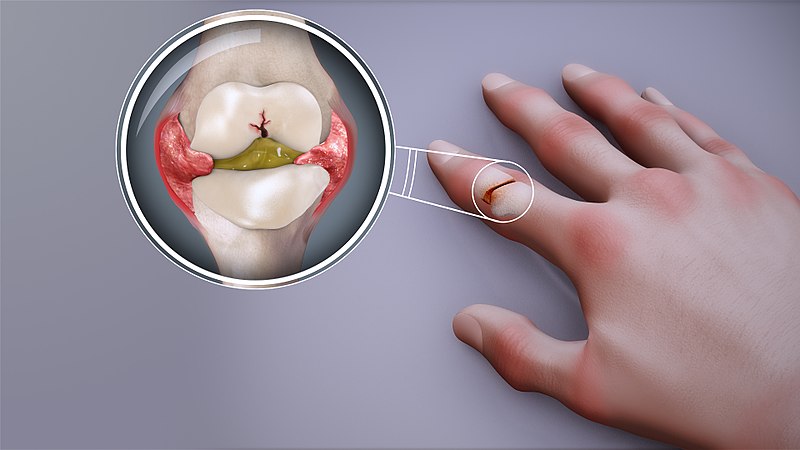
rheumatoid arthritis
autoimmune disease which attacks healthy cells and tissue located in joints
rheumatism
Rheumatism (from the Ancient Greek , rheûma) or rheumatic disorders are conditions causing chronic, often intermittent pain affecting the joints or connective tissue. Rheumatism does not designate any specific disorder, but covers at least 200 different conditions, including arthritis and "non-articular rheumatism", also known as "regional pain syndrome" or "soft tissue rheumatism". There is a close overlap between the term soft tissue disorder and rheumatism. Sometimes the term "soft tissue rheumatic disorders" is used to describe these conditions.

fibromyalgia

ankylosing spondylitis
type of arthritis in which there is long term inflammation of the joints of the spine

rheumatic fever
post-streptococcal inflammatory disease that can involve the heart, joints, skin, & brain

Raynaud syndrome
medical condition in which spasm of arteries cause episodes of reduced blood flow

vasculitis
Vasculitis is a group of disorders that destroy blood vessels by inflammation. Both arteries and veins are affected. Lymphangitis (inflammation of lymphatic vessels) is sometimes considered a type of vasculitis. Vasculitis is primarily caused by leukocyte migration and resultant damage. Although both occur in vasculitides, inflammation of veins (phlebitis) or arteries (arteritis) on their own are separate entities.

fibrosis
Fibrosis, also known as fibrotic scarring, is the development of fibrous connective tissue in response to an injury. Fibrosis can be a normal connective tissue deposition or excessive tissue deposition caused by a disease.
psoriatic arthritis
syndrome that occurs in humans with psoriasis who also experience symptoms similar to arthritis
juvenile rheumatoid arthritis
rheumatoid arthritis that involves an autoimmune disease onset in children under 16 which attacks the healthy cells and tissue of located in joint
arthralgia
Arthralgia () literally means 'joint pain'. Specifically, arthralgia is a symptom of injury, infection, illness (in particular arthritis), or an allergic reaction to medication.
giant cell arteritis
human disease
Henoch-Schoenlein purpura
Human disease
granulomatosis with polyangiitis
wegner granulomatosis
antiphospholipid syndrome
human disease
familial Mediterranean fever
Human disease
polyarteritis nodosa
segmental transmural, necrotizing vasculitis
hypermobility syndrome
human disease: joints that stretch farther than normal

osteopenia
thumb|Osteopenia exists on a spectrum of normal to dangerously low bone density (osteoporosis).
Stickler syndrome
rare genetic disorder affecting collagen
lupus nephritis
inflammation of the kidneys
neurogenic arthropathy
Human disease
tophus
A tophus (Latin: "stone", : tophi) is a deposit of monosodium urate crystals in people with longstanding high levels of uric acid (urate) in the blood, a condition known as hyperuricemia. Tophi are pathognomonic for the disease gout. Most people with tophi have had previous attacks of acute arthritis, eventually leading to the formation of tophi. Chronic tophaceous gout is known as Harrison syndrome.
myofascial pain syndrome
human disease
livedo reticularis
common skin finding consisting of a mottled reticulated vascular pattern that appears as a lace-like purplish discoloration of the skin
knee pain
symptom
SAPHO syndrome
variety of inflammatory bone disorders that may be associated with skin changes

localized scleroderma
Morphea is a form of scleroderma that mainly involves isolated patches of hardened skin on the face, hands, and feet, or anywhere else on the body, usually with no internal organ involvement. However, in Deep Morphea inflammation and sclerosis can be found in the deep dermis, panniculus, fascia, superficial muscle and bone.

Muckle-Wells syndrome
Human disease
chondritis
Chondritis is inflammation of cartilage.
Schober's test
physical examination to measure the ability to flex the lower back

enthesitis
Enthesitis is inflammation of the entheses (singular: enthesis), the sites where tendons, ligaments and joint capsules attach to bones.
dactylitis
Dactylitis or sausage digit is inflammation of an entire digit (a finger or toe), and can be painful.
femoral acetabular impingement
structural disorder of the hip
Marshall syndrome
medical condition
systemic-onset juvenile idiopathic arthritis
Systemic inflammatory disorder, and a subtype of juvenile idiopathic arthritis, associated with fever, rash, and arthritis.
catastrophic antiphospholipid syndrome
human disease
central nervous system vasculitis
Human disease
Genu recurvatum
deformity in the knee joint
joint injection
method of delivering drugs into a joint space
palindromic rheumatism
human disease
CINCA syndrome
Chronic Infantile Neurological, Cutaneous, and Articular (CINCA) syndrome is characterised by skin rash, joint involvement, chronic meningitis with granulocytes and, in some cases, sensorineural hearing loss and ocular signs
hyper-IgD syndrome
autosomal dominant familial periodic fever
human disease
childhood arthritis
arthritis in children, with onset before 16 years of age
overlap syndrome
medical condition
plica syndrome
human disease
remitting seronegative symmetrical synovitis with pitting edema
medical condition
scleromyositis
Scleromyositis, is an autoimmune disease (a disease in which the immune system attacks the body). People with scleromyositis have symptoms of both systemic scleroderma and either polymyositis or dermatomyositis, and is therefore considered an overlap syndrome. Although it is a rare disease, it is one of the more common overlap syndromes seen in scleroderma patients, together with MCTD and Antisynthetase syndrome. Autoantibodies often found in these patients are the anti-PM/Scl (anti-exosome) antibodies.
functional somatic syndrome
medical condition
retinal vasculitis
human disease
Chondrolysis
Chondrolysis [ICD Code ] is the process of breakdown of cartilage. It can occur as a result of trauma (traumatic chondrolysis). Intra-articular infusions of certain local anesthetic agents such as bupivacaine, lidocaine, ropivacaine and levobupivacaine can also lead to this effect.