Category
page 1RNA

ribonucleic acid
thumb|A hairpin loop from a pre-mRNA. Highlighted are the nucleobases (green) and the ribose-phosphate backbone (blue). This is a single strand of RNA that folds back upon itself.

nucleic acids
large biomolecules essential to known life

messenger RNA
large family of RNA molecules that convey genetic information from DNA to the ribosome, where they specify the amino acid sequence of the protein products of gene expression
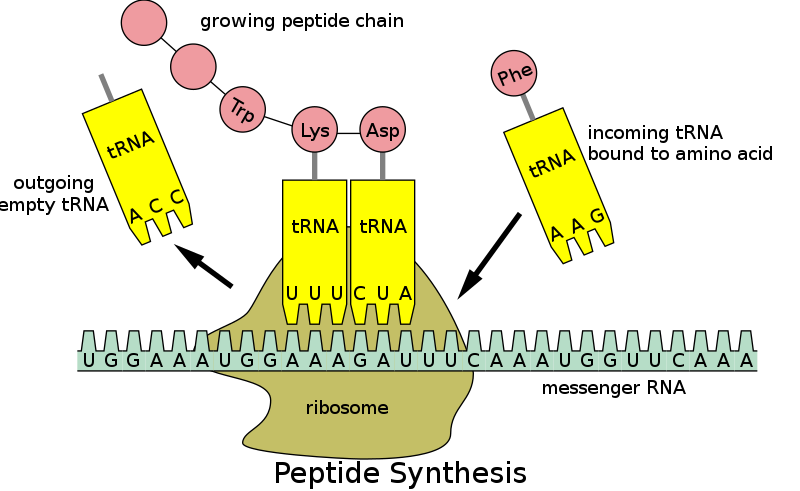
transfer RNA
adaptor molecule composed of RNA, typically 76–90 nucleotides, that carries amino acids to the ribosome as directed by codons in mRNA

ribozyme
thumb|3D structure of a hammerhead ribozyme

ribosomal RNA
RNA component of the ribosome, essential for protein synthesis in all living organisms

RNA polymerase
class of enzymes that synthesize RNA from a DNA template
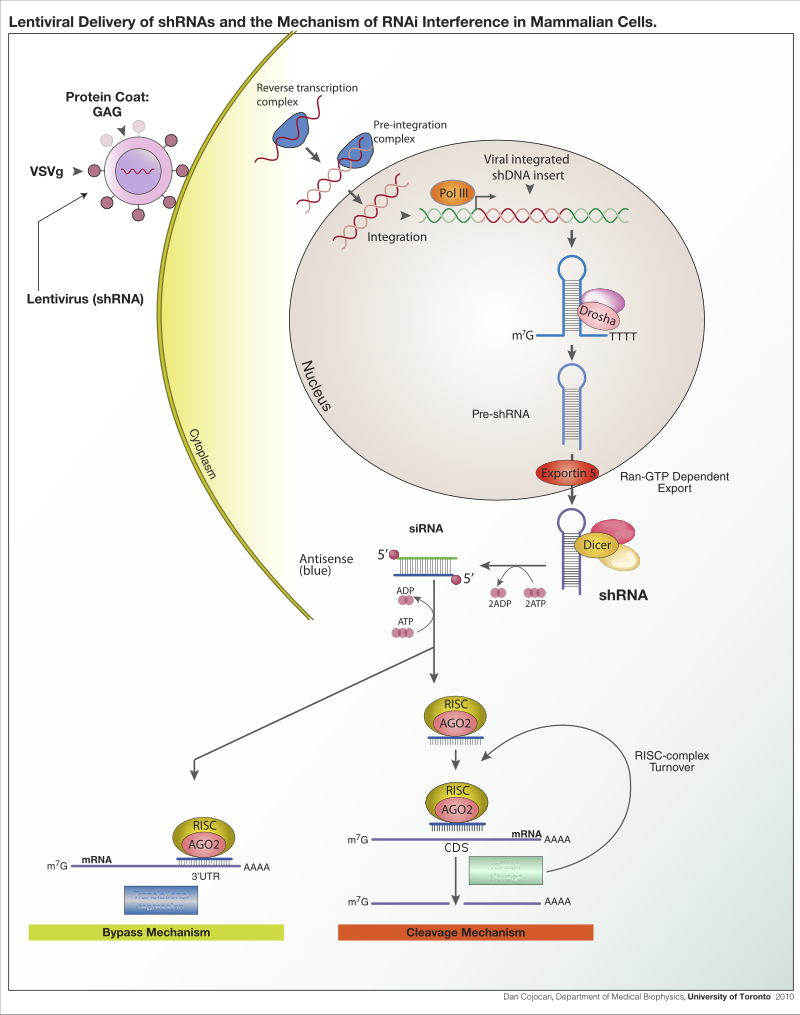
RNA interference
any process of posttranscriptional gene inactivation mediated by small RNA molecules that may trigger mRNA degradation or down-regulate translation
RNA world hypothesis
hypothetical phase of the history of life, in which self-replicating RNA proliferated
nucleotide base
nitrogen-containing biological compounds that form nucleosides

RNA viruses
subclass of viruses
RNA vaccine
vaccine that transfects synthetic RNA, reprogramming cells to make foreign protein that stimulates an adaptive immune response

microRNA
thumb|400px|Pre-miRNA instead of Pri-miRNA in the first point of mechanism. Diagram of microRNA (miRNA) action with mRNA
thumb|400px|Examples of miRNA hairpins (stem-loops), with the mature miRNAs shown in red
nucleic acid sequence
succession of letters that indicate the order of nucleotides within a DNA (using GACT) or RNA (GACU) molecule
small interfering RNA
biomolecule
non-coding RNA
class of RNA that is not translated into proteins
regulation of gene expression
process that modulates frequency, rate or extent of gene expression
small nuclear RNA
class of RNA molecules, found in splicing speckles and Cajal bodies, about 150 nucleotides long
directionality
End-to-end chemical orientation of a single strand of nucleic acid
post-transcriptional modification
processes by which an RNA primary transcript is chemically altered to produce a functional RNA molecule
RNA modification
covalent alteration of one or more nucleotides within an RNA molecule to produce an RNA molecule with a sequence that differs from that coded genetically
untranslated region
Non-coding regions on either end of mRNA
exosome (RNase complex)
multi-protein intracellular complex capable of degrading various types of RNA molecules

ribonucleotide
In biochemistry, a ribonucleotide is a nucleotide containing ribose as its pentose component. It is considered a molecular precursor of nucleic acids. Nucleotides are the basic building blocks of DNA and RNA. Ribonucleotides themselves are basic monomeric building blocks for RNA. Deoxyribonucleotides, formed by reducing ribonucleotides with the enzyme ribonucleotide reductase (RNR), are essential building blocks for DNA. There are several differences between DNA deoxyribonucleotides and RNA ribonucleotides. Successive nucleotides are linked together via phosphodiester bonds.

transcriptome
The transcriptome is the set of all RNA molecules (transcripts) in a cell or a population of cells. It includes all of the functional RNA molecules and all other transcripts that may arise by spurious transcription or transcription of non-functional regions such as pseudogenes or virus fragments. A major goal of modern molecular biology is to determine which transcripts are functional and which ones are junk RNA.
sense
nature of the roles of nucleic acid molecules in specifying amino acids: DNA is positive-sense if an RNA version of the same sequence is translated or translatable into protein, negative-sense if not
gene silencing
process that prevents the expression of a gene
nucleic acid double helix
the structure formed by double-stranded molecules of nucleic acids such as DNA.

stem-loop
thumb|An example of an RNA stem-loop

G-quadruplex
thumb|400px |Structure of a G-quadruplex. Left: a G-tetrad. Right: an intramolecular G4 complex.
RNA-dependent RNA polymerase
enzyme that synthesizes RNA from an RNA template
precursor mRNA
Piwi-interacting RNA
largest class of small non-coding RNA molecules in animals
Small hairpin RNA
type of RNA

riboswitch
thumb|A 3D representation of the lysine riboswitch (Protein Data Bank|PDB code:3DIL, orange and blue tubes) bound to lysine (shown as grey, red and blue spheres in the upper middle of the structure)
In molecular biology, a riboswitch is a regulatory segment of a messenger RNA molecule that binds a small molecule, resulting in a change in production of the proteins encoded by the mRNA. Thus, an mRNA that contains a riboswitch is directly involved in regulating its own activity, in response to the concentrations of its effector molecule. The discovery that modern organisms use RNA to bind small
RISC complex
ribonucleoprotein complex central to RNA interference
transfer-messenger RNA
bifunctional RNA that has properties of a tRNA and an mRNA
long non-coding RNA
non-protein coding transcripts longer than 200 nucleotides
small nucleolar RNA
class of small RNA molecules that guide chemical modifications of other RNAs
obelisk
viroid-like element
small nuclear ribonucleoproteins
snRNPs (pronounced "snurps"), or small nuclear ribonucleoproteins, are RNA-protein complexes that combine with unmodified pre-mRNA and various other proteins to form a spliceosome, a large RNA-protein molecular complex upon which splicing of pre-mRNA occurs. The action of snRNPs is essential to the removal of introns from pre-mRNA, a critical aspect of post-transcriptional modification of RNA, occurring only in the nucleus of eukaryotic cells.
Additionally, U7 snRNP is not involved in splicing at all, as U7 snRNP is responsible for processing the 3′ stem-loop of histone pre-mRNA.

pseudoknot
thumb|300px|This example of a naturally occurring pseudoknot is found in the RNA component of human telomerase. Sequence from Chen and Greider (2005).
thumb|300px|Three dimensional structure of almost the same pseudoknot from telomerase RNA. (A) sticks (B) backbone. The pdb-file is based on .
Colors: A U C G
__NOTOC__
A pseudoknot is a nucleic acid secondary structure containing at least two stem-loop structures in which half of one stem is intercalated between the two halves of another stem. The pseudoknot was first recognized in the turnip yellow mosaic virus in 1982. Pseudoknots fold into k

RNA sequencing
thumb|419x419px|Summary of RNA-Seq. Within the organism, genes are transcribed and (in a eukaryote|eukaryotic organism) spliced to produce mature mRNA transcripts (red). The mRNA is extracted from the organism, fragmented and copied into stable ds-cDNA (blue). The ds-cDNA is sequenced using high-throughput, short-read sequencing methods. These sequences can then be aligned to a reference genome sequence to reconstruct which genome regions were being transcribed. This data can be used to annotate where expressed genes are, their relative expression levels, and any alternative splice variants.
nucleic acid secondary structure
basepairing interactions within a single nucleic acid polymer or between two polymers, list of bases which are paired in a nucleic acid molecule
nucleic acid analogue
compound which is analogous (structurally similar) to naturally occurring RNA and DNA, used in medicine and in molecular biology research
nucleic acid structure
organization of DNA and RNA molecules at different scales
cis-regulatory element
type of regulatory sequence
three prime untranslated region
sequence at the 3' end of messenger RNA that does not code for product
five prime untranslated region
region of a messenger RNA
guide RNA
subtype of RNA involved in nucleic acids editing
Formose reaction
chemical reaction involving the formation of sugars from formaldehyde
nucleic acid tertiary structure
three-dimensional shape of a nucleic acid polymer

Orthornavirae
Orthornavirae is a kingdom of viruses that have genomes made of ribonucleic acid (RNA), including genes which encode an RNA-dependent RNA polymerase (RdRp). The RdRp is used to transcribe the viral RNA genome into messenger RNA (mRNA) and to replicate the genome. Viruses in this kingdom share a number of characteristics which promote rapid evolution, including high rates of genetic mutation, recombination, and reassortment.
mRNA trans splicing, via spliceosome
'''Trans-splicing''' is a special form of RNA processing where exons from two different primary RNA transcripts are joined end to end and ligated. It is usually found in eukaryotes and mediated by the spliceosome, although some bacteria and archaea also have "half-genes" for tRNAs.
Spiegelman's Monster
term
T7 RNA polymerase
class of enzymes
primary transcript
RNA produced by transcription
Ribonuclease III
class of enzymes
nucleoside-modified messenger RNA
chemically modified messenger RNA
list of RNAs
Wikimedia list article