Category
page 1Rodent families

Muridae
The Muridae, or murids, are either the largest or second-largest family of rodents and of mammals, containing approximately 870 species, including many species of mice, rats, and gerbils found naturally throughout Eurasia, Africa, and Australia.

Cricetidae
The Cricetidae are a family of rodents in the large and complex superfamily Muroidea. It includes true hamsters, voles, lemmings, muskrats, and New World rats and mice. At over 870 species, it is either the largest or second-largest family of mammals, and has members throughout the Americas, Europe and Asia.
.jpg)
Caviidae
Caviidae, the cavy family, is composed of rodents native to South America and includes the domestic guinea pig, wild cavies, and the largest living rodent, the capybara. They are found across South America in open areas from moist savanna to thorn forests or scrub desert. This family of rodents has fewer members than most other rodent families, with 19 species in seven genera in three subfamilies.

Spalacidae
The Spalacidae, or spalacids, are a family of rodents in the large and complex superfamily Muroidea. They are native to eastern Asia, the Horn of Africa, the Middle East, and southeastern Europe. It includes the blind mole-rats, bamboo rats, mole-rats, and zokors. This family represents the oldest split (excluding perhaps the Platacanthomyidae) in the muroid superfamily, and comprises animals adapted to a subterranean way of life. These rodents were thought to have evolved adaptations to living underground independently until recent phylogenetic studies demonstrated they form a monophyletic gr

Heteromyidae
Heteromyidae is a family of rodents consisting of kangaroo rats, kangaroo mice, pocket mice and spiny pocket mice. Most heteromyids live in complex burrows within the deserts and grasslands of western North America, though species within the genus Heteromys are also found in forests and their range extends as far south as northern South America. They feed mostly on seeds and other plant parts, which they carry in their fur-lined cheek pouches to their burrows.

Chinchillidae
The family Chinchillidae is in the order Rodentia and consists of the chinchillas, the viscachas, and their fossil relatives. This family is restricted to southern and western South America, mostly living in mountainous regions of the Andes, except one species living on plains. They are medium to large-sized rodents, weighing from to , with strong hind legs and large ears and a bushy tail. All species have thick, soft fur, which is considered valuable in some cultures.
Dasyproctidae
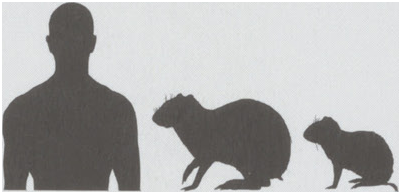
Dasyproctidae, from Ancient Greek δασύς (dasús), meaning "hair", and πρωκτός (prōktós), meaning "anus", is a family of large South American rodents, comprising the agoutis and acouchis. Their fur is a reddish or dark colour above, with a paler underside. They are herbivorous, often feeding on ripe fruit that falls from trees. They live in burrows, and, like squirrels, will bury some of their food for later use.
%20(cropped).jpg)
Castoridae
Castoridae is a family of rodents that contains the two living species of beavers and their fossil relatives. A formerly diverse group, only a single genus is extant today, Castor. Two other genera of "giant beavers", Castoroides and Trogontherium, became extinct in the Late Pleistocene.
Octodontidae
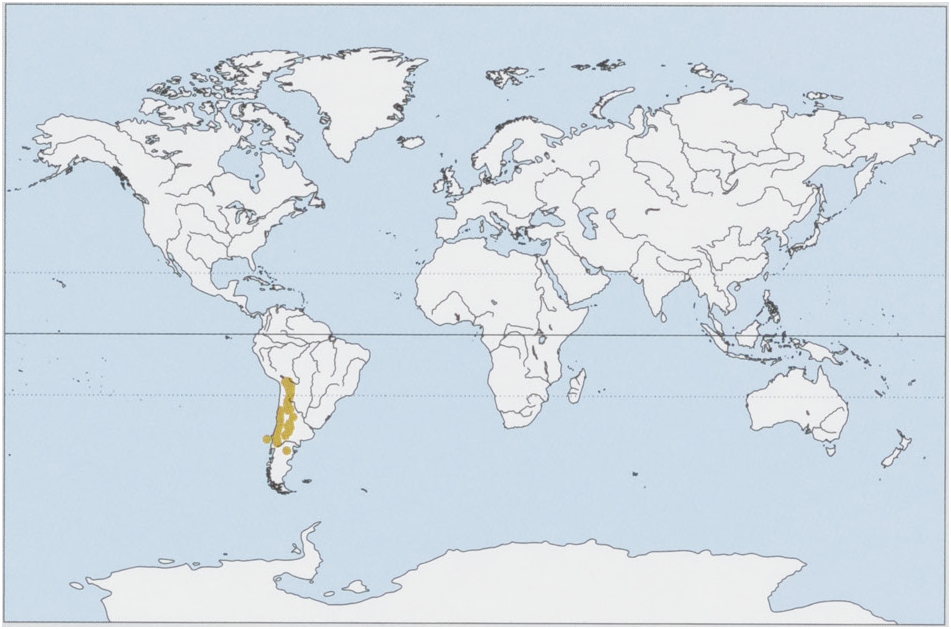
Octodontidae, from Ancient Greek ὀκτώ (oktṓ), meaning "eight", and ὀδούς (odoús), meaning "tooth", is a family of rodents, restricted to southwestern South America. Fourteen species of octodontid are recognised, arranged in seven genera. The best known species is the common degu, Octodon degus.

Echimyidae
thumb|right|Armored rat, Hoplomys gymnurus
thumb|right|White-tailed olalla rat, Olallamys albicauda
thumb|right|Red-crested tree rat, Santamartamys rufodorsalis
Nesomyidae
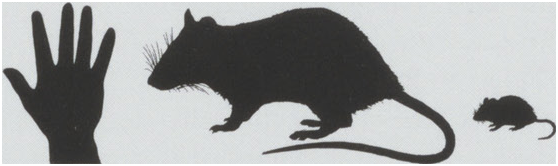
The Nesomyidae are a family of African rodents in the large and complex superfamily Muroidea. It includes several subfamilies, all of which are native to either continental Africa or to Madagascar. Included in this family are Malagasy rodents, climbing mice, African rock mice, swamp mice, pouched rats, and the white-tailed rat.
Platacanthomyidae
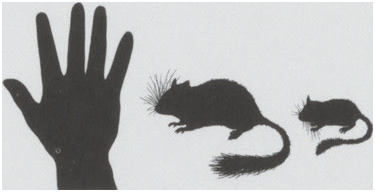
The rodent family Platacanthomyidae, or Oriental dormice, includes the spiny dormice and the Chinese pygmy dormice. In spite of their appearance, these animals are not true dormice, but are part of the large and complex superfamily Muroidea. The platacanthomyids can be distinguished from the true dormice, because they have no premolars, giving them three cheek teeth, like their relatives, the Muroidea.

Dinomyidae
The Dinomyidae are a family of South American hystricognath rodents: the dinomyids were once a very speciose group, but now contain only a single living species, the pacarana. Several of the extinct dinomyids were among the largest rodents known to date; these included the bison-sized Josephoartigasia monesi and the smaller Josephoartigasia magna. The dinomyids are thought to have occupied ecological niches associated with large grazing mammals due to their ability to compete with the native ungulates of South America. Conversely, they could feed on aquatic or swampy plants along the ancient r

Pedetidae
The Pedetidae are a family of rodents. The two living species, the springhares, are distributed throughout much of Southern Africa and also around Kenya, Tanzania, and Uganda. Fossils have been found as far north as Turkey. Together with the anomalures and zenkerella, Pedetidae forms the suborder Anomaluromorpha. The fossil genus Parapedetes is also related.
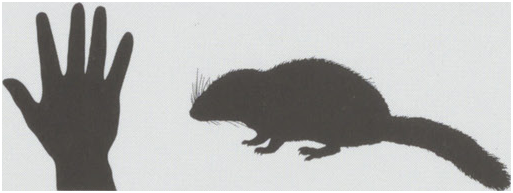
Diatomyidae
Diatomyidae is a family of hystricomorph rodents. It is represented by a single living species, Laonastes aenigmamus, native to Laos in Southeast Asia. Fossil species are known from the Oligocene and Miocene of Asia and eastern Europe.
Olallamys
Olallamys is a genus of Andean soft-furred spiny rat that range from Panama through Colombia and Venezuela to northern Ecuador. These species are typically found at elevations above .
Aplodontiidae
The family Aplodontiidae also known as Aplodontidae, Haplodontiidae or Haploodontini is traditionally classified as the sole extant family of the infraorder Protrogomorpha. It may be the sister family of the Sciuridae.
There are fossils from the Oligocene until Miocene in Asia, from Oligocene in Europe and from the Oligocene until the present in North America, where there is the only living species: the mountain beaver (Aplodontia rufa).
Thryonomyidae
Thryonomyidae is a family of hystricognath rodents that contains the cane rats (Thryonomys) found throughout sub-Saharan Africa, and a number of fossil genera.

jumping mice
Zapodidae, the jumping mice, is a family of mouse-like rodents in North America and China.
Petromuridae
Petromuridae is a family of hystricognath rodents that contains the dassie rat (Petromus typicus) of southwestern Africa, the only extant member of this group.
Calomyscidae
REDIRECT mouse-like hamster
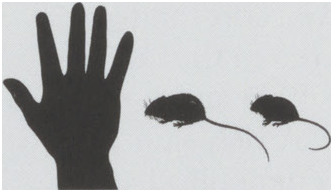
Sminthidae
Sminthidae is a family of mouse-like jumping rodents. They are represented by only one extant genus, Sicista, represented by 19 species found throughout most of Eurasia, from central Europe east to Siberia, and south to southern China. However, they were much more diverse and had a much wider range in prehistory, having multiple genera and being found not only in Eurasia but also throughout North America, where they existed up to the early Pleistocene. They have a well-attested fossil record which dates as far back as the early Oligocene.