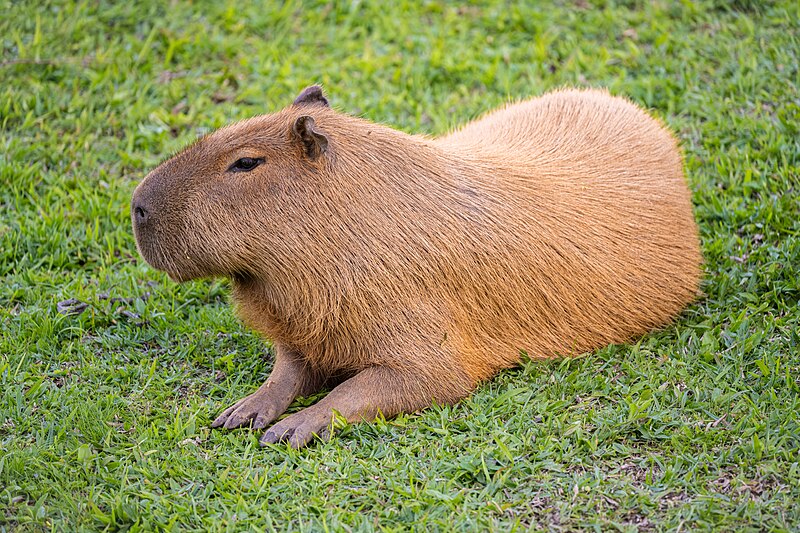
File:Hydrochoeris_hydrochaeris_in_Brazil_in_Petrópolis,_Rio_de_Janeiro,_Brazil_09.jpg · Wikimedia Commons · See Wikimedia Commons
Caviidae
Sign in to saveAlso known as Caviid, Caviids
Caviidae, the cavy family, is composed of rodents native to South America and includes the domestic guinea pig, wild cavies, and the largest living rodent, the capybara. They are found across South America in open areas from moist savanna to thorn forests or scrub desert. This family of rodents has fewer members than most other rodent families, with 19 species in seven genera in three subfamilies.
OverviewAI-generated
Caviidae is a family of mammals within the order Rodentia, class Mammalia, and phylum Chordata. It belongs to the kingdom Animalia and is governed by the International Code of Zoological Nomenclature. The family is classified under the superfamily Cavioidea and the suborder Hystricognathi. Its scientific name is Caviidae, with the taxon rank of family.
The temporal range for this family begins in the Middle Miocene. The taxon status is accepted, with the authority cited as Waterhouse, 1839. Records associated with Caviidae have been documented in Argentina, Bolivia, Colombia, and the United States. These records are held by institutions including MCZ, AMNH, UCMP, and UF.
Synthesized by Vinony from 33 facts across 6 sources: Wikidata, GBIF, Gbif Occ, iDigBio, WoRMS, Vinony graph. Generated from structured data (not the Wikipedia text) and checked against those facts — may still contain errors.
Species
Caviidae
FAMILY
- KingdomAnimalia
- PhylumChordata
- ClassMammalia
- OrderRodentia
- FamilyCaviidae
取自“https://zh.wikipedia.org/w/index.php?title=豚鼠科&oldid=45537514” 分类:豚鼠科隐藏分类:物种微格式条目含有拉丁語的條目
via GBIF
Museum specimens
- Specimen records
- 93
- With media
- 10
- Family
- Caviidae
- Collections
- MCZ, AMNH, UCMP, UF
- Recorded in
- Argentina, Bolivia, Colombia, United States
Wikidata facts
Show 8 more facts
- Commons category
- Caviidae
- taxon rank
- family
- Code of nomenclature
- International Code of Zoological Nomenclature
- taxon name
- Caviidae
- topic's main category
- Category:Cavies
- Commons gallery
- Caviidae
- vocalized name
- קַּבְיָתִיִּים
- temporal range start
- Middle Miocene
Sources (2)
via Wikidata · CC0
~3 min read
Encyclopedic overview
3 sectionsContents
- Characteristics
- Classification
- References
Caviidae, the cavy family, is composed of rodents native to South America and includes the domestic guinea pig, wild cavies, and the largest living rodent, the capybara. They are found across South America in open areas from moist savanna to thorn forests or scrub desert. This family of rodents has fewer members than most other rodent families, with 19 species in seven genera in three subfamilies.
==Characteristics== thumb|left|Guinea pig skull on top of a capybara skull With the exception of the maras, which have a more rabbit-like appearance, caviids have short, heavy bodies and large heads. Most have no visible tails. They range in size from the smaller cavies at 22 cm in body length, and 300 grams in weight, up to the capybara, the largest of all rodents at 106 to 134 cm in length, and body weights of 35 to 66 kilograms. Even larger forms existed in the Pliocene, such as Phugatherium, which was about the size of a tapir.
Excerpted from Wikipedia’s “Caviidae” article, available under the CC BY-SA 4.0 licence.