Category
page 1Roman quaestors

Cicero
Marcus Tullius Cicero ( , ; 3 January 106 BC – 7 December 43 BC) was a Roman statesman, lawyer, scholar, philosopher, orator, and writer who tried to uphold principles during the political crises of the Roman Republic that led to the establishment of the Roman Empire. The extensive writings of Cicero include treatises on rhetoric, philosophy, and politics. He is considered one of Rome's greatest orators and prose stylists and the innovator of what became known as "Ciceronian rhetoric". Cicero was educated in Rome and in Greece. He came from a wealthy municipal () family of the Roman

Caligula
Gaius Julius Caesar Augustus Germanicus (31 August AD 12 – 24 January AD 41), also called Gaius and Caligula (), was Roman emperor from AD 37 until his assassination in AD 41. He was the son of the Roman general Germanicus and Augustus' granddaughter Agrippina the Elder, members of the first ruling family of the Roman Empire. He was born two years before Tiberius became emperor. Gaius accompanied his father, mother and siblings on campaign in Germania, at little more than four or five years old. He had been named after Gaius Julius Caesar, but his father's soldiers affectionately nicknamed him

Tiberius
Tiberius Julius Caesar Augustus ( ; 16 November 42 BC – 16 March AD 37) was Roman emperor from AD 14 until 37. He succeeded his stepfather Augustus, the first Roman emperor. Tiberius was born in Rome in 42 BC to politician Tiberius Claudius Nero and his wife, Livia Drusilla. In 38 BC, Livia divorced Nero and married Augustus. Following the untimely deaths of Augustus's two grandsons and adopted heirs, Gaius and Lucius Caesar, Tiberius was designated Augustus's successor. Prior to this, Tiberius had proved himself an able diplomat and one of the most successful Roman generals. His conquests of

Vespasian
Vespasian (; ; 17 November 9 AD – 23 June 79) was Roman emperor from 69 to 79. The last emperor to reign in the Year of the Four Emperors, he founded the Flavian dynasty, which ruled the empire for 27 years. His fiscal reforms and consolidation of the empire brought political stability and an extensive building program.
.png)
Hadrian
Hadrian ( ; born Publius Aelius Hadrianus, 24 January 76 – 10 July 138) was Roman emperor from 117 to 138. Hadrian was born in Italica, in the present-day Andalusian province of Seville in southern Spain, an Italic settlement in Hispania Baetica; his gens Aelia came from the town of Hadria in eastern Italy. He was a member of the Nerva–Antonine dynasty.
.png)
Titus
Titus Flavius Vespasianus (; 30 December 39 – 13 September 81 AD) was Roman emperor from 79 to 81 AD. A member of the Flavian dynasty, Titus succeeded his father Vespasian upon his death, becoming the first Roman emperor ever to succeed his biological father.

Antoninus Pius
15th Roman Emperor (138–161)
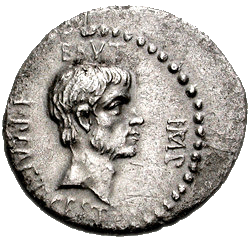
Marcus Junius Brutus
assassin of Julius Caesar
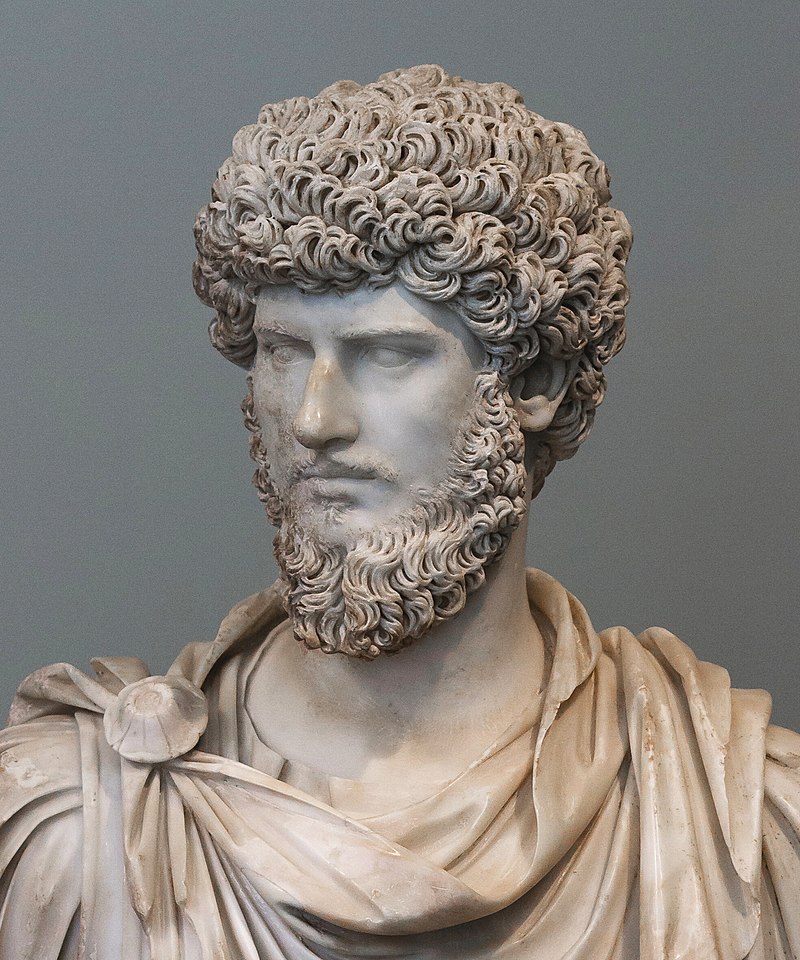
Lucius Verus
joint Roman Emperor with Marcus Aurelius (161–169)
.jpg)
quaestor
A quaestor ( , ; ; "investigator") was a public official in ancient Rome. There were various types of quaestors, with the title used to describe greatly different offices at different times.

Gaius Cassius Longinus
ancient Roman politician, known for his role in the assassination of Julius Caesar

Gaius Gracchus
ancient Roman politician

Quintus Sertorius
Roman rebel leader (Sertorian War)

Quintus Aurelius Symmachus
consul of the Roman Empire 391, orator (340-402)
Avidius Cassius
Roman general and usurper (c. 130–175)

Gaius Terentius Varro
Roman consul 216 BC
Tiberius Claudius Nero
father of Roman emperor Tiberius
Lucius Appuleius Saturninus
Roman populist and tribune (died 100 BC)
Faustus Cornelius Sulla
son of the Roman dictator Sulla
Gaius Sosius
1st-century BC Roman general and politician
Gnaeus Cornelius Lentulus Marcellinus
Roman consul of 56 BC
Lucius Cornelius Balbus the Younger
Roman general and writer
Gaius Flavius Fimbria
praefectus equitum 87 BC
Gaius Norbanus
Roman consul 83 BC
Gaius Flaminius
politician
Gnaeus Cornelius Lentulus
Roman consul 201 BC
Lucius Valerius Potitus
Roman consul 483 BC

Potitus Valerius Messalla
Roman suffect consul 29 BC
Gaius Julius Caesar Strabo Vopiscus
Roman senator, orator and poet (c. 131 – 87 BC)
Gaius Rubellius Blandus
1st century AD Roman politician and senator
Quintus Fabius Labeo
Roman consul 183 BC
Helvidius Priscus
Roman philosopher and statesman
Quintus Servilius Caepio
quaestor in 103 BC
Quintus Cassius Longinus
tribune of the plebs in 49 BC and supporter of Julius Caesar
Publius Vitellius the Elder
ancient Roman Procurator
Marcus Licinius Crassus
quaestor 54 BC
Gaius Cassius Parmensis
1st century BC Roman politician and writer
Caeso Fabius Ambustus
Late-5th/early-4th century BC Roman politician and soldier
Gaius Cornelius
Roman Republic tribune of the plebs in 67 BC

Marcus Pontius Laelianus Larcius Sabinus
2nd century Roman senator, general and consul
Gnaeus Pinarius Cornelius Severus
Roman consul suffectus in 112
Marcus Marius
first century BC Roman quaestor and general
Flavius Liberalis
1st century AD Roman equite, quaestor