Category
page 1Rotational symmetry
.png)
swastika
thumb|The swastika is a symbol with many styles and meanings and has been used in many cultures and religions around the world for millennia.
thumb|The Cultural appropriation|appropriation of the swastika by the [[Nazi Party (1920–1945) is the most recognisable modern usage of the symbol in the Western world.]]

spin
intrinsic form of angular momentum as a property of quantum particles

angular velocity
physical quantity defined as the rate of change of angular position whose direction is (if regarded as a vector) the axis of rotation

triskelion
thumb|Neolithic triple-spiral symbol
.jpg)
triptych
thumb|330px|Triptych of the The Elevation of the Cross (Rubens)|Raising of the Cross, Rubens, 1610–11, Antwerp Cathedral
A triptych ( ) is a work of art (usually a panel painting) that is divided into three sections, or three carved panels that are hinged together and can be folded shut or displayed open. It is therefore a type of polyptych, the term for all multi-panel works. The middle panel is typically the largest and flanked by two smaller related works, although there are triptychs of equal-sized panels. The form can also be used for pendant jewelry.

rigid body
idealization of a solid body in which deformation is neglected (distance between any two given points of a rigid body remains constant in time regardless of external forces exerted on it)

ambigram
thumb|Animation of a half-turn ambigram of the word ambigram, with 180-degree rotational symmetry
An ambigram is a calligraphic composition of glyphs (letters, numbers, symbols or other shapes) that can yield different meanings depending on the orientation of observation. Most ambigrams are visual palindromes that rely on some kind of symmetry, and they can often be interpreted as visual puns.
Although the concept is older, the term "ambigram" was coined by Douglas Hofstadter in 1983–1984.
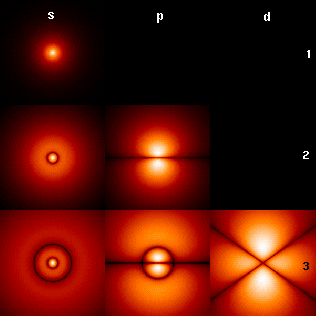
azimuthal quantum number
quantum number for an atomic orbital that determines its orbital angular momentum and describes the shape of the orbital, and is symbolized as ℓ
Pauli matrices
matrices important in quantum mechanics and the study of spin

hexagram
[[File:Regular_hexagon_as_intersection_of_two_triangles.png|thumb|A regular hexagram, [[List_of_regular_polytopes_and_compounds#Two_dimensional_compounds|{6}[2{3}]{6}]], can be seen as a compound composed of an upwards (blue here) and downwards (pink) facing equilateral triangle, with their intersection as a regular hexagon (in green).]]
rotation
congruent transformation of a geometric space that preserves at least one point
magnetic quantum number
third in a set of four quantum numbers that distinguishes the orbitals available within a subshell and can be used to calculate the azimuthal component of the orientation of orbital in space
spherical harmonic
special function over the surface of a sphere
Armenian eternity sign
ancient Armenian national symbol and a symbol of the national identity of the Armenian people
Laplace–Runge–Lenz vector
vector used chiefly to describe the shape and orientation of the orbit of one astronomical body around another, such as a planet revolving around a star
spin quantum number
quantum number parameterizing spin and angular momentum
rotational symmetry
symmetry (something looking the same) under rotation

triquetra
right|thumb|Interlaced triquetra which is a trefoil knot
The triquetra ( ; from the Latin adjective triquetrus "three-cornered") is a triangular figure composed of three interlaced arcs, or (equivalently) three overlapping vesicae piscis lens shapes. It is used as an ornamental design in architecture, and in medieval manuscript illumination (particularly in the Insular tradition). Its depiction as interlaced is common in Insular ornaments from about the 7th century. In this interpretation, the triquetra represents the topologically simplest possible knot.
thumb|Comparison of associated Reuleau
angular momentum operator
quantum mechanical operator related to rotational symmetry

Borjgali
A borjgali () is a Georgian symbol of the sun and eternity. The Borjgali is often represented with seven rotating wings over the tree of life which can be used to create various shapes and variations and is considered one of the main symbols of Georgian culture.
.svg)
yin-yang
In Chinese philosophy, a taijitu () is a symbol or diagram () representing taiji () in both its monist (wuji) and its dualist (yin and yang) forms. A taijitu in application provides a deductive and inductive theoretical model. Such a diagram was first introduced by Neo-Confucian philosopher Zhou Dunyi of the Song Dynasty in his Taijitu shuo ().
Clebsch–Gordan coefficient
coefficients in angular momentum eigenstates of quantum systems
rotation group SO(3)
group of rotations in 3 dimensions
triplet state
quantum state of a system with a spin of quantum number s =1, such that there are three allowed values of the spin component, ms = −1, 0, and +1
total angular momentum quantum number
quantum number describing the total angular momentum of an atom
rigid body dynamics
study of systems of undeformable bodies under applied forces and how they change with time
tetrahedral symmetry
3D symmetry group
octahedral symmetry
3D symmetry group

Wigner 3-j symbol
coefficients coupled with angular momentum
Wigner D-matrix
irreducible representation of the rotation group SO
intersystem crossing
excited state dynamic in chemistry and physics
6-j symbol
sum of multiples of four 3j symbols
icosahedral symmetry
full icosahedral symmetry
three hares
traditional motif showing three hares sharing ears
doublet state
mixed quantum state of a system with a spin of 1/2, such that there are two allowed values of the spin component, −1/2 and +1/2
Gankyil
thumb|upright|Gankyil Unicode symbol (U+0FCB), ࿋, as rendered in Jomolhari (typeface)|Jomolhari font.
angular momentum coupling
coupling in quantum physics
rotational invariance
function defined on an inner product space is said to have rotational invariance if its value does not change when arbitrary rotations are applied to its argument
9-j symbol
symbol used in quantum mechanics
Hexafoil
thumb|A geometrical hexafoil
multiplet
In physics and particularly in particle physics, a multiplet is the state space for 'internal' degrees of freedom of a particle; that is, degrees of freedom associated to a particle itself, as opposed to 'external' degrees of freedom such as the particle's position in space. Examples of such degrees of freedom are the spin state of a particle in quantum mechanics, or the color, isospin and hypercharge state of particles in the Standard Model of particle physics. Formally, we describe this state space by a vector space which carries the action of a group of continuous symmetries.