Category
page 1Search engine optimization
World Wide Web
global system of interlinked hypertext documents accessed via the Internet
search engine optimization
practice and strategies of increasing online visibility in search engine results pages

PageRank
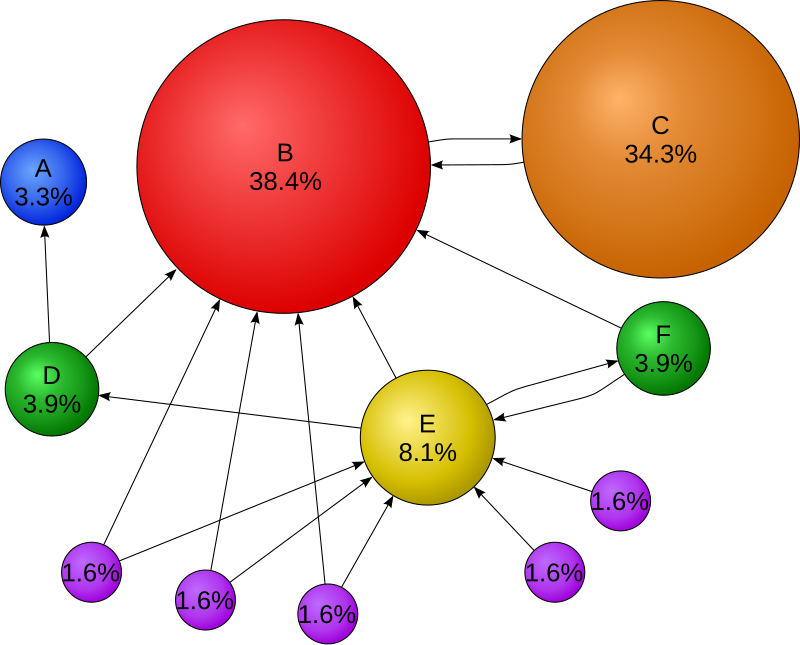
thumb|upright=1.35|An animation of the PageRank algorithm running on a small network of pages. The size of the nodes represents the perceived importance of the page, and arrows represent hyperlinks.
thumb|upright=1.35|A simple illustration of the Pagerank algorithm. The percentage shows the perceived importance, and the arrows represent hyperlinks.
PageRank (PR) is an algorithm used by Google Search to rank web pages in their search engine results. It is named after both the term "web page" and co-founder Larry Page. PageRank is a way of measuring the importance of website pages. According to
pay-per-click
Pay-per-click (PPC) is an online advertising model in which advertisers pay a publisher—typically a search engine or website—each time a user clicks on an advertisement.
web directory
catalogue of websites itself published on the internet
robots.txt
robots.txt is the filename used for implementing the Robots Exclusion Protocol, a standard used by websites to indicate to visiting web crawlers and other web robots which portions of the website they are allowed to visit.
nofollow
nofollow is a setting on a web page hyperlink that directs search engines not to use the link for page ranking calculations. It is specified in the page as a type of link relation; that is: <a rel="nofollow" ...>. Because search engines often calculate a site's importance according to the number of hyperlinks from other sites, the nofollow setting allows website authors to indicate that the presence of a link is not an endorsement of the target site's importance.
link building
efforts to increase the number of high-quality links pointing to a website
landing page
a single web page that appears in response to clicking on a search engine optimized search result, marketing promotion, marketing email, or an online advertisement
generative engine optimization
digital marketing technique to improve visibility in generative AI search engines
site map
list of pages of a website
meta element
HTML element
anchor text
visible and clickable text in an HTML hyperlink
lead generation
the process of raising buyer interest and generating inquiries from prospective clients, often in the form of name and contact information
search engine results page
Pages displayed by search engines in response to a query. The main component of the SERP is the listing of results in response to a keyword query. Pages may also contain other sponsored results (search engine advertising).
content farm
website hosting a high volume of cheaply-produced content
Yandex Search
web search engine owned by Yandex
Google Panda
update of Google's search results ranking algorithm
Google Penguin
Google search engine algorithm update
link farm
group of websites that link to each other
Microdata
WHATWG HTML specification used to nest metadata within existing content on web. Similar to RDFa.

HubSpot
HubSpot, Inc. is a US-based developer and marketer of software products for marketing, sales, and customer service. HubSpot was founded by Brian Halligan and Dharmesh Shah in 2006. The global headquarters is in Cambridge, MA.
clean URL
URL intended to improve the usability and accessibility of a website or web service by being immediately and intuitively meaningful to non-expert users
RankBrain
RankBrain is a machine learning-based search engine algorithm, the use of which was confirmed by Google on 26 October 2015. It helps Google to process search results and provide more relevant search results for users. In a 2015 interview, Google commented that RankBrain was the third most important factor in the ranking algorithm, after links and content, out of about 200 ranking factors whose exact functions are not fully disclosed. , "RankBrain was used for less than 15% of queries". The results show that RankBrain guesses what the other parts of the Google search algorithm will pick as the
link exchange
confederation of websites that operates similarly to a web ring
Sandbox effect
proposed effect affecting search engine rankings

organic search
search results through unpaid search engine listings, rather than through paid advertisements
Semrush
Semrush Holdings, Inc. is an American public company that has a SaaS platform known as Semrush. The platform is used for keyword research, competitive analysis, site audits, backlink tracking, domain authority tracking, and online visibility insights. The keyword research tool provides various data points on each keyword. The platform also collects information about online keywords gathered from Google and Bing search engines. It was released by Boston-based company Semrush Inc, founded by Oleg Shchegolev and Dmitri Melnikov.
Google Hummingbird
search engine algorithm used by Google
noindex
The noindex value of an HTML robots meta tag requests that automated Internet bots avoid indexing a web page. It is also a value of the HTTP response header X-Robots-Tag. Reasons why one might want to use this meta tag include advising robots not to index a very large database, web pages that are very transitory, web pages that are under development, web pages that one wishes to keep slightly more private, or the printer and mobile-friendly versions of pages. Since the burden of honoring a website's noindex tag lies with the author of the search robot, sometimes these tags are ignored. Also th
AI Overviews
Google Search feature
keyword advertising
form of advertising on the Internet
performance-based advertising
advertising strategy
local search engine optimisation
process affecting the visibility of a website or a web page in a web search engine's unpaid results
Google Lighthouse
open-source, automated tool for measuring the quality of web pages
App store optimization
process of improving the visibility of a mobile app in an app store
User Intent
Web search optimisation algorithms
canonical link element
type of hyperlink
keyword density
percentage of times a keyword or phrase appears on a web page compared to the total number of words on the page
AI Mode
feature of Google Search
duplicate content
content that appears on more than one web page
paid inclusion
paid inclusion of a website in the database of a search engine or web catalog
hreflang
The rel="alternate" hreflang="x" link attribute is a HTML meta element described in RFC 8288. Hreflang specifies the language and optional geographic restrictions for a document. Hreflang is interpreted by search engines and can be used by webmasters to clarify the lingual and geographical targeting of a website.
keyword research
The process of finding popular and relevant search terms used by people searching online for a particular product, service or piece of information.
search neutrality
principle that search engines should have no editorial policies other than that their results be comprehensive, impartial and based solely on relevance
search engine privacy
subset of internet privacy that deals with user data being collected by search engines
discoverability
Discoverability is the degree to which something, especially a piece of content or information, can be found in a search of a file, database, or other information system. Discoverability is a concern in library and information science, many aspects of digital media, software and web development, and in marketing, since products and services cannot be used if people cannot find it or do not understand what it can be used for.
Yoast SEO
search engine optimization plugin for WordPress
domain authority
relevance for a specific subject area or industry of a website
search engine manipulation effect
term
SEO contest
Competition on search engines