Category
page 1Species made extinct by human activities

Dodo
The dodo (Raphus cucullatus) is an extinct flightless bird that was endemic to Mauritius, an island east of Madagascar in the Indian Ocean. The dodo's closest relative was the also-extinct and flightless Rodrigues solitaire. The two formed the subtribe Raphina, a clade of extinct flightless birds that are a part of the group that includes pigeons and doves (the family Columbidae). The closest living relative of the dodo is the Nicobar pigeon. A white dodo was once thought to have existed on the nearby island of Réunion, but it is now believed that this assumption was merely confusion based on

thylacine
The thylacine (; binomial name Thylacinus cynocephalus), also commonly known as the Tasmanian tiger or Tasmanian wolf, is an extinct species of carnivorous marsupial that was native to the Australian mainland and the islands of Tasmania and New Guinea. The thylacine died out in New Guinea and mainland Australia around 3,600–3,200 years ago, possibly because of the introduction of the dingo, whose earliest record dates to around the same time, but which never reached Tasmania. Prior to European settlement, around 5,000 remained in the wild on the island of Tasmania. Beginning in the nineteenth

aurochs
The aurochs (Bos primigenius; or ; pl.: aurochs or aurochsen; also ure or urus) is an extinct species of bovine, considered to be the wild ancestor of modern domestic cattle. With a shoulder height of up to in bulls and in cows, it was one of the largest herbivores in the Holocene; it had massive elongated and broad horns that reached in length.

Dinornithiformes
Moa (order Dinornithiformes) are an extinct group of flightless birds formerly endemic to New Zealand. During the Late Pleistocene-Holocene, there were nine species, in six genera. The two largest species, Dinornis robustus and Dinornis novaezelandiae, reached about in height with neck outstretched, and weighed about ; the smallest, the bush moa (Anomalopteryx didiformis), was about the size of a turkey. Estimates of the moa population when Polynesians settled New Zealand circa 1300 C.E. range from 58,000 to 2.5 million.

Great Auk
species of bird (extinct)
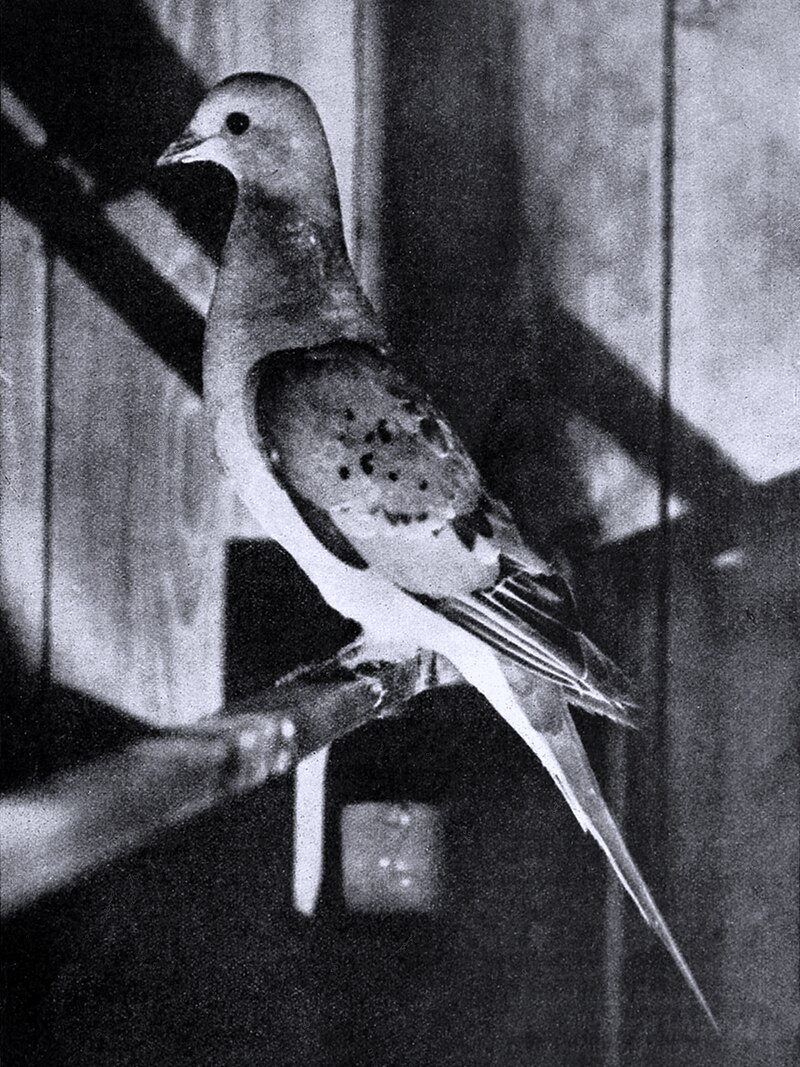
Passenger Pigeon
extinct species of North American pigeon, most abundant bird on Earth before extinction

quagga
The quagga ( or ) (Equus quagga quagga) is an extinct subspecies of the plains zebra that was endemic to South Africa until it was hunted to extinction in the late 19th century. It was long thought to be a distinct species, but mtDNA studies have supported it being a subspecies of plains zebra. A more recent study suggested that it was the southernmost cline or ecotype of the species.

Steller’s sea cow
species of extinct mammal

elephant bird
family of birds (subfossil)

Javan tiger
subspecies of mammal (fossil)

Equus ferus ferus
The tarpan (Equus ferus ferus) was a free-ranging horse population of the Eurasian steppe from the 18th to the 20th century. What qualifies as a tarpan is subject to debate; whether tarpans were genuine wild horses, feral domesticated horses, or hybrids is unclear, though DNA sequencing suggests that at least some tarpans were genetically distinct from modern domestic horses. The last individual believed to be a tarpan died in captivity in the Russian Empire in 1909.

Falkland Islands wolf
species of mammal

Haast's Eagle
extinct species of eagle
Caribbean monk seal
species of mammal (fossil)
Carolina Parakeet
extinct species of North American parrot
Chinese paddlefish
extinct large freshwater fish native to China
Cuban Macaw
species of bird
Ursus arctos crowtheri
subspecies of mammal
Holocene extinction
massive extinction event during the current Holocene geological epoch
Alaotra Grebe
species of bird
Schomburgk's deer
species of mammal (fossil)

huia
The huia ( ; ; Heteralocha acutirostris) is an extinct species of New Zealand wattlebird, endemic to the North Island of New Zealand. The last confirmed sighting of a huia was in 1907, although there was another credible sighting in 1924.
Japanese sea lion
species of mammal

Hippotragus leucophaeus
The bluebuck (Afrikaans: bloubok ) or blue antelope (Hippotragus leucophaeus) is an extinct species of antelope that lived in South Africa until around 1800. It was smaller than the other two species in its genus Hippotragus, the roan antelope and sable antelope. The bluebuck was sometimes considered a subspecies of the roan antelope, but a genetic study has confirmed it as a distinct species.
steppe bison
species of mammal (fossil)
Honshū wolf
extinct subspecies of mammal
New Zealand Quail
species of bird
Kauaʻi ʻŌʻō
extinct species of Moho songbird
Sea Mink
species of mammal
Norfolk Kaka
species of bird
Hokkaidō wolf
extinct subspecies of mammal
lesser bilby
species of extinct mammal
Notamacropus greyi
species of mammal

Formosan clouded leopard
subspecies of mammal
Atitlán Grebe
species of bird
Snail-eating Coua
species of bird
Colombian Grebe
species of bird

Stephens Island Wren
species of bird
Bramble Cay melomys
recently extinct species of rodent
Ursus arctos nelsoni
population of mammal

bushwren
The bushwren (Xenicus longipes), also known as the in the Māori language, is an extinct species of diminutive and nearly flightless bird that was endemic to New Zealand. It had three subspecies on each of the major islands of New Zealand, the North Island, South Island, and Stewart Island / Rakiura and nearby smaller islands. The species disappeared gradually after the introduction of invasive mammalian predators, last being seen on the North Island in 1955 and the South Island in 1968. Attempts were made to save the remaining population on small islands off Stewart Island, but they ultimately

Newton's parakeet
extinct species of bird
King Island emu
subspecies of the largest bird native to Australia
Guadalupe Caracara
species of bird
Mauritius Blue Pigeon
species of bird
Cape lion
subspecies of mammal (fossil)
Desert rat-kangaroo
species of mammal
Hawaiʻi ʻŌʻō
species of bird
Bishop's ʻŌʻō
species of bird
Kioea
The kioea or kiowea (Chaetoptila angustipluma) is an extinct species of Hawaiian honeyeater that was endemic to the islands of Hawaii before going extinct around the mid-19th century.

Arabian Ostrich
subspecies of large flightless bird
Broad-billed Parrot
species of bird (extinct)

Zənzibar leopard
subspecies of mammal
Bulldog Rat
species of mammal

Japanese otter
species of mammal
Wake Island Rail
species of bird
Hawai'i Mamo
species of bird
Canary Islands Oystercatcher
species of bird

Poʻouli
The poo-uli (Melamprosops phaeosoma) or Hawaiian black-faced honeycreeper is an extinct species of passerine bird that was endemic to the island of Maui in Hawaiʻi. It is considered to be a member of the Hawaiian honeycreepers, and is the only member of its genus Melamprosops. It had a black head, brown upper parts and pale gray underparts. This bird inhabited only the wetter, easternmost side of Maui, where it had rapidly decreased in numbers. With extinction threatening, efforts were made to capture birds to enable them to breed in captivity. These efforts were unsuccessful; in 2004, only tw
Round Island Burrowing Boa
species of reptile