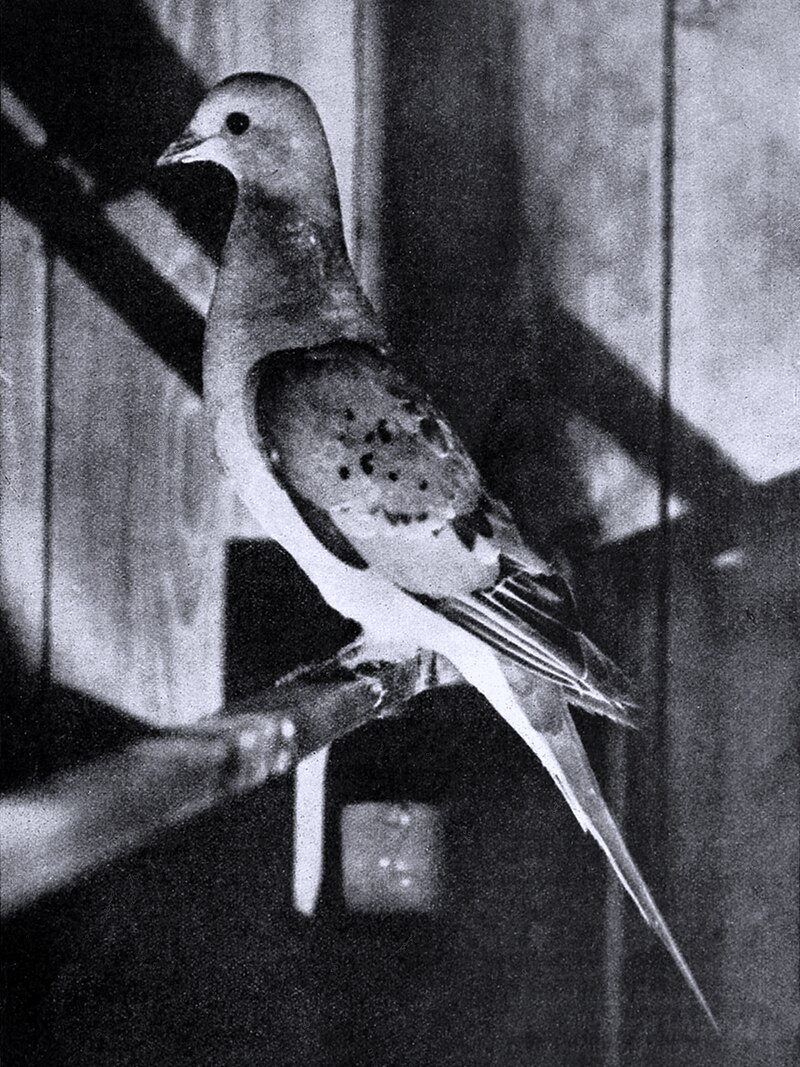
File:Bird_lore_(1913)_(14562557107).jpg · Wikimedia Commons · See Wikimedia Commons
Passenger Pigeon
Sign in to saveAlso known as Ectopistes migratorius, wild pigeon
extinct species of North American pigeon, most abundant bird on Earth before extinction
The Passenger Pigeon was a North American pigeon species that was once the most abundant bird on Earth before it went extinct. Its disappearance represents a dramatic example of how human activity can drive even the most numerous species to complete extinction.
AI-generated from the Wikipedia summary — may contain errors.
Wikidata facts
- Parent taxon
- Ectopistes
- Image
- Bird lore (1913) (14562557107).jpg
- Length
- 32
Show 11 more facts
- taxon rank
- species
- on focus list of Wikimedia project
- Wikipedia:Vital articles/Level/4
- IUCN conservation status
- extinct species
- taxon name
- Ectopistes migratorius
- Commons category
- Ectopistes migratorius
- Commons gallery
- Ectopistes migratorius
- taxon common name
- golub selac
- topic's main category
- Category:Ectopistes
- extinction date
- 1914-00-00
- start time
- 5333000-00
- short name
- E. migratorius
Sources (2)
via Wikidata · CC0
~40 min read
Encyclopedic overview
The passenger pigeon or wild pigeon (Ectopistes migratorius) is an extinct species of pigeon that was endemic to North America. Its common name is derived from the French word passager, meaning "passing by", due to the migratory habits of the species. The scientific name also refers to its migratory characteristics. The morphologically similar mourning dove (Zenaida macroura) was long thought to be its closest relative, and the two were at times confused, but genetic analysis has shown that the genus Patagioenas is more closely related to it than the Zenaida doves.
The passenger pigeon was sexually dimorphic in size and coloration. The male was 390 to 410 mm (15.4 to 16.1 in) in length, mainly gray on the upperparts, lighter on the underparts, with iridescent bronze feathers on the neck, and black spots on the wings. The female was 380 to 400 mm (15.0 to 15.7 in), and was duller and browner than the male overall. The juvenile was similar to the female, but without iridescence. It mainly inhabited the deciduous forests of eastern North America and was also recorded elsewhere, but bred primarily around the Great Lakes. The pigeon migrated in enormous flocks, constantly searching for food, shelter, and breeding grounds, and was once the most abundant bird in North America, numbering around 3 billion, and possibly up to 5 billion. A very fast flyer, the passenger pigeon could reach a speed of 100 km/h (62 mph). The bird fed mainly on mast, and also fruits and invertebrates. It practiced communal roosting and communal breeding, and its extreme gregariousness may have been linked with searching for food and predator satiation.
Excerpted from Wikipedia’s “Passenger Pigeon” article, available under the CC BY-SA 4.0 licence.
Gallery (12)
Available in 64 languages
- Español
- Français
- Deutsch
- 中文
- 日本語
- Русский
- Português
- Italiano
- العربية
- Afrikaans
- Asturian
- Bahasa Indonesia
- Balinese
- Basque
- Belarusian
- Bulgarian
- Catalan
- Cebuano
Show 45 more
- Czech
- Danish
- Egyptian Arabic
- Esperanto
- Filipino
- Finnish
- Galician
- Georgian
- Hebrew
- Hungarian
- Icelandic
- Ido
- Irish
- Javanese
- Kazakh
- Kotava
- Latin
- Latvian
- Lithuanian
- Malay
- Malayalam
- Nederlands
- Norwegian
- Norwegian Nynorsk
- Polski
- Romanian
- Rusyn
- Serbian
- simple
- Slovak
- Slovenian
- Svenska
- Tamil
- Tiếng Việt
- Türkçe
- Ukrainian
- Waray
- Welsh
- Western Frisian
- Western Panjabi
- Wu Chinese
- zh_yue
- فارسی
- ไทย
- 한국어
via Wikidata sitelinks · CC0