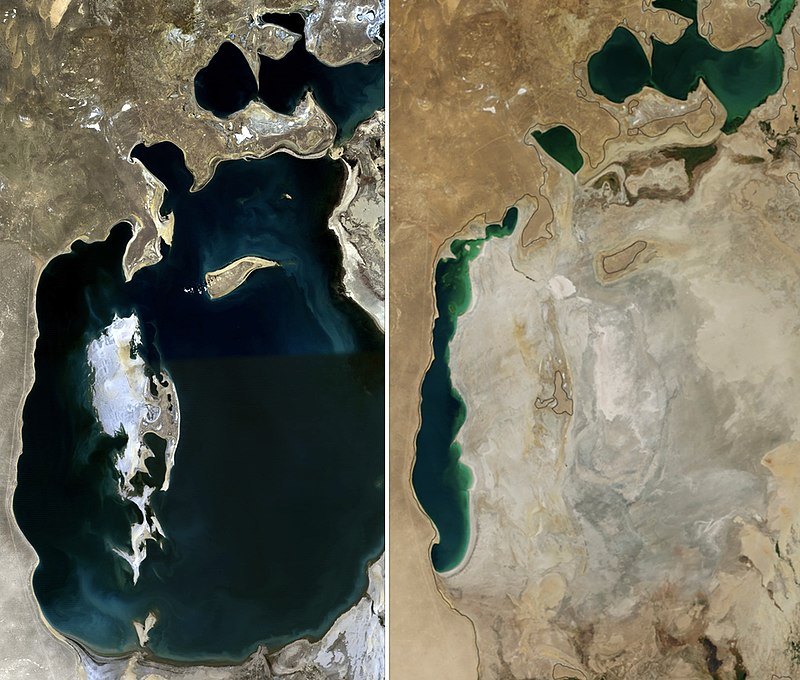
File:AralSea1989_2014.jpg · Wikimedia Commons · See Wikimedia Commons
Holocene extinction
Sign in to saveAlso known as Anthropocene extinction, sixth extinction
massive extinction event during the current Holocene geological epoch
Described at

Holocene extinction | Science | Research Starters | EBSCO Research
The Holocene extinction, also known as the Anthropocene extinction or the sixth mass extinction, refers to the ongoing loss of species primarily driven by human activities during the Holocene epoch, which began around 12,000 years ago. This period marks significant changes in human civilization, particularly following the advent of agriculture about 10,000 years ago, which allowed for larger populations and intensified land use. Scientists estimate that human actions threaten up to one million plant and animal species through activities such as deforestation, hunting, overfishing, and pollution, leading to an unprecedented rate of extinction. The natural extinction rate is typically one to five species per year; however, estimates suggest that dozens of species may be going extinct daily in the early 21st century. Habitat destruction is identified as the primary cause of this crisis, with vast areas of natural environments being converted for agriculture and urban development. The loss of biodiversity, which refers to the variety of life forms within a given ecosystem, is crucial for species survival, as it enables resilience against threats like disease and climate change. The decline in genetic diversity within species, such as the platypus, further exacerbates their vulnerability. Overall, the Holocene extinction highlights the critical intersection of human activity and ecological balance, raising urgent concerns about the future of global biodiversity.
ebsco.com →The Holocene extinction, also known as the Anthropocene extinction or the sixth mass extinction, refers to the ongoing loss of species primarily driven by human activities during the Holocene epoch, which began around 12,000 years ago. This period marks significant changes in human civilization, particularly following the advent of agriculture about 10,000 years ago, which allowed for larger populations and intensified land use. Scientists estimate that human actions threaten up to one million plant and animal species through activities such as deforestation, hunting, overfishing, and pollution, leading to an unprecedented rate of extinction. The natural extinction rate is typically one to five species per year; however, estimates suggest that dozens of species may be going extinct daily in the early 21st century. Habitat destruction is identified as the primary cause of this crisis, with vast areas of natural environments being converted for agriculture and urban development. The loss of biodiversity, which refers to the variety of life forms within a given ecosystem, is crucial for species survival, as it enables resilience against threats like disease and climate change. The decline in genetic diversity within species, such as the platypus, further exacerbates their vulnerability. Overall, the Holocene extinction highlights the critical intersection of human activity and ecological balance, raising urgent concerns about the future of global biodiversity. Deliberate extinction by genome modification: An ethical challenge.; Genomic signatures indicate biodiversity loss in an endemic island ant fauna.; Increasing applied pesticide toxicity trends counteract the global reduction target to safeguard biodiversity.; Integrating multiple evidence streams to understand insect biodiversity change.; Unifying spatial scaling laws of biodiversity and ecosystem stability. The Holocene extinction refers to the loss of species due to human activity during the Holocene epoch. It is also sometimes referred to as the Anthropocene extinction or the sixth mass extinction. The Holocene epoch began about 12,000 years ago at the end of the last ice age and continues into modern times. The development of agriculture, which began about 10,000 years ago, greatly changed human civilization and the planet, allowing larger populations of humans to affect ever-increasing areas of land. A mass extinction is defined as a period when at least 60 percent of extant genera become extinct within a few hundred thousand years. Extant refers to those living, while genera is the plural form of genus, the taxonomic rank of biological classification that is below family and above species. For example, the genus Homo includes modern humans ( Homo sapiens ) and their extinct close relatives, such as Homo neanderthalensis and Homo floresiensis . By the mid-2020s, some experts believed at least seventy-three genera had gone extinct since 1500 AD. While not all scientists agree, many believe a sixth mass extinction event is taking place in modern times. The last mass extinction occurred at the end of the Cretaceous Period, 65 million years ago. Scientists believe a large asteroid that struck the planet caused the fifth mass extinction, which resulted in the extinction of all non-avian dinosaurs and the eventual rise of mammals. The asteroid impact killed off about 76 percent of all species on the planet. Earlier mass extinctions have been caused by events such as enormous volcanic eruptions or global cooling. When the last ice age ended about 12,000 years ago, the warming climate caused large mammals, such as the mammoth, to become extinct. Humans who relied on these large animals for food had to turn to small game and plants. The world experienced a brief cold period a number of years later. These few years of a very cold climate greatly affected the smaller game and the plant materials available as food sources. When the climate warmed again, humans adapted yet ag
Excerpt from a page describing this subject · 29,262 chars · not written by Vinony
Wikidata facts
- Instance of
- extinction event
- Subclass of
- human impact on the environment
- Follows
- Quaternary extinction event
- Image
- Panel of the hemione.jpg
Show 10 more facts
- Commons category
- Holocene extinction
- facet of
- Great Acceleration
- topic's main category
- Category:Holocene extinctions
- start time
- 10000-00-0
- on focus list of Wikimedia project
- WikiProject Climate change
- different from
- Background extinction rate
- has contributing factor
- habitat destruction
- handled, mitigated, or managed by
- sustainability
- described at URL
- www.ebsco.com/research-starters/science/holocene-extinction
- has cause
- climate change
Sources (3)
via Wikidata · CC0
~40 min read
Encyclopedic overview
Marine extinction intensity during Phanerozoic
%
Excerpted from Wikipedia’s “Holocene extinction” article, available under the CC BY-SA 4.0 licence.