Category
page 1Taxa described in 1958
Charniodiscus
Charniodiscus is an Ediacaran fossil that in life was probably a stationary filter feeder that lived anchored to a sandy sea bed. The organism had a holdfast, stalk and frond. The holdfast was bulbous shaped, and the stalk was flexible. The frond was segmented and had a pointed tip. There were two growth forms: one with a short stem and a wide frond, and another with a long stalk, elevating a smaller frond about above the holdfast. While the organism superficially resembles the sea pens (cnidaria), it is probably not a crown-group animal.
Camarophyllopsis
Camarophyllopsis is a genus of agarics (gilled fungi) in the family Clavariaceae. Basidiocarps (fruit bodies) are dull-coloured and have dry caps, rather distant, decurrent lamellae, white spores, and smooth, ringless stems. In Europe species are characteristic of old, unimproved grasslands (termed waxcap grasslands) which are a declining habitat, making them of conservation concern.

Skeletocutis
Skeletocutis is a genus of about 40 species of poroid fungi in the family Polyporaceae. The genus has a cosmopolitan distribution, although most species are found in the Northern Hemisphere. It causes a white rot in a diverse array of woody substrates, and the fruit bodies grow as a crust on the surface of the decaying wood. Sometimes the edges of the crust are turned outward to form rudimentary bracket-like caps.
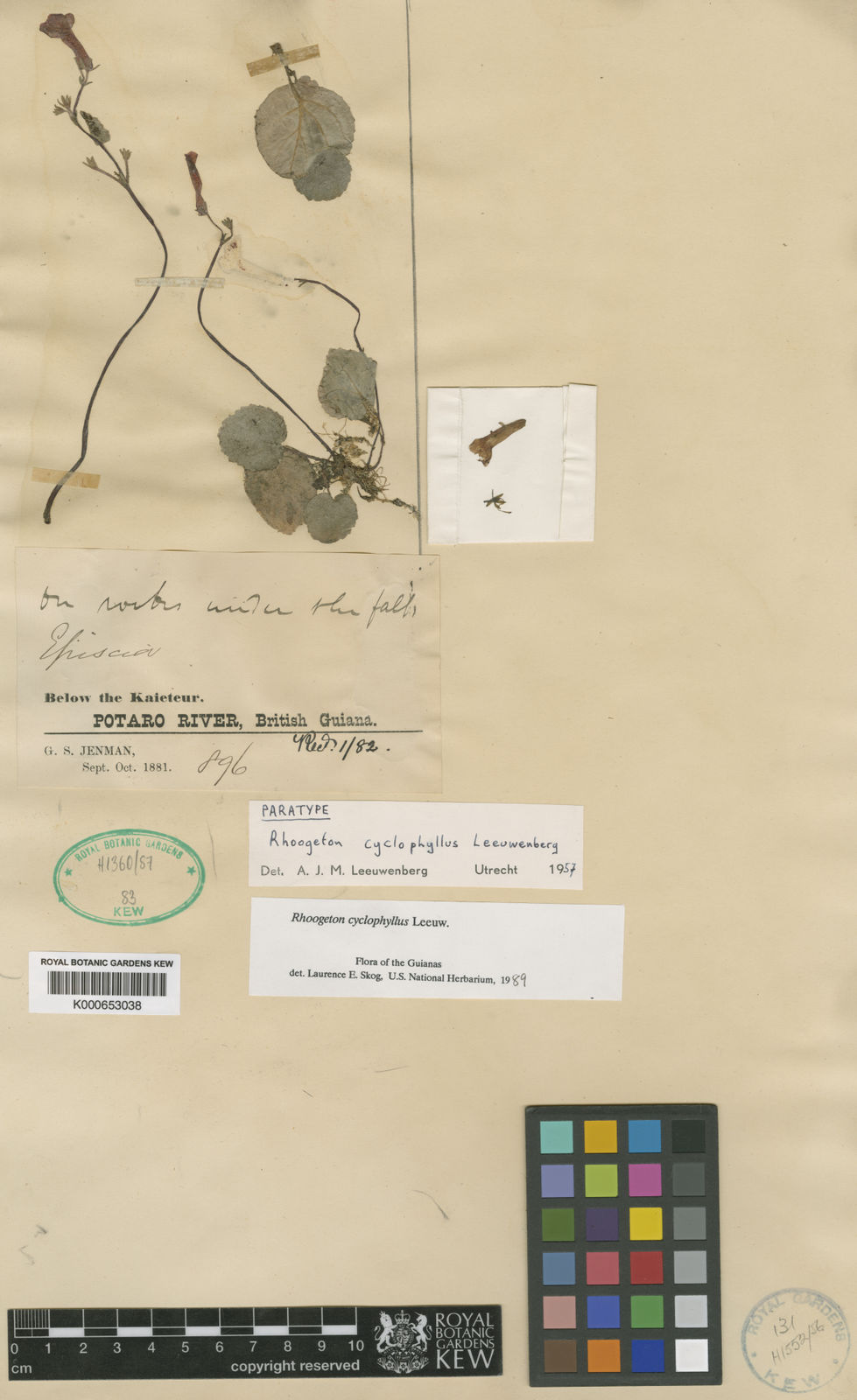
Rhoogeton
Rhoogeton is a genus of flowering plants belonging to the family Gesneriaceae.

Gliophorus
Gliophorus is a genus of agaric fungi in the family Hygrophoraceae. Gliophorus species belong to a group known as waxcaps in English, sometimes also waxy caps in North America or waxgills in New Zealand. In Europe, Gliophorus species are typical of waxcap grasslands, a declining habitat due to changing agricultural practices. As a result, two species, Gliophorus europerplexus and Gliophorus reginae, are of global conservation concern and are listed as "vulnerable" on the IUCN Red List of Threatened Species.
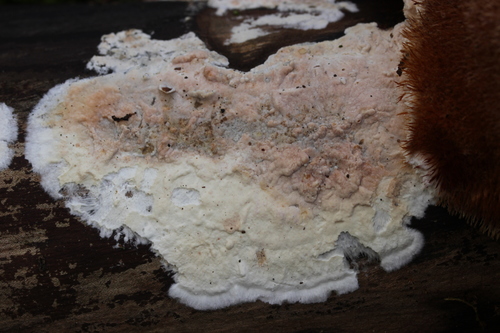
Hypochnicium
Hypochnicium is a genus of corticioid fungi in the family Meruliaceae. The genus was circumscribed by mycologist John Eriksson in 1958.
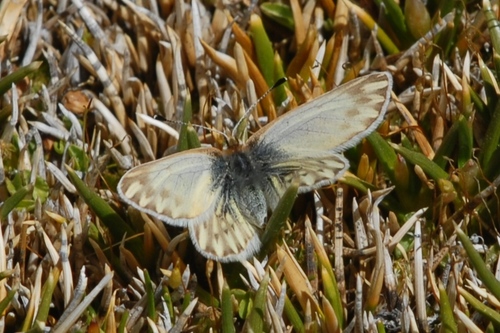
Infraphulia
Infraphulia is a Neotropical genus of butterflies in the family Pieridae.
.jpg)
Squamarina
Squamarina is a genus of lichens in the family Stereocaulaceae. They form patches of radiating or overlapping scales (), with a well-developed upper and no lower cortex. They grow on calcareous soil and rocks. Squamarina lentigera can be used to make a yellow dye.
Taeniolella
Taeniolella is a genus of asexual fungi hyphomycetes in the family Mytilinidiaceae. Some of the species are lichenicolous (lichen-dwelling), others are saprophytic, while others are endophytic. The genus was circumscribed in 1958 by Canadian mycologist Stanley John Hughes, with Taeniolella exilis as the type species. Major revisions of the lichenicolous species in the genus were published in 2016 and 2018.
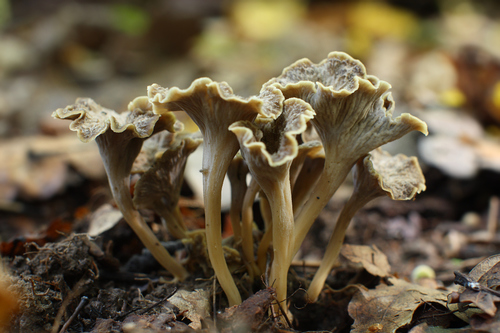
Pseudocraterellus
Pseudocraterellus is a genus of fungi in the family Cantharellaceae.
Climacocystis
Climacocystis is a genus of poroid fungi in the family Climacocystaceae. Until recently, it was monotypic genus, containing the single widespread species Climacocystis borealis. In 2014, Chinese mycologists added the newly described species Climacocystis montana. The generic name combines the name Climacodon with the Ancient Greek word ("bladder").
Griveaudia
'''Griveaudia ''' is a genus of moths of the family Callidulidae.
Lembocarpus
Lembocarpus is a genus of flowering plants belonging to the family Gesneriaceae.
Utharomyces epallocaulus
Utharomyces is a fungal genus in the family Pilobolaceae. The genus is monotypic, containing the single coprophilous (dung-loving) species Utharomyces epallocaulus, which is widely distributed in subtropical regions. Utharomyces was circumscribed by the Dutch botanist Karel Bernard Boedijn in 1958. U. epallocaulus has been collected in Bahamas, Ghana, India, Indonesia, Mexico, China, and the United States.
Maudheimia
Maudheimia is a genus of oribatid mite, the only one in the family Maudheimiidae. All species within this genus are native to continental Antarctica. Adults generally measure around 0.6–0.7 mm in length with a lightly hardened exoskeleton compared to many other oribatid mites. They occupy ice-free areas, called nunataks, in continental Antarctica, typically found under stones, in thin soils, and among moss or lichen patches.
Theochila
Theochila is a Neotropical genus of butterflies in the family Pieridae.
Hodophilus
Hodophilus is a genus of agarics (gilled fungi) in the family Clavariaceae. Basidiocarps (fruit bodies) are dull-coloured and have dry caps, rather distant, decurrent lamellae, white spores, and smooth, ringless stems. In Europe species are characteristic of old, unimproved grasslands (termed waxcap grasslands) which are a declining habitat, making them of conservation concern. Several species have a distinct odour of naphthalene.
Monodictys
Monodictys is a genus of fungi of uncertain familial and ordinal placement in the class Ascomycetes. The genus was circumscribed by Welsh-born Canadian mycologist Stanley Hughes in 1956. He assigned Monodictys putredinis as the type species.
Repetobasidium
Repetobasidium is a genus of fungi in the Hymenochaetales. It was circumscribed by Swedish mycologist John Eriksson in 1958.
Oliveonia
Oliveonia is a genus of fungi in the order Auriculariales. Species form thin, effused, corticioid basidiocarps (fruit bodies) with microscopically prominent cystidia and aseptate basidia producing basidiospores that give rise to secondary spores. All species are believed to be saprotrophic, most growing on dead wood. The genus was originally published by American mycologist L.S. Olive in 1957 as Heteromyces, but this is an illegitimate later homonym of the lichen genus Heteromyces Müll.Arg. (1889). The genus was renamed Oliveonia by Dutch mycologist M.A. Donk in 1958.
Neostrearia
Neostrearia is a monotypic genus - i.e. a genus containing only one species - of plants in the witch-hazel family Hamamelidaceae. It is the second described of three monotypic Australian genera in this family, the others being Ostrearia and Noahdendron. It is most closely related to these genera, as well as Trichocladus (4 species) from southern Africa and Dicoryphe (13 species) from Madagascar, and together these five genera form a distinct clade within Hamamelidaceae.
Carinostoma
Carinostoma is a genus of harvestmen in the family Nemastomatidae with three described species from southeastern Europe.
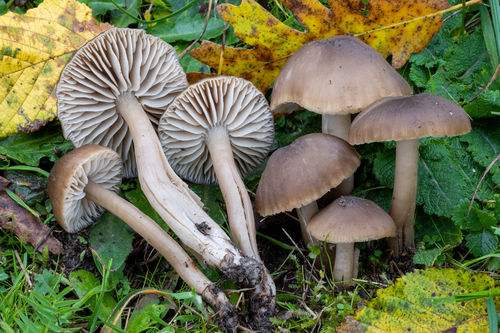
Neohygrocybe
Neohygrocybe is a genus of agaric fungi in the family Hygrophoraceae. Neohygrocybe species belong to a group known as waxcaps in English, sometimes also waxy caps in North America or waxgills in New Zealand. In Europe, Neohygrocybe species are typical of waxcap grasslands, a declining habitat due to changing agricultural practices. As a result, three species, Neohygrocybe ingrata, Neohygrocybe nitrata, and Neohygrocybe ovina, are of global conservation concern and are listed as "vulnerable" on the IUCN Red List of Threatened Species.