Category
page 1Transfusion medicine

anemia
Anemia (also spelt anaemia in British English) is a blood disorder in which the blood has a reduced ability to carry oxygen. This can be due to a lower than normal number of red blood cells, a reduction in the amount of hemoglobin available for oxygen transport, or abnormalities in hemoglobin that impair its function. The name is derived .

blood type
classification of blood based on antibodies and antigens on red blood cell surfaces
blood plasma
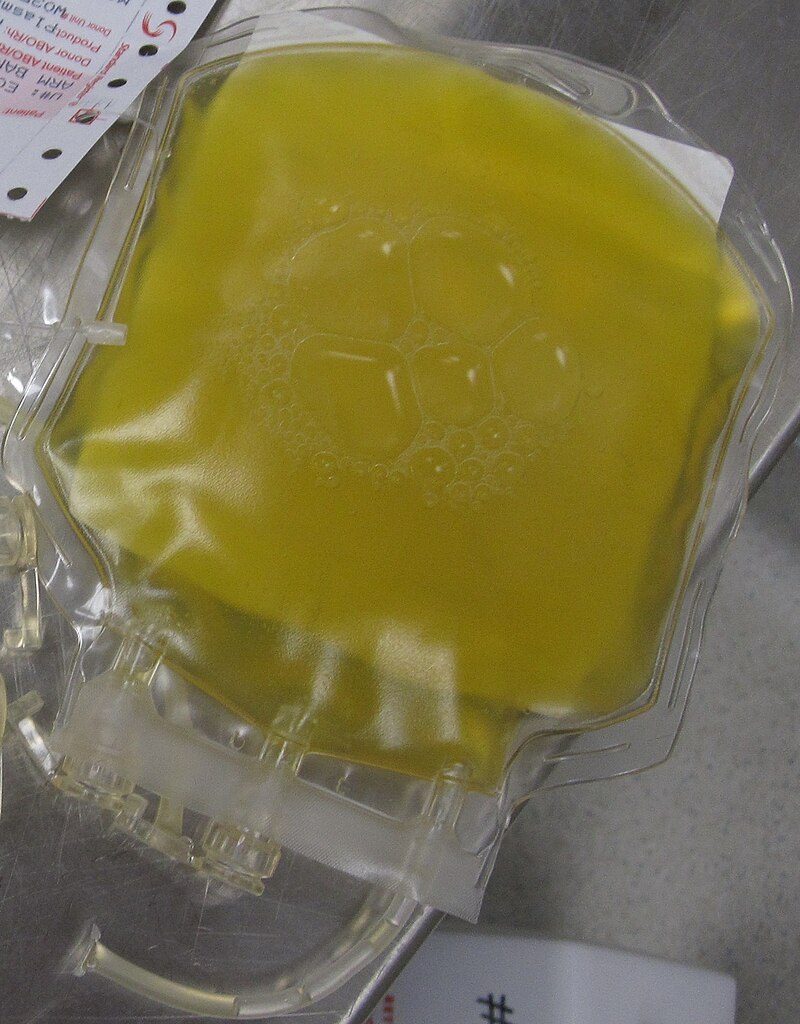
liquid component of blood

platelet
Platelets or thrombocytes () are a part of blood whose function (along with the coagulation factors) is to react to bleeding from blood vessel injury by clumping to form a blood clot. Platelets have no cell nucleus; they are fragments of cytoplasm from megakaryocytes which reside in bone marrow or lung tissue, and then enter the circulation. Platelets are found only in mammals, whereas in other vertebrates (e.g. birds, amphibians), thrombocytes circulate as intact mononuclear cells.

bleeding
Bleeding, hemorrhage, haemorrhage or blood loss, is blood escaping from the circulatory system from damaged blood vessels. Bleeding can occur internally, or externally either through a natural opening such as the mouth, nose, ear, urethra, vagina, or anus, or through a puncture in the skin.
Hypovolemia is a massive decrease in blood volume, and death by excessive loss of blood is referred to as exsanguination. Typically, a healthy person can endure a loss of 10–15% of the total blood volume without serious medical difficulties (by comparison, blood donation typically takes 8–10% of the donor's

blood transfusion
generally the process of receiving blood or blood products into one's circulation intravenously

blood donation
activity in which a person or other mammal voluntarily has blood drawn to be tranfused

Rh blood group system
human blood group system

ABO blood group system
classification of blood types
blood bank
cache or bank of blood components, stored for later use, e.g. in blood transfusion or they reserve blood for later and emergency use e.g. delivery of baby
gastrointestinal bleeding
bleeding from any part of the gastrointestinal tract
postpartum hemorrhage
loss of blood following childbirth
tranexamic acid
chemical compound used to treat or prevent blood loss

plasmapheresis
Plasmapheresis (from the Greek πλάσμα, plasma, something molded, and ἀφαίρεσις aphairesis, taking away) is the removal, treatment, and return or exchange of blood plasma or components thereof from and to the blood circulation. It is thus an extracorporeal therapy, a medical procedure performed outside the body.
human leukocyte antigen
a gene complex responsible for the regulation of the immune system in humans
fetal erythroblastosis
Human disease
hh blood group
Rare blood group first found in Bombay(1982)
Rh disease
problem with Rh+ fetuses in Rh- mothers
transfusion medicine
medical specialty
packed red blood cell
red blood cells separated for blood transfusion
blood product
therapeutic substance prepared from human blood
platelet-rich plasma
concentrate of platelet-rich plasma protein derived from whole blood
twin-to-twin transfusion syndrome
complication of disproportionate blood supply, resulting in high morbidity and mortality
Coombs test
blood test used in immunohematology, application of anti-antibodies (Coombs' reagent)

apheresis
Apheresis (ἀφαίρεσις (aphairesis, "a taking away")) is a medical technology in which the blood of a person is passed through an apparatus that separates one particular constituent and returns the remainder to the circulation. It is thus an extracorporeal therapy.

antihemorrhagic
An antihemorrhagic () agent is a substance that promotes hemostasis (a process which stops bleeding). It may also be known as a hemostatic (also spelled haemostatic) agent.
immunoglobulin therapy
injection of a specific mixture of antibodies to treat a number of health conditions
blood substitute
substance that is used in place of blood
whole blood
unseparated donated human blood
fresh frozen plasma
frozen plasma, used in medical labs

autotransplantation
Autotransplantation, also called autologous transplantation, is the surgical transplantation of organs, tissues, or even particular proteins from one site in an individual’s body to another site within the same person (auto- meaning "self" in Greek).
CD59 molecule (CD59 blood group)
CD59 glycoprotein, also known as MAC-inhibitory protein (MAC-IP), membrane inhibitor of reactive lysis (MIRL), or protectin, is a protein that in humans is encoded by the CD59 gene. It is an LU domain and belongs to the LY6/uPAR/alpha-neurotoxin protein family.
CD44 molecule (Indian blood group)
The CD44 antigen is a cell-surface glycoprotein involved in cell–cell interactions, cell adhesion and migration. In humans, the CD44 antigen is encoded by the CD44 gene on chromosome 11. CD44 has been referred to as HCAM (homing cell adhesion molecule), Pgp-1 (phagocytic glycoprotein-1), Hermes antigen, lymphocyte homing receptor, ECM-III, and HUTCH-1.
autoimmune hemolytic anemia
autoimmune disease of blood that is characterized by deficient red blood cells caused by auto-antibodies.

globoside
thumb|right|120px|N-Acetylgalactosamine|N-Acetylgalactosamine
thumb|Sphingosine
Globosides (also known as globo-series glycosphingolipids) are a sub-class of the lipid class glycosphingolipid with three to nine sugar molecules as the side chain (or R group) of ceramide. The sugars are usually a combination of N-acetylgalactosamine, D-glucose or D-galactose. One characteristic of globosides is that the "core" sugars consists of Glucose-Galactose-Galactose (Ceramide-βGlc4-1βGal4-1αGal), like in the case of the most basic globoside, globotriaosylceramide (Gb3), also known as pk-antigen. Another i
MNS antigen system
human blood group system
CD55 molecule (Cromer blood group)
mammalian protein found in Homo sapiens
anemia in pregnancy
disease of anemia during pregnancy in humans
Jehovah's Witnesses and blood transfusions
Jehovah's Witnesses doctrinal position about use of blood
KEL
antigen system in humans which determines Kell blood type
platelet transfusion
treatment for bleeding irregularities
prothrombin complex concentrate
chemical compound
Rho(D) immune globulin
medication used to prevent RhD isoimmunization
autohemotherapy
therapy using a patient's own blood, with various forms from quackery to low-evidence medicine
cross-matching
Cross-matching or crossmatching is a test performed before a blood transfusion as part of blood compatibility testing. Normally, this involves adding the recipient's blood plasma to a sample of the donor's red blood cells. If the blood is incompatible, the antibodies in the recipient's plasma will bind to antigens on the donor red blood cells. This antibody-antigen reaction can be detected through visible clumping or destruction of the red blood cells, or by reaction with anti-human globulin. Along with blood typing of the donor and recipient and screening for unexpected blood group antibodies
cryoprecipitate
Cryoprecipitate, also called cryo for short, or Cryoprecipitate Antihemophilic factor (AHF), is a frozen blood product prepared from blood plasma. To create cryoprecipitate, plasma is slowly thawed to 1–6 °C. A cold-insoluble precipitate is formed, which is collected by centrifugation, resuspended in a small amount of residual plasma (generally 10–15 mL) and then re-frozen for storage. Cryoprecipitate contains fibrinogen, Factor VIII, Factor XIII and vWF. In many clinical contexts, use of cryoprecipitate has been replaced with use of clotting factor concentrates (where available), but the
Basigin (Ok blood group)
Basigin (BSG) also known as extracellular matrix metalloproteinase inducer (EMMPRIN) or cluster of differentiation 147 (CD147) is a protein that in humans is encoded by the BSG gene. This protein is a determinant for the Ok blood group system. There are three known antigens in the Ok system; the most common being Oka (also called OK1), OK2 and OK3. Basigin has been shown to be an essential receptor on red blood cells for the human malaria parasite, Plasmodium falciparum. The common isoform of basigin (basigin-2) has two immunoglobulin domains, and the extended form basigin-1 has three.

exchange transfusion
blood transfusion in which the patient's blood or components of it are exchanged with other blood or blood products
antifibrinolytic
Antifibrinolytics are a class of medication that are inhibitors of fibrinolysis. Examples include aminocaproic acid (ε-aminocaproic acid) and tranexamic acid. These lysine-like drugs interfere with the formation of the fibrinolytic enzyme plasmin from its precursor plasminogen by plasminogen activators (primarily t-PA and u-PA) which takes place mainly in lysine rich areas on the surface of fibrin.
damage control surgery
form of surgery which is used in cases of severe trauma
emergency bleeding control
procedures to limit dangerous levels of bleeding

autotransfusion
Autotransfusion is a process wherein a person receives their own blood for a transfusion, instead of banked allogenic (separate-donor) blood. There are two main kinds of autotransfusion: Blood can be autologously "pre-donated" (termed so despite "donation" not typically referring to giving to one's self) before a surgery, or alternatively, it can be collected during and after the surgery using an intraoperative blood salvage device (such as a Cell Saver, HemoClear or CATS). The latter form of autotransfusion is utilized in surgeries where there is expected a large volume blood loss – e.g. aneu

immunohaematology
Immunohematology is a branch of hematology and transfusion medicine which studies antigen-antibody reactions and analogous phenomena as they relate to the pathogenesis and clinical manifestations of blood disorders. A person employed in this field is referred to as an immunohematologist or colloquially as a blood banker. Their day-to-day duties include blood typing, cross-matching and antibody identification.
alt=Red White Blood cells.jpg|thumb|
Immunohematology and Transfusion Medicine is a medical post graduate specialty in many countries. The specialist Immunohematology and Transfusion Phys
atypical chemokine receptor 1 (Duffy blood group)
mammalian protein found in Homo sapiens
transfusion related acute lung injury
medical condition
hemoperfusion
Hemoperfusion or hæmoperfusion (see spelling differences) is a method of filtering the blood extracorporeally (that is, outside the body) to remove a toxin. As with other extracorporeal methods, such as hemodialysis (HD), hemofiltration (HF), and hemodiafiltration (HDF), the blood travels from the patient into a machine, gets filtered, and then travels back into the patient, typically by venovenous access (out of a vein and back into a vein).
human blood group system
classification system consisting of a set of blood antigens, chosen for the purpose of blood typing
International Society of Blood Transfusion
International Blood Transfusion Society
immunoglobulin A deficiency
dysgammaglobulinemia characterized by a deficiency of immunoglobulin A
AQP3
right|frameless|524x524px