Picture of the Day · NASA
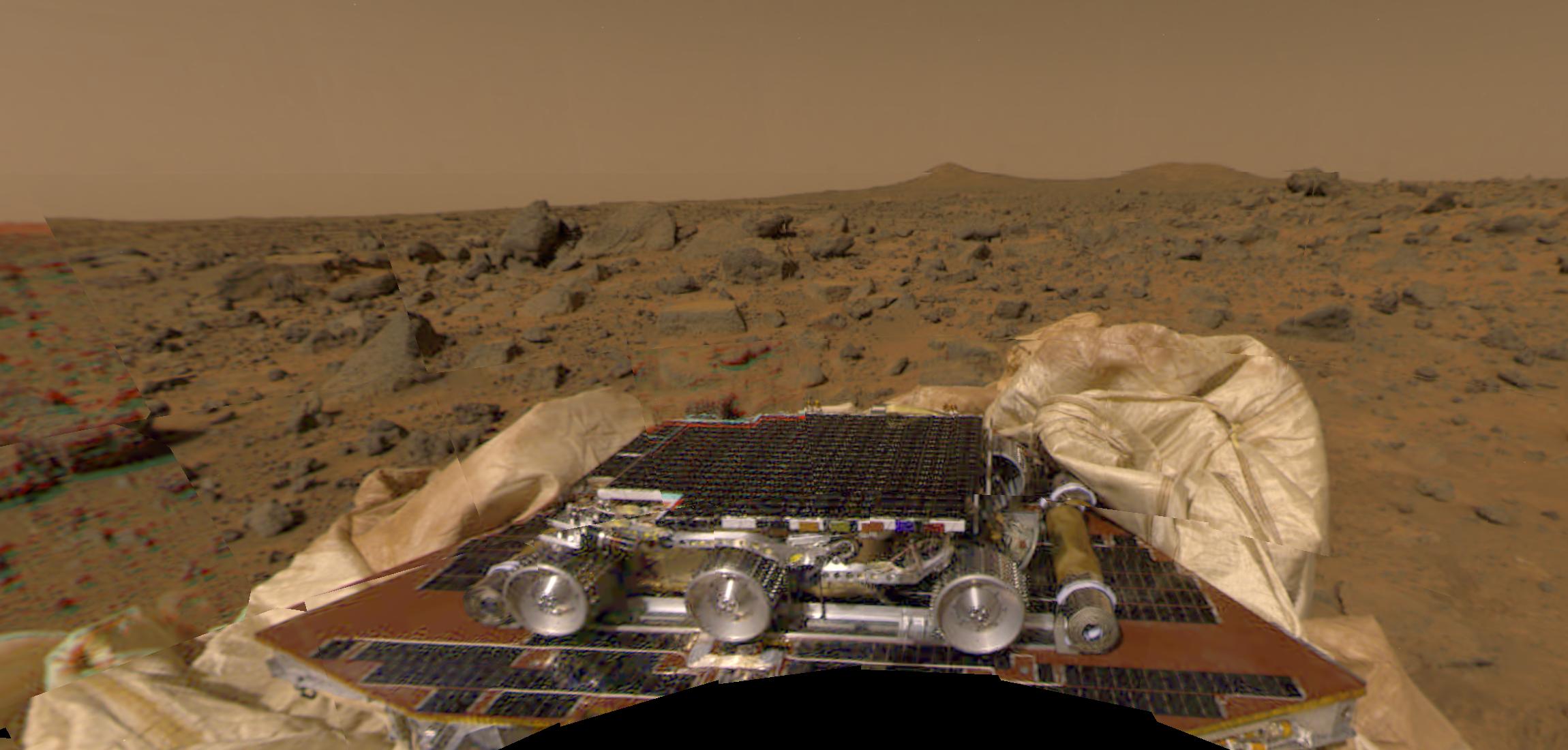
Pathfinder on Mars
2026-07-04
On July 4th, 1997, using its own array of fireworks, a parachute, and a cocoon of airbags, the Mars Pathfinder spacecraft bounced like a giant beach ball at least 15 times before it came to rest on the surface of Mars at 10:07 AM Pacific Daylight Time. After its then novel airbag-assisted landing sequence was completed, Pathfinder transmitted this color mosaic to mission operators on Earth. In the scene from another world, the Mars Sojourner robot rover is visible in the foreground, crouched on top of the unfolded Pathfinder. About the size of a large house cat, the six-wheeled, solar-powered Sojourner became the first successful Martian rover. Surrounding Pathfinder are deflated airbags and the rock-strewn terrain of the Ares Vallis floodplain. In the distance Martian hills appear against a dusty brownish sky. The Pathfinder lander was subsequently renamed the Carl Sagan Memorial Station.
via NASA APOD
Wikidata facts
- Orbital period
- 687.2778411533945
Show 13 more facts
- time of discovery or invention
- 1998-11-13
- provisional designation
- 1998 VF31
- orbital inclination
- 31.29714044228502
Article · Español
(101429) 1998 VF31 es un asteroide troyano de Marte que orbita 60º por detrás de Marte, en el punto lagrangiano L5 de ese planeta. Estudios espectrales efectuados en 2007 revelan similitudes con el asteroide (5261) Eureka, primero de los troyanos descubiertos en Marte, al que le siguieron (121514) 1999 UJ7 y en el punto lagrangiano L4, 60º por delante de Marte, incluyendo una gran proporción de metal y acondrita, así como similares indicios de erosión espacial en el regolito en su superficie, por lo que, teniendo en cuenta la extrema estabilidad de sus órbitas (que habrían así mantenido durante la mayor parte de la historia del Sistema Solar), es posible que ambos sean asteroides primordiales de Marte.
Abstract from DBpedia / Wikipedia · CC BY-SA