File:Lagrange_very_massive.svg · Wikimedia Commons · See Wikimedia Commons
trojan
Sign in to saveAlso known as Lagrangian object, trojan asteroid
minor planet or natural satellite that shares an orbit with a planet or larger moon
A trojan is a small celestial object, like an asteroid or moon, that orbits in the same path as a larger planet or moon. These objects are significant because they help us understand the structure and history of our solar system, and they may hold clues about how planetary systems form and evolve.
AI-generated from the Wikipedia summary — may contain errors.
Wikidata facts
- Subclass of
- asteroid
Show 3 more facts
- Commons category
- Trojans
- different from
- Troy
- topic's main category
- Category:Trojan minor planets
via Wikidata · CC0
~7 min read
Encyclopedic overview
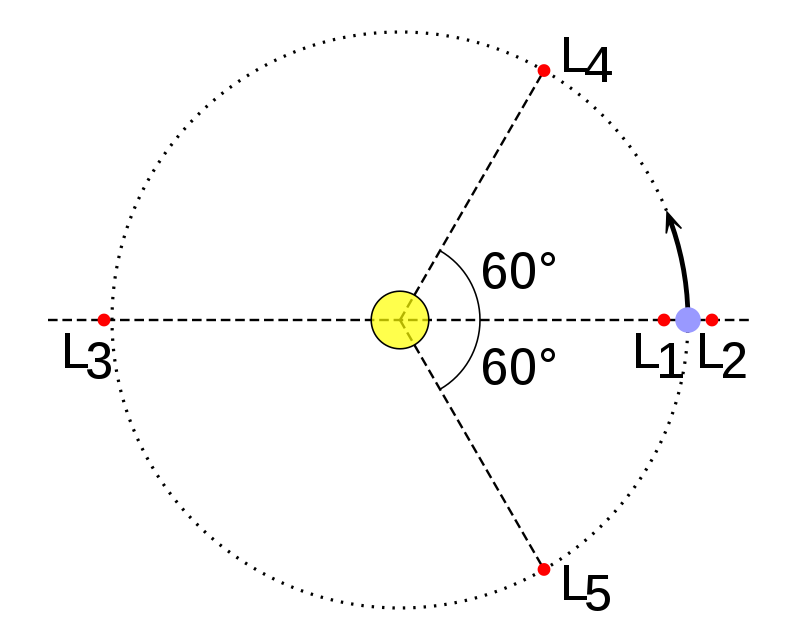
The trojan points are located on the L4 and L5 Lagrange points, on the orbital path of the secondary object (blue), around the primary object (yellow). All of the Lagrange points are highlighted in red.
In astronomy, a trojan is a small celestial body (mostly asteroids) that shares the orbit of a larger body, remaining in a stable orbit approximately 60° ahead of or behind the main body near one of its Lagrangian points L4 and L5. Trojans can share the orbits of planets or of large moons.
Excerpted from Wikipedia’s “trojan” article, available under the CC BY-SA 4.0 licence.
Gallery (2)
Available in 59 languages
- Español
- Français
- Deutsch
- 中文
- 日本語
- Русский
- Português
- Italiano
- العربية
- हिन्दी
- Afrikaans
- Armenian
- Asturian
- Bahasa Indonesia
- Bashkir
- Basque
- Bavarian
- be_x_old
Show 40 more
- Belarusian
- Bosnian
- Bulgarian
- Catalan
- Central Kurdish
- Croatian
- Danish
- eml
- Esperanto
- Finnish
- Galician
- Greek
- Hebrew
- Hungarian
- Ido
- Kazakh
- Lithuanian
- Luxembourgish
- Macedonian
- Malayalam
- Nederlands
- Norwegian
- Norwegian Nynorsk
- Occitan
- Polski
- Romanian
- Serbian
- Serbian (Latin)
- simple
- Slovak
- Slovenian
- Svenska
- Swahili
- Tiếng Việt
- Türkçe
- Ukrainian
- Uzbek
- فارسی
- ไทย
- 한국어
via Wikidata sitelinks · CC0