
File:Potw1749a_Pallas_crop.png · Wikimedia Commons · See Wikimedia Commons
2 Pallas is a large asteroid located in the main asteroid belt between Mars and Jupiter. It matters because it is one of the largest asteroids in our solar system and helps scientists understand the composition and history of the early solar system.
AI-generated from the Wikipedia summary — may contain errors.
Picture of the Day · NASA
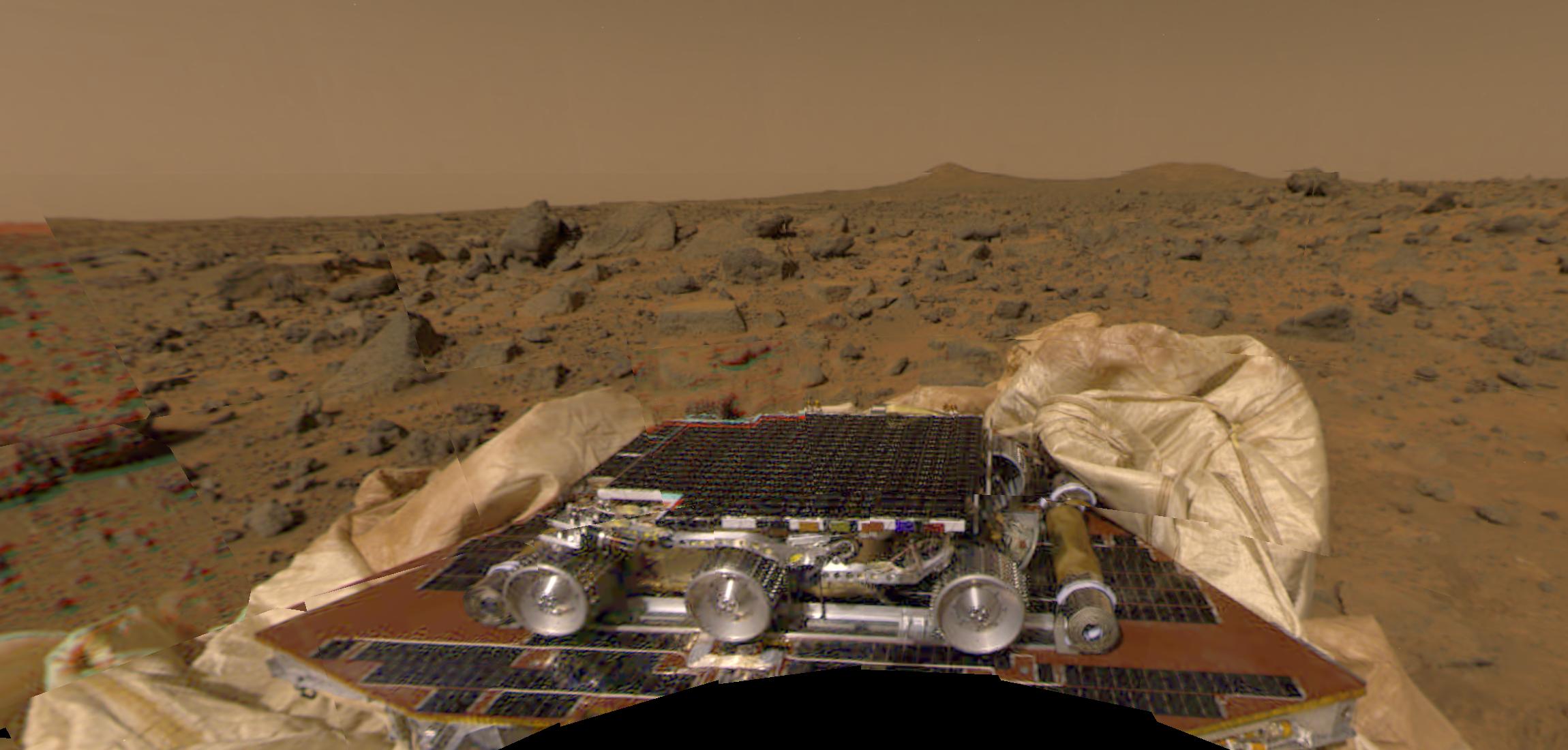
Pathfinder on Mars
2026-07-04
On July 4th, 1997, using its own array of fireworks, a parachute, and a cocoon of airbags, the Mars Pathfinder spacecraft bounced like a giant beach ball at least 15 times before it came to rest on the surface of Mars at 10:07 AM Pacific Daylight Time. After its then novel airbag-assisted landing sequence was completed, Pathfinder transmitted this color mosaic to mission operators on Earth. In the scene from another world, the Mars Sojourner robot rover is visible in the foreground, crouched on top of the unfolded Pathfinder. About the size of a large house cat, the six-wheeled, solar-powered Sojourner became the first successful Martian rover. Surrounding Pathfinder are deflated airbags and the rock-strewn terrain of the Ares Vallis floodplain. In the distance Martian hills appear against a dusty brownish sky. The Pathfinder lander was subsequently renamed the Carl Sagan Memorial Station.
via NASA APOD
Small body data
(2) Pallas
- Orbit class
- Main-belt
- Semi-major axis
- 2.770 AU
- Eccentricity
- 0.231
- Inclination
- 34.933 °
- Absolute magnitude
- 4.120 H
via Minor Planet Center
Wikidata facts
- Instance of
- asteroid
- Named after
- Athena
- Followed by
- 3 Juno
- Follows
- Ceres
- Parent body
- Sun
- Minor-planet group
- asteroid belt
- Diameter
- 513.0
- Mass
- 211
- Orbital period
- 1683.839278437529
- Image
- Potw1749a Pallas crop.png
Show 24 more facts
- discoverer or inventor
- Heinrich Wilhelm Olbers
- Commons category
- 2 Pallas
- time of discovery or invention
- 1802-03-28
- Unicode character
- ⚴
- asteroid spectral type
- B-type asteroid
- Commons gallery
- (2) Pallas
- described by source
- Brockhaus and Efron Encyclopedic Dictionary
- density
- 2.89
- rotation period
- 7.8132214
- asteroid family
- Pallas family
- site of astronomical discovery
- Bremen
- albedo
- 0.155
- provisional designation
- A802 FA
- absolute magnitude
- 4.11
- orbital eccentricity
- 0.2306429787720982
- semi-major axis of an orbit
- 2.76992582509809
- periapsis
- 2.131061881819705
- apoapsis
- 3.408789768376475
- orbital inclination
- 34.9283268715924
- longitude of ascending node
- 172.8885963396175
- argument of periapsis
- 310.9333840231888
- mean anomaly
- 211.5297777960524
- time of periapsis
- 2461694.944421737
- epoch
- November 21, 2025
Sources (8)
via Wikidata · CC0
~16 min read
Encyclopedic overview
Pallas (minor-planet designation: 2 Pallas) is the third-largest asteroid in the Solar System by volume and mass. It is the second asteroid to have been discovered, after Ceres, and is likely a remnant protoplanet. Like Ceres, it is believed to have a mineral composition similar to carbonaceous chondrite meteorites, though significantly less hydrated than Ceres. It is 79% the mass of Vesta and 22% the mass of Ceres, constituting an estimated 7% of the total mass of the asteroid belt. Its estimated volume is equivalent to a sphere 507 to 515 kilometers (315 to 320 mi) in diameter, 90–95% the volume of Vesta.
During the planetary formation era of the Solar System, objects grew in size through an accretion process to approximately the size of Pallas. Most of these protoplanets were incorporated into the growth of larger bodies, which became the planets, whereas others were ejected by the planets or destroyed in collisions with each other. Pallas, Vesta and Ceres appear to be the only intact bodies from this early stage of planetary formation to survive within the orbit of Neptune.
Excerpted from Wikipedia’s “2 Pallas” article, available under the CC BY-SA 4.0 licence.
Gallery (10)
Available in 93 languages
- Español
- Français
- Deutsch
- 中文
- 日本語
- Русский
- Português
- Italiano
- العربية
- हिन्दी
- Afrikaans
- Albanian
- Angika
- Aragonese
- Armenian
- Asturian
- Azerbaijani
- Bahasa Indonesia
Show 74 more
- Basque
- be_x_old
- Belarusian
- Bosnian
- Breton
- Bulgarian
- Catalan
- Central Kurdish
- Chechen
- Church Slavic
- Croatian
- Czech
- Danish
- Egyptian Arabic
- Esperanto
- Estonian
- Filipino
- Finnish
- Galician
- Georgian
- Greek
- Hebrew
- Hungarian
- Ido
- Interlingua
- Irish
- Javanese
- Kannada
- Kazakh
- Komi
- Kurdish
- Kyrgyz
- Latin
- Latvian
- Limburgish
- Lingua Franca Nova
- Lithuanian
- Lombard
- Low German
- Luxembourgish
- Macedonian
- Nederlands
- Norwegian
- Norwegian Nynorsk
- Occitan
- Polski
- Romanian
- Scots
- Serbian
- Serbian (Latin)
- Sicilian
- simple
- Sinhala
- Slovak
- Slovenian
- Sundanese
- Svenska
- Swahili
- Tatar
- Tiếng Việt
- Türkçe
- Tyap
- Ukrainian
- Urdu
- Uzbek
- Waray
- Welsh
- Western Panjabi
- Wu Chinese
- zh_min_nan
- zh_yue
- فارسی
- ไทย
- 한국어
via Wikidata sitelinks · CC0