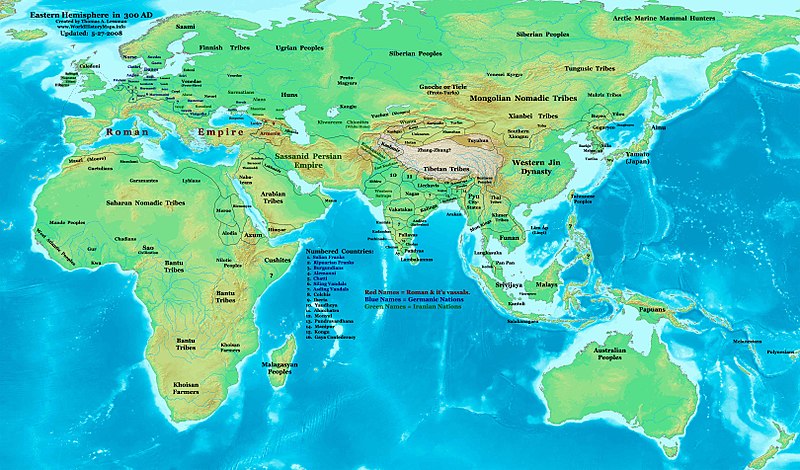
File:East-Hem_300ad.jpg · Wikimedia Commons · See Wikimedia Commons
The 4th century refers to the period from 301 to 400 CE, marking a pivotal era in world history when major empires and religions underwent significant transformation. It matters because during this time Christianity became the official religion of the Roman Empire, the Roman Empire itself began to decline and split, and important developments occurred across Asia, Africa, and other regions that shaped the course of subsequent history.
AI-generated from the Wikipedia summary — may contain errors.
Wikidata facts
- Instance of
- century
- Part of
- 1st millennium
- Has part
- 370s
- Followed by
- 5th century
- Follows
- 3rd century
Show 9 more facts
- Commons category
- 4th century
- topic's main category
- Category:4th century
- point in time
- 0400-01-01
- start time
- 0301-01-01
- end time
- 0400-12-31
- category for births in this time period
- Category:4th-century births
- category for deaths in this time period
- Category:4th-century deaths
- P8168
- Matigny
- P13311
- headache
Sources (1)
via Wikidata · CC0
~6 min read
Encyclopedic overview
Eastern Hemisphere at the beginning of the 4th century AD. Eastern Hemisphere at the end of the 4th century AD.
The 4th century was the time period from 301 AD (represented by the Roman numerals CCCI) to 400 AD (CD) in accordance with the Julian calendar. In the West, the early part of the century was shaped by Constantine the Great, who became the first Roman emperor to adopt Christianity. Gaining sole reign of the empire, he is also noted for re-establishing a single imperial capital, choosing the site of ancient Byzantium in 330 (over the current capitals, which had effectively been changed by Diocletian's reforms to Milan in the West, and Nicomedeia in the East) to build the city soon called Nova Roma (New Rome); it was later renamed Constantinople in his honor.
Excerpted from Wikipedia’s “4th century” article, available under the CC BY-SA 4.0 licence.
Gallery (6)
Available in 132 languages
- Español
- Français
- Deutsch
- 中文
- 日本語
- Русский
- Português
- Italiano
- العربية
- हिन्दी
- Afrikaans
- Albanian
- Albanian
- Amharic
- Aragonese
- Armenian
- Asturian
- Avaric
Show 113 more
- Azerbaijani
- Bahasa Indonesia
- Balinese
- Basque
- bat_smg
- be_x_old
- Belarusian
- Bosnian
- Breton
- Bulgarian
- Burmese
- Catalan
- cdo
- Central Kurdish
- Chechen
- Chuvash
- Cornish
- Croatian
- Czech
- Danish
- Egyptian Arabic
- eml
- Erzya
- Esperanto
- Estonian
- Extremaduran
- Faroese
- Filipino
- Finnish
- fiu_vro
- Friulian
- Galician
- Gan Chinese
- Georgian
- Greek
- Haitian Creole
- Hebrew
- Hungarian
- Icelandic
- Ido
- Interlingua
- Irish
- Javanese
- Kazakh
- Kotava
- Kurdish
- Kyrgyz
- Latin
- Latvian
- Lezghian
- Ligurian
- Limburgish
- Lingua Franca Nova
- Lithuanian
- Lombard
- Low German
- Luxembourgish
- Macedonian
- Malay
- map_bms
- Marathi
- Mari
- Mingrelian
- Moroccan Arabic
- nds_nl
- Neapolitan
- Nederlands
- Northern Frisian
- Northern Sotho
- Norwegian
- Norwegian Nynorsk
- nrm
- Occitan
- Polski
- Quechua
- Romanian
- Rusyn
- Saterland Frisian
- Scottish Gaelic
- Serbian
- Serbian (Latin)
- Shan
- Sicilian
- simple
- Slovak
- Slovenian
- Sundanese
- Svenska
- Swahili
- Tajik
- Tamil
- Tatar
- Tiếng Việt
- Türkçe
- Turkmen
- Ukrainian
- Urdu
- Uzbek
- Venetian
- Walloon
- Waray
- Welsh
- Western Frisian
- Western Panjabi
- Wu Chinese
- Yakut
- Yiddish
- Zaza
- zh_min_nan
- zh_yue
- فارسی
- ไทย
- 한국어
via Wikidata sitelinks · CC0