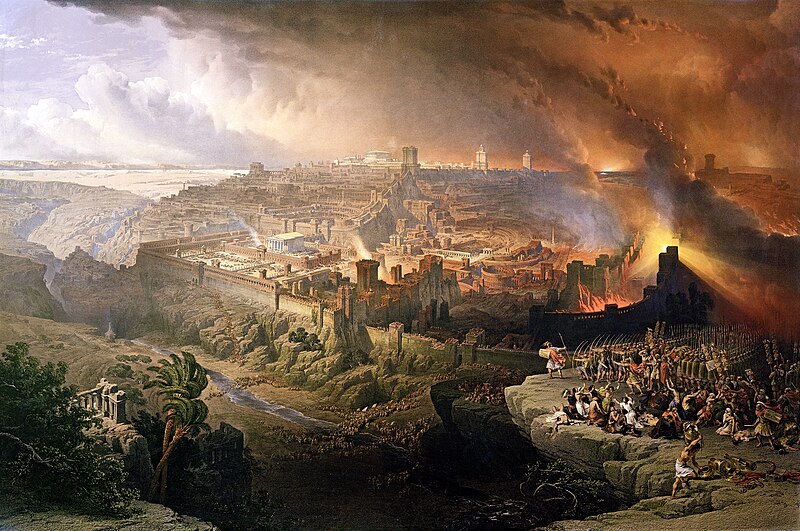
File:David_Roberts_-_The_Siege_and_Destruction_of_Jerusalem_by_the_Romans_Under_the_Command_of_Titus,_A.D._70.jpg · Wikimedia Commons · See Wikimedia Commons
thumb|279x279px|19th-century painting depicting the Siege of Jerusalem (70 CE)|siege of Jerusalem (70). The 70s was a decade that ran from January 1, AD 70, to December 31, AD 79.
The 70s was a decade that ran from January 1, AD 70, to December 31, AD 79. This period is historically significant as it includes the Siege of Jerusalem in 70 CE, a major event in ancient history.
AI-generated from the Wikipedia summary — may contain errors.
Wikidata facts
- Instance of
- decade
- Part of
- 1st century
- Has part
- 77
- Followed by
- 80s
- Follows
- 60s
Show 6 more facts
- different from
- 1870s
- Commons category
- 70s
- topic's main category
- Category:70s
- point in time
- 0070-01-01
- category for births in this time period
- Category:70s births
- category for deaths in this time period
- Category:70s deaths
Sources (2)
via Wikidata · CC0
~3 min read
Encyclopedic overview
3 sectionsContents
- Significant people
- References
- External links
thumb|279x279px|19th-century painting depicting the Siege of Jerusalem (70 CE)|siege of Jerusalem (70). The 70s was a decade that ran from January 1, AD 70, to December 31, AD 79.
As the decade began, the First Jewish–Roman War continued: In AD 70, the Romans besieged and sacked Jerusalem and destroyed the Second Temple. After this major victory, the Romans continued to clear pockets of Jewish resistance, with the final stronghold taken being Masada (73). The Flavian dynasty, which included emperors Vespasian and Titus, ruled the empire during this decade. During their reign, the Romans faced military challenges from various sources, including clashes with British and Germanic tribes. However, the Romans were largely successful in defeating these tribes, expanding their territories and consolidating their power. Following the death of Vologases I in 78, Parthia saw internal conflict as Vologases II and Pacorus II competed for the throne. In China, the Han–Xiongnu War was re-invigorated, with the Han defeating the Northern Xiongnu in the Battle of Yiwulu (73). In 75, Emperor Ming of Han died, being succeeded by Emperor Zhang: the reign of these two emperors is considered to have been a golden age.
Excerpted from Wikipedia’s “70s” article, available under the CC BY-SA 4.0 licence.
Gallery (3)
Available in 81 languages
- Español
- Français
- Deutsch
- 中文
- 日本語
- Русский
- Português
- Italiano
- العربية
- Albanian
- Albanian
- Aragonese
- Asturian
- Bahasa Indonesia
- Balinese
- Bangla
- Basque
- be_x_old
Show 62 more
- Belarusian
- Bosnian
- Breton
- Catalan
- cdo
- Chuvash
- Czech
- Danish
- Egyptian Arabic
- eml
- Esperanto
- Estonian
- Faroese
- Finnish
- Galician
- Gan Chinese
- Georgian
- Hebrew
- Hungarian
- Irish
- Javanese
- Komi
- Ligurian
- Macedonian
- Malay
- Marathi
- Mari
- Mingrelian
- Moroccan Arabic
- nah
- Nederlands
- Northern Sotho
- Norwegian
- Romanian
- Scottish Gaelic
- Serbian
- Serbian (Latin)
- simple
- Slovak
- Slovenian
- Sundanese
- Svenska
- Swahili
- Tajik
- Tamil
- Tatar
- Tiếng Việt
- Türkçe
- Turkmen
- Ukrainian
- Urdu
- Uzbek
- Walloon
- Waray
- Welsh
- Wu Chinese
- Yakut
- zh_min_nan
- zh_yue
- فارسی
- ไทย
- 한국어
via Wikidata sitelinks · CC0