
806 Gyldénia
Also known as (806) Gyldénia, Gyldénia, Gyldenia
outer main-belt asteroid
Picture of the Day · NASA
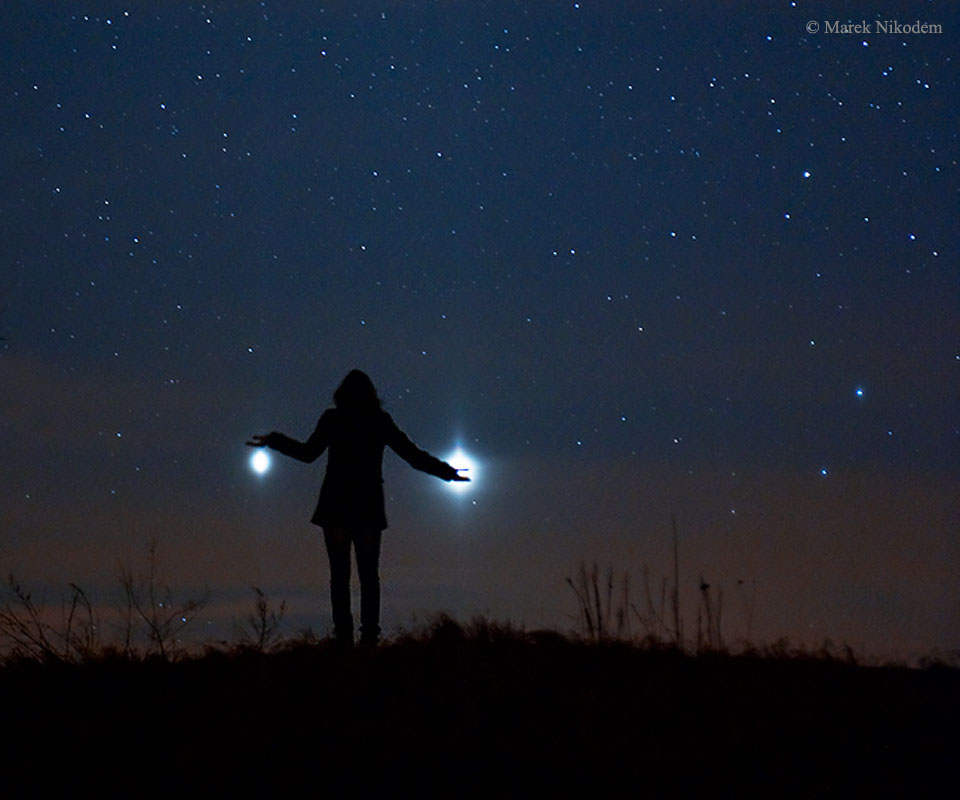
Jupiter and Venus from Earth
2026-06-07
It was visible around the world. The sunset conjunction of Jupiter (left) and Venus (right) in 2012 was visible almost no matter where you lived on Earth. Anyone on our planet with a clear western horizon at sunset could see them. That year, a creative photographer traveled away from the town lights of Szubin, Poland to photograph a near closest approach of the two planets. The bright planets were then separated by only three degrees and his daughter struck a humorous pose. A faint red sunset still glowed in the background. Jupiter and Venus are together again this week after sunset, passing within a degree of each other about two days from today.
© Marek Nikodem (PPSAE) · via NASA APOD
Key facts
- Discovered by
- M. F. Wolf
- Discovery site
- Heidelberg Obs.
- Discovery date
- 18 April 1915
- Named after
- Hugo Gyldén , (astronomer)
- Alternative designations
- 1915 WX · 1950 LT
- Minor planet category
- main-belt · ( outer )
Article
806 Gyldénia, provisional designation 1915 WX, is a carbonaceous asteroid from the outer region of the asteroid belt, approximately 63 kilometers in diameter. It was discovered on 18 April 1915, by German astronomer Max Wolf at Heidelberg Observatory in southern Germany. The discovery observation was ignored for orbital determination, with the first used observation made at Vienna Observatory on 1 May 2015, reducing the asteroid's observation arc by 2 weeks.
The dark C-type asteroid orbits the Sun at a distance of 3.0–3.5 AU once every 5 years and 9 months (2,100 days). Its orbit has an eccentricity of 0.08 and an inclination of 14° with respect to the ecliptic. Several photometric light-curve analysis rendered a rotation period of 16.852±0.006 hours (best result) with a brightness variation of 0.18 in magnitude (U=3).