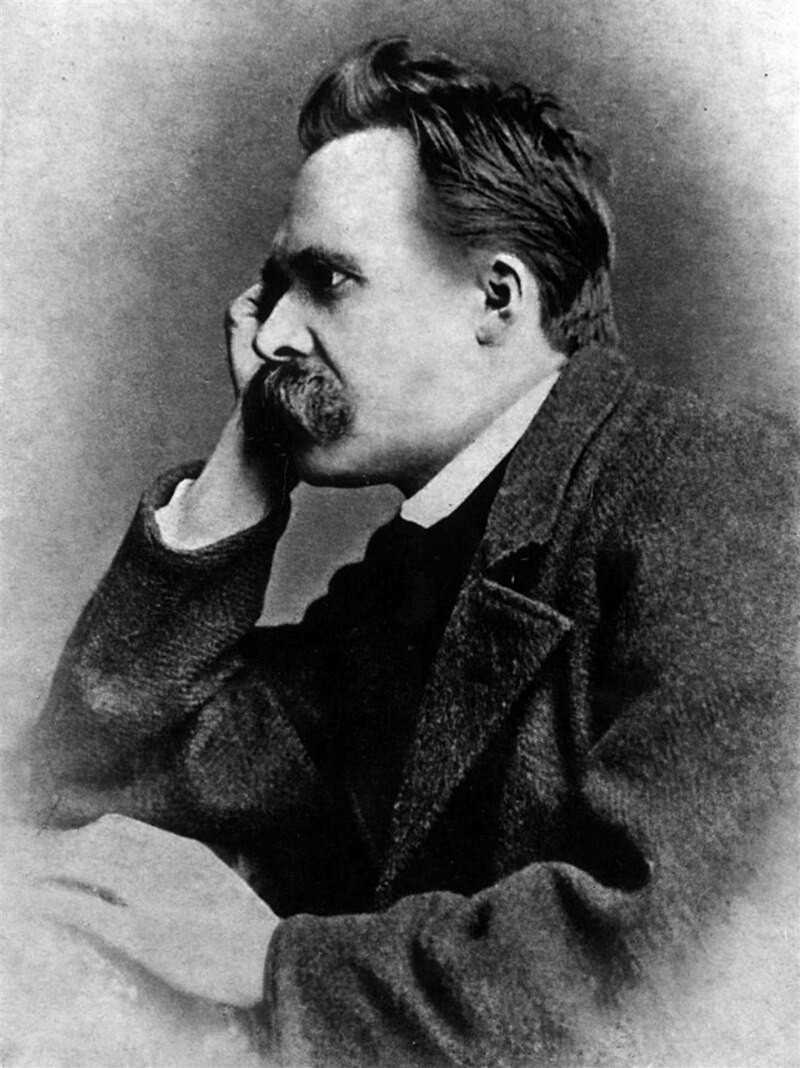
File:Nietzsche1882.jpg · Wikimedia Commons · See Wikimedia Commons
Friedrich Nietzsche
Sign in to saveGerman philosopher (1844-1900)
OverviewAI-generated
Friedrich Wilhelm Nietzsche was a German philosopher, poet, writer, and composer. Born in Röcken in 1844, he died in Weimar in 1900 from neurosyphilis. He was educated at Landesschule Pforta, the University of Bonn, and Leipzig University, earning a doctorate and becoming a full professor. He worked at the University of Basel and held positions in Bonn, Leipzig, Basel, and Weimar.
His notable works include Thus Spoke Zarathustra, The Birth of Tragedy, Untimely Meditations, and On the Advantage and Disadvantage of History for Life. His fields of work were classical philology and philosophy. He was influenced by Arthur Schopenhauer, Heraclitus, Ralph Waldo Emerson, and Charles Darwin. He participated in the Franco-Prussian War. He spoke German, Italian, and French. His father was Carl Ludwig Nietzsche, and his sibling was Elisabeth Förster-Nietzsche.
Synthesized by Vinony from 43 facts across 6 sources: Wikidata, Firecrawl, Last.fm, Europeana Sparql, MusicBrainz, VIAF. Generated from structured data (not the Wikipedia text) and checked against those facts — may still contain errors.
Listeners · Last.fm
- Listeners
- 25,078
- Total plays
- 367,546
Tags
Similar artists
This artist name may refer to: 1. Musical compositions of Friedrich Nietzsche 2. Audiobooks of Nietzsche's writings Friedrich Wilhelm Nietzsche (October 15, 1844 – August 25, 1900), was a nineteenth-century German philosopher. He wrote critiques of religion, morality, contemporary culture, philosophy, and science, using a distinctive style and displaying a fondness for aphorism. Nietzsche's influence remains substantial within and beyond philosophy, notably in existentialism and postmodernism. <a href="https://www.last.fm/music/Friedrich+Nietzsche">Read more on Last.fm</a>
Authority record · VIAF
- Lifespan
- 1844–1900
- Nationality
- DE, IT, CH, DEU
- Role / Field
- Philosophers, Authors, Profesores universitarios, Poets, Philosophes, Filozofia
- Language
- ger, deu
- Gender
- Male
Recorded by 48 libraries
via VIAF · OCLC
Described at
Eugenio Pacelli. Kritische Online-Edition der Nuntiaturberichte 1917–1929
Eugenio Pacelli, der spätere Papst Pius XII. (1939-1958), ist eine der bekanntesten und umstrittensten Persönlichkeiten des 20. Jahrhunderts. Die Öffnung aller Akten aus dem Pontifikat Pius' XI. (1922-1939) im Vatikanischen Geheimarchiv 2003 und 2006 macht es möglich, alle Nuntiaturberichte, die Pacelli in den zwölf Jahren seiner Tätigkeit in Deutschland nach Rom sandte, zu edieren. Eine Edition der Weisungen von Kardinalstaatssekretär Pietro Gasparri ergänzt den Quellenbestand.
pacelli-edition.de →1864-1867 Studium der protestantischen Theologie und der Altphilologie in Bonn und Leipzig, 1869 Dr. phil. und Professor für griechische Sprache und Literatur in Basel, 1870 Teilnahme am Deutsch-Französischen Krieg, 1876 krankheitsbedingte Suspendierung vom Lehramt und 1879 Aufgabe der Professur und daraufhin wechselnde Aufenthalte in Venedig, Genua, Sils-Maria, Rapallo, Nizza und Turin, 1889 geistiger Zusammenbruch in Turin und anschließend in der Obhut seiner Mutter in Jena und Naumburg, 1897 Übersiedlung zur Schwester nach Weimar. NIETZSCHE, Friedrich, Briefe. Kritische Gesamtausgabe, hg. von Giorgio COLLI und Mazzino MONTINARI, Berlin / New York 1975-2004. NIETZSCHE, Friedrich, Sämtliche Briefe, Kritische Studienausgabe, hg. von Giorgio COLLI und Mazzino MONTINARI, München / New York 1986. NIETZSCHE, Friedrich, Sämtliche Werke, Kritische Studienausgabe, 15 Bde., hg. von Giorgio Colli und Mazzino Montinari, München / New York 1980. NIETZSCHE, Friedrich, Werke. Kritische Gesamtausgabe, hg. von Giorgio COLLI und Mazzino MONTINARI, Berlin / New York 1967-1977. HARDERS, Levke / WALTHER, Lutz, Friedrich Nietzsche, in: Lebendiges virtuelles Museum online, in: www.dhm.de (Letzter Zugriff am: 11.05.2011). PIERRARD, Annemarie, Nietzsche, Friedrich Wilhelm, in: Lexikon für Theologie und Kirche3 7 (1998), Sp. 829 f.
Excerpt from a page describing this subject · 3,530 chars · not written by Vinony
Wikidata facts
- Instance of
- human
- Given name
- Friedrich
- Gender
- male
- Place of birth
- Röcken
- Place of death
- Weimar
- Father
- Carl Ludwig Nietzsche
- Sibling
- Elisabeth Förster-Nietzsche
- Occupation
- playwright
- Position held
- volunteer serving one year
- Educated at
- Landesschule Pforta
- Employer
- University of Basel
- Languages spoken
- Italian
- Native language
- German
- Academic degree
- full professor
- Student of
- Friedrich Wilhelm Ritschl
- Field of work
- philosophy
- Instrument
- piano
- Conflict
- Franco-Prussian War
- Image
- Friedrich Nietzsche - 1864.jpg
- Residence
- Naumburg
Show 29 more facts
- Commons category
- Friedrich Nietzsche
- date of birth
- 1844-10-15
- date of death
- 1900-08-25
- topic's main category
- Category:Friedrich Nietzsche
- Commons gallery
- Friedrich Nietzsche
- cause of death
- neurosyphilis
- Commons Creator page
- Friedrich Nietzsche
- influenced by
- Alexander Herzen
- birth name
- Friedrich Wilhelm Nietzsche
- name in native language
- Friedrich Nietzsche
- on focus list of Wikimedia project
- Wikipedia:Vital articles/Level/4
- place of burial
- Röcken
- hashtag
- Nietzsche
- has works in the collection
- Anne Frank House
- writing language
- German
- time period
- 19th-century philosophy
- bibliography
- Friedrich Nietzsche bibliography
- facial hair
- walrus moustache
- P8168
- Thomas Einwaller
- list of works
- Friedrich Nietzsche bibliography
- different from
- Nietzsche
- start of work period
- 1865-01-01
- end of work period
- 1889-00-00
- maintained by WikiProject
- WikiProject Mathematics
- topic has template
- Template:Friedrich Nietzsche
- described at URL
- pacelli-edition.de/gnd/118587943
- manner of death
- natural causes
- academic major
- philology
- medical condition
- mental confusion
Sources (8)
via Wikidata · CC0
Works in European collections
18 objects attributed to Friedrich Nietzsche, held across European museums, libraries & archives · via Europeana
El nacimiento de la tragedia o Helenismo y pesimismo [Texto impreso]

Belsazer (Heine)
![[1]](https://api.europeana.eu/thumbnail/v2/url.json?uri=http%3A%2F%2Fmedia.dwds.de%2Fdta%2Fimages%2Fnietzsche_zarathustra01_1883%2Fnietzsche_zarathustra01_1883_0007_1600px.jpg&type=IMAGE)
[1]

2

3

So Zarathustra spoke

Idylene from Messina

A talk by Friedrich Nietzsche

Im-ígyen szóla Zarathustra

Friedrich Nietzsche versei

Nietzsche

Túl az erkölcs világán...

A Menschliches, Allzumenschliches-ből
Der Fall Wagner. Nietzsche contra Wagner
Untitled

Untitled
Untitled
Untitled
~40 min read
Encyclopedic overview
Friedrich Wilhelm Nietzsche (15 October 1844 – 25 August 1900) was a German philosopher and writer who started his career as a classical philologist and turned to philosophy early in his academic career. In 1869, at age 24, he was appointed Professor of Classical Philology at the University of Basel. Plagued by health problems for most of his life, he resigned from the university in 1879. He afterward lived as an independent writer, spending much of his life in relative solitude and financial insecurity while moving between Switzerland, Italy, and southern France in search of climates that might alleviate his condition, and in the following decade, he completed much of his core writing. In 1889, aged 44, he suffered a neurological collapse, and thereafter a complete loss of his mental faculties, with paralysis and vascular dementia; he lived out his remaining 11 years, first under the care of his mother, and later his sister, until his death. His works and his philosophy have fostered not only extensive scholarship but also much popular interest.
Nietzsche's work encompasses poetry, cultural criticism, and philosophical essays while displaying a fondness for aphorisms and irony. Prominent elements of his philosophy include his critique of objective truth in favour of perspectivism; a genealogical critique of Christian morality and a related theory of master–slave morality; the affirmation of life in response to both the weakening of religion ("God is dead") and the crisis of passive nihilism which followed it; the notion of Apollonian and Dionysian duality; and a characterisation of the human subject as the expression of competing wills, collectively understood as the will-to-power. His later work developed influential concepts such as the Übermensch, the transvaluation of values, and his unique formulation of eternal return. His body of work touched a wide range of topics, including aesthetic, philology, history, music, religion, tragedy, culture and science, and drew inspiration from such diverse sources as Greek tragedy, Arthur Schopenhauer, Ralph Waldo Emerson, and Richard Wagner.
Excerpted from Wikipedia’s “Friedrich Nietzsche” article, available under the CC BY-SA 4.0 licence.
Gallery (12)
Available in 177 languages
- Español
- Français
- Deutsch
- 中文
- 日本語
- Русский
- Português
- Italiano
- العربية
- हिन्दी
- abstract
- Afrikaans
- Albanian
- Albanian
- Amharic
- Aragonese
- Armenian
- Assamese
Show 158 more
- Asturian
- azb
- Azerbaijani
- Bahasa Indonesia
- Balinese
- Bangla
- Bashkir
- Basque
- bat_smg
- Bavarian
- be_x_old
- Belarusian
- Bhojpuri
- Bishnupriya
- Bosnian
- Breton
- btm
- Bulgarian
- Buriat
- Catalan
- Central Kurdish
- Chechen
- Cherokee
- Chuvash
- Cornish
- Crimean Tatar
- Croatian
- Czech
- Danish
- Egyptian Arabic
- eml
- Erzya
- Esperanto
- Estonian
- Extremaduran
- Faroese
- Fiji Hindi
- Filipino
- Finnish
- fiu_vro
- Galician
- Gan Chinese
- gcr
- Georgian
- Greek
- Guarani
- Haitian Creole
- Hausa
- Hebrew
- Hungarian
- hyw
- Icelandic
- Ido
- Iloko
- Interlingua
- Irish
- Jamaican Creole English
- Javanese
- Kabyle
- Kanuri
- Kara-Kalpak
- Kazakh
- kbp
- Kurdish
- Kyrgyz
- Latin
- Latvian
- Lezghian
- Limburgish
- Lingua Franca Nova
- Lithuanian
- Lombard
- Low German
- Luxembourgish
- Macedonian
- Madurese
- Malagasy
- Malay
- Malayalam
- Maltese
- Marathi
- Mazanderani
- Mingrelian
- Mirandese
- Moksha
- Mongolian
- Moroccan Arabic
- nds_nl
- Nederlands
- Nepali
- Newari
- Northern Frisian
- Northern Sami
- Norwegian
- Norwegian Nynorsk
- nrm
- Occitan
- Old English
- olo
- Oromo
- Pangasinan
- Papiamento
- Pashto
- Piedmontese
- Polski
- Punjabi
- Quechua
- Romanian
- Romansh
- Rusyn
- Samoan
- Saterland Frisian
- Scots
- Scottish Gaelic
- Serbian
- Serbian (Latin)
- Sicilian
- simple
- Sindhi
- Slovak
- Slovenian
- Standard Moroccan Tamazight
- Sundanese
- Svenska
- Swahili
- Tajik
- Tamil
- Tatar
- Telugu
- Tiếng Việt
- Toki Pona
- Türkçe
- Turkmen
- Tuvinian
- Ukrainian
- Urdu
- Uzbek
- Venetian
- Veps
- Volapük
- Walloon
- Waray
- Welsh
- Western Frisian
- Western Mari
- Western Panjabi
- Wu Chinese
- Yakut
- Yiddish
- Yoruba
- Zaza
- Zeelandic
- zh_classical
- zh_min_nan
- zh_yue
- فارسی
- ไทย
- 한국어
via Wikidata sitelinks · CC0