File:Königsberg_Castle.jpg · Wikimedia Commons · See Wikimedia Commons
Königsberg
Sign in to saveAlso known as Königsberg i. Pr., Konigsberg, Königsberg in Preußen, Twangste
Königsberg (, ) was the historic German name of the city that is now modern-day Kaliningrad, Russia. The city was founded in 1255 on the site of the Old Prussian settlement Twangste by the Teutonic Knights during the Baltic Crusades. It was named in honour of King Ottokar II of Bohemia, who led a campaign against the pagan Old Prussians, a Baltic tribe that was native to the area.
OverviewAI-generated
Königsberg was a city and Hanseatic town in East Prussia, established in 1255. It served as the capital of Prussia, the Duchy of Prussia, the Königsberg Region, and Ober Ost. The city was located in the administrative entities of East Prussia, the Duchy of Prussia, Brandenburg-Prussia, and the Province of Prussia. Its country affiliations included Prussia, the German Empire, Nazi Germany, and the Soviet Union.
The city was dissolved on January 1, 1945, and was replaced by Kaliningrad. Significant events associated with the location include the Bombing of Königsberg in World War II and the Battle of Königsberg. The site is now an archaeological site and historical region.
Synthesized by Vinony from 49 facts across 7 sources: Wikidata, Open Meteo, Openweathermap, OpenStreetMap, GeoNames, Vinony graph, Geo. Generated from structured data (not the Wikipedia text) and checked against those facts — may still contain errors.
Weather now
7-day forecast
via Open-Meteo
Place details
- Locality
- Калининград
- Region
- Калининградская область
- Country
- Россия
- Population
- 475,056
- Timezone
- Europe/Kaliningrad
via OpenStreetMap · GeoNames
Key facts
- Ancient site.name
- Königsberg
- Ancient site.image
- Königsberg Castle.jpg
- Ancient site.alt
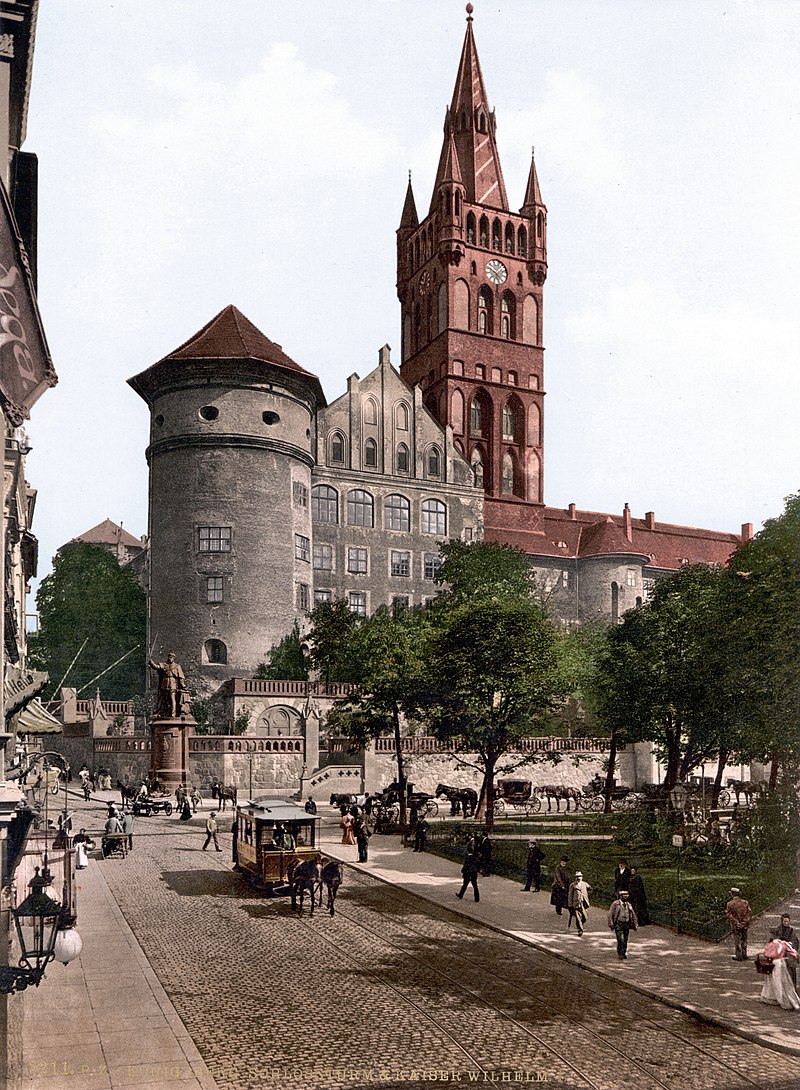
- Königsberg Castle before World War I
- Ancient site.caption
- Königsberg Castle before World War I; ruined in WWII, ruins demolished in 1968–1969 on Soviet leader Leonid Brezhnev's orders
- Ancient site.map_type
- Baltic Sea#Europe
- Ancient site.map_caption
- Königsberg was a port city on the southeastern corner of the Baltic Sea. It is today known as Kaliningrad and is part of Russia.
- Ancient site.relief
- yes
- Ancient site.occupants
- Germans, Sambians, Poles, Jews, Russians, Lithuanians
- Ancient site.event
- World War II
- Ancient site.ownership
- State of the Teutonic Order, Kingdom of Poland, Duchy of Prussia, Brandenburg-Prussia, Kingdom of Prussia, Russian Empire, German Empire, Nazi Germany, Soviet Union, Russian Federation
via Wikipedia infobox
Wikidata facts
- Country
- Soviet Union
- Located in
- Province of Prussia
- Elevation
- 48
- Capital of
- State of the Teutonic Order
- Followed by
- Kaliningrad
- Image
- Königsberg Castle.jpg
- Significant event
- Battle of Königsberg
Show 12 more facts
- Commons category
- Königsberg
- topic's main category
- Category:Königsberg
- inception
- 1255-00-00
- dissolved, abolished or demolished date
- 1945-01-01
- category for people born here
- Category:Births in Königsberg
- category for people who died here
- Category:Deaths in Königsberg
- permanent duplicated item
- Kaliningrad
- category of associated people
- Category:People from Königsberg
- replaced by
- Kaliningrad
- native label
- Königsberg
- P8168
- Veckring
- P12749
- Leopold Hager
via Wikidata · CC0
Travel guide
Understand
thumb|The Kaliningrad Cathedral
Get around
The city has bus, minibus, trolleybus, tram and commuter railway networks.
Do
thumb|The Seven Bridges Problem
Buy
Amber jewellery and art and craft is the local speciality:
Drink
Local beer brands that are available in stores.
Go next
thumb|Curonian Spit Curonian Spit A nearly 50-km-long spit stretching between Zelenogradsk and the Lithuanian border, separating the Baltic Sea from the Curonian Bay, it includes pine forest, hiking paths (beware of encephalitis-bearing ticks), and beaches. The average height of the sand dunes is 35 m, with some reaching 70 m. Entry fees are per person, plus per car. The entire spit, including the Lithuanian part, is a world heritage site.
Travel guide from Wikivoyage (CC BY-SA 4.0)
~59 min read
Encyclopedic overview
37 sectionsContents
- Name
- History
- Sambians
- Arrival of the Teutonic Order
- Polish sovereignty
- Duchy of Prussia
- Brandenburg-Prussia
- Kingdom of Prussia
- Russian occupation
- Kingdom of Prussia after 1773
- Weimar Republic
- Nazi Germany
- Persecution of Jews under the Nazi regime
- Persecution of Poles during World War II
- Destruction in World War II
- Soviet Kaliningrad
- Demographics
- Jews
- Lithuanians
- Poles
- French
- Culture and society
- Notable people
- Languages
- Arts
- Königsberg Castle
- Education
- Multiculturalism
- Sports
- Cuisine
- Fortifications
- See also
- Notes
- References
- Citations
- Sources
- External links
Königsberg (, ) was the historic German name of the city that is now modern-day Kaliningrad, Russia. The city was founded in 1255 on the site of the Old Prussian settlement Twangste by the Teutonic Knights during the Baltic Crusades. It was named in honour of King Ottokar II of Bohemia, who led a campaign against the pagan Old Prussians, a Baltic tribe that was native to the area.
A Baltic port city, it successively became the capital of the State of the Teutonic Order and the Duchy of Prussia. Königsberg remained the coronation city of the Prussian monarchy from 1701 onwards, though the capital was Berlin. From the thirteenth century, it was inhabited by Germans and Old Prussians, then also by Poles, Lithuanians and French from the 14th, 15th and 17th centuries, respectively. Although a predominantly German-speaking city, it had a profound influence upon the Lithuanian and Polish cultures. It was a publishing center of Lutheran literature; this included the first Polish translation of the New Testament, printed in the city in 1551, as well as the first book in Lithuanian and the first Lutheran catechism, both printed in Königsberg in 1547.
Excerpted from Wikipedia’s “Königsberg” article, available under the CC BY-SA 4.0 licence.
Gallery (32)
On the map
2 mapped locations