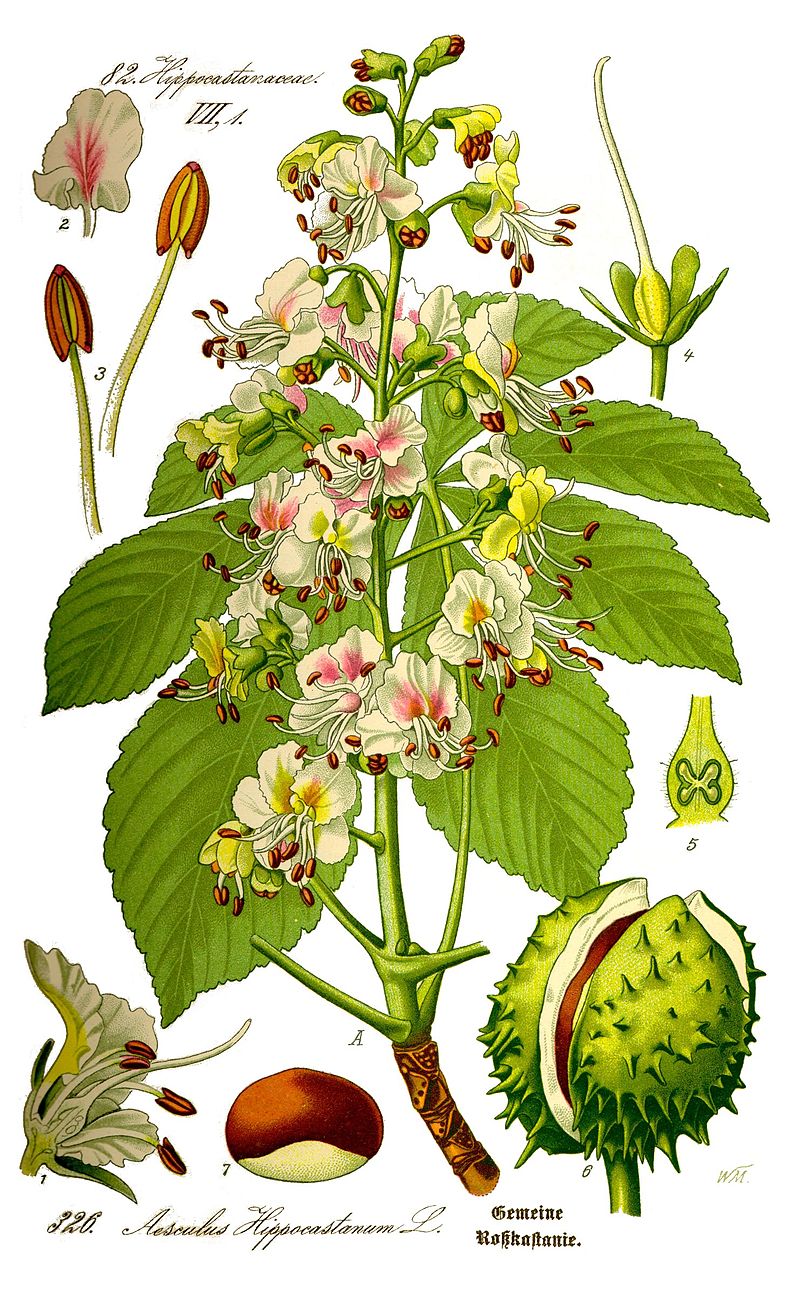
File:Illustration_Aesculus_hippocastanum0_clean.jpg · Wikimedia Commons · See Wikimedia Commons
Aesculus hippocastanum
Sign in to saveAlso known as conker tree, horse chestnut, horse chestnut tree, horse-chestnut, white horse chestnut, common horse chestnut, European horse chestnut, European horsechestnut
species of plant
OverviewAI-generated
Aesculus hippocastanum, commonly known as the horse-chestnut, is a species of deciduous plant in the family Sapindaceae. It belongs to the genus Aesculus and is classified within the order Sapindales. The species produces fruit in the form of capsules and utilizes zoochory for seed dispersal. Its inflorescence is a panicle, and it has uses as a medicinal plant and for wood.
The taxon is endemic to the Balkans, with native ranges including Albania, Bulgaria, Greece, the NW. Balkan Pen., Turkmenistan, and Türkiye. It is also recorded in China. The IUCN Red List assessed the species as Vulnerable in 2017. Occurrence records exist in Canada, the United States, and Germany, with collections held by institutions such as the University of Alberta Museums and Memorial University of Newfoundland.
Synthesized by Vinony from 48 facts across 8 sources: Wikidata, GBIF, iNaturalist, IUCN Red List, Gbif Occ, Plants of the World, iDigBio, Vinony graph. Generated from structured data (not the Wikipedia text) and checked against those facts — may still contain errors.
Species
Vulnerablehorse-chestnut
Aesculus hippocastanum
SPECIES
- KingdomPlantae
- PhylumTracheophyta
- ClassMagnoliopsida
- OrderSapindales
- FamilySapindaceae
Marronnier commun, marronnier d'Inde, marronnier blanc Le marronnier commun, marronnier d'Inde ou marronnier blanc (Aesculus hippocastanum L.) est un arbre, anciennement de la famille des Hippocastanaceae (Classification de Cronquist (1981)), laquelle est aujourd'hui incluse dans la famille des Sapindaceae (en classification APGIII). Il est parfois appelé châtaignier de mer, marronnier faux-châtaignier ou châtaignier des chevaux. Il est souvent confondu avec le châtaignier commun (Castanea sativa), qui produit la véritable châtaigne comestible. Ses cousins nord-américains, nommés paviers, ont des feuilles plus lisses et non dentelées, avec des fleurs qui rappellent celles du marronnier européen. Le marronnier est très répandu dans les parcs publics et le long des avenues en Europe et Amérique du Nord. L’espèce est considérée en Europe comme « vulnérable » par le comité français de l’Union internationale pour la conservation de la nature,. Toutefois, ceci ne s'applique pas aux individus plantés en France, mais uniquement aux populations sauvages, originaires des Balkans.
via GBIF · IUCN · Kew POWO
Museum specimens
- Specimen records
- 2,096
- With media
- 1,458
- Family
- Sapindaceae
- Collections
- UNIVERSITY OF ALBERTA MUSEUMS, NY, MSC, OSU, MEMORIAL UNIVERSITY OF NEWFOUNDLAND, CM
- Recorded in
- Canada, United States, Germany
Wikidata facts
Show 14 more facts
- taxon rank
- species
- taxon name
- Aesculus hippocastanum
- Commons category
- Aesculus hippocastanum
- IUCN conservation status
- Vulnerable
- Commons gallery
- Aesculus hippocastanum
- endemic to
- Balkans
- has fruit type
- capsule
- taxon common name
- navadni divji kostanj
- taxon range
- China
- foliage type
- deciduous plant
- short name
- A. hippocastanum
- taxon author citation
- L.
- inflorescence
- panicle
Sources (9)
via Wikidata · CC0
~9 min read
Encyclopedic overview
Aesculus hippocastanum, the horse chestnut, is a species of flowering plant in the maple, soapberry and lychee family Sapindaceae. It is a large, deciduous, synoecious (hermaphroditic-flowered) tree. It is also called horse-chestnut, European horsechestnut, buckeye, and conker tree. It is not to be confused with the sweet chestnut or Spanish chestnut, Castanea sativa, which is a tree in another family, Fagaceae.
Description
Excerpted from Wikipedia’s “Aesculus hippocastanum” article, available under the CC BY-SA 4.0 licence.
Gallery (19)
Available in 69 languages
- Español
- Français
- Deutsch
- 中文
- 日本語
- Русский
- Português
- Italiano
- العربية
- Albanian
- Albanian
- Aragonese
- Armenian
- Asturian
- Azerbaijani
- Bahasa Indonesia
- Basque
- bat_smg
Show 50 more
- be_x_old
- Belarusian
- Bosnian
- Bulgarian
- Catalan
- Cebuano
- Croatian
- Czech
- Danish
- Egyptian Arabic
- Esperanto
- Estonian
- Finnish
- Galician
- Georgian
- Greek
- Hebrew
- Hungarian
- Icelandic
- Ido
- Irish
- Latin
- Latvian
- Lithuanian
- Macedonian
- Nederlands
- Northern Frisian
- Norwegian
- Norwegian Nynorsk
- Occitan
- Piedmontese
- Polski
- Romanian
- Sardinian
- Scots
- Serbian
- Serbian (Latin)
- simple
- Slovak
- Slovenian
- Svenska
- Tiếng Việt
- Türkçe
- Ukrainian
- Upper Sorbian
- Uzbek
- Waray
- Wu Chinese
- فارسی
- 한국어
via Wikidata sitelinks · CC0