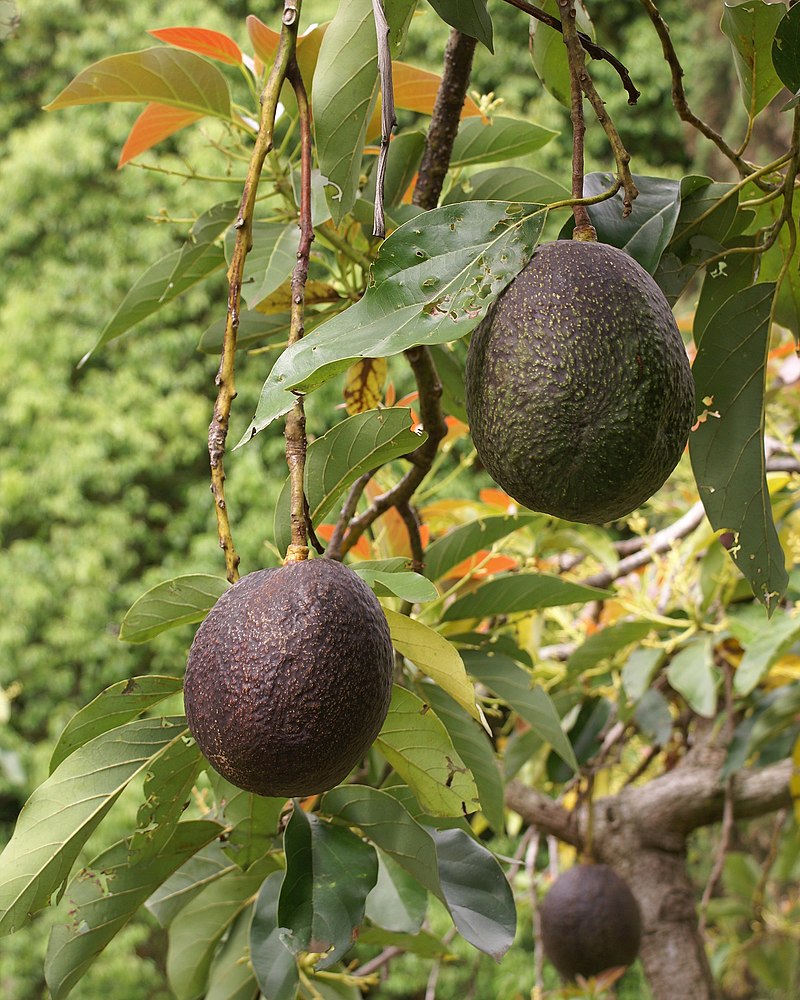
File:Persea_americana_fruit_2.JPG · Wikimedia Commons · See Wikimedia Commons
Aguacate
Sign in to saveAlso known as abacate, avocados, avocadoes, Persea americana, alligator pear
The avocado, alligator pear or avocado pear (Persea americana) is an evergreen tree in the laurel family (Lauraceae). It is native to the Americas, with archaeological evidence of early human avocado use dating back thousands of years across various regions of Central and South America. It was prized for its large and unusually oily fruit. The native range of avocado (Persea americana) extends from Mexico to Peru, encompassing much of Central America and parts of northern and western South America.
OverviewAI-generated
Persea americana is a species within the genus Persea, described by Mill. It is classified as a useful plant and a taxon. The organism is the source of avocado and avocado oil. Its common names include Avocado, 酪梨, hedelmäavokado, and 鳄梨. The fruit is a drupe that can be dark green, green, purple, or black.
The country of origin is Mexico. The taxon range includes Fujian and Guangdong. It has uses in afforestation, as a fruit vegetable, and as a medicinal plant. The IUCN conservation status is Least Concern, recorded in 2017. The taxon has been present since about 15 million years ago. It is referenced by 1,082 other encyclopedia articles.
Synthesized by Vinony from 25 facts across 3 sources: Wikidata, IUCN Red List, Vinony graph. Generated from structured data (not the Wikipedia text) and checked against those facts — may still contain errors.
Species
Least Concern鳄梨(学名:Persea americana),又称牛油果、油梨、樟梨、酪梨,是一種生長於熱帶的樟科树的果實,這種樹也被稱為鱷梨。長期以來它的原產地都被定爲墨西哥中南部地區,但後來有考古發現稱秘魯在8,000至15,000年前就已經有鱷梨存在了。現在鱷梨已經被移植到世界各地的熱帶和地中海氣候地區。酪梨雖然是植物的果實,但在營養學來說它被歸類為油脂類,因為其脂肪含量比水份還要多。
via IUCN
Wikidata facts
- Instance of
- taxon
- Subclass of
- useful plant
- Parent taxon
- Persea
- Country of origin
- Mexico
- Image
- Persea americana fruit 2.JPG
- Has use
- medicinal plant
Show 18 more facts
- taxon name
- Persea americana
- taxon rank
- species
- Commons category
- Persea americana
- Commons gallery
- Persea americana
- this taxon is source of
- avocado oil
- taxon common name
- avocatier
- different from
- avocado
- has fruit type
- drupe
- IUCN conservation status
- Least Concern
- described by source
- Encyclopædia Britannica 11th edition
- start time
- 15000000-0
- on focus list of Wikimedia project
- Wikipedia:Vital articles/Level/4
- fruit color
- black
- taxon author citation
- Mill.
- taxon range
- Guangdong
- short name
- P. americana
- Unicode character
- 🥑
via Wikidata · CC0
~34 min read
Encyclopedic overview
42 sectionsContents
- Description
- Flower
- Fruit
- Taxonomy and evolution
- History
- Etymology
- Regional names
- Cultivation
- Domestication and cultivation history
- Requirements
- Harvest and postharvest
- Breeding
- Propagation and rootstocks
- As a houseplant
- Pests and diseases
- Cultivation by location
- Cultivation in Mexico
- Cultivation in California
- Cultivation in Peru
- Cultivation in Chile
- Cultivars
- A cultivars
- B cultivars
- Other cultivars
- Stoneless avocado
- Production
- International market
- Toxicity
- Allergies
- Toxicity to animals
- Uses
- Nutrition
- Fat composition
- Research
- Culinary
- International
- Leaves
- See also
- Explanatory notes
- References
- Further reading
- External links
The avocado, alligator pear or avocado pear (Persea americana) is an evergreen tree in the laurel family (Lauraceae). It is native to the Americas, with archaeological evidence of early human avocado use dating back thousands of years across various regions of Central and South America. It was prized for its large and unusually oily fruit. The native range of avocado (Persea americana) extends from Mexico to Peru, encompassing much of Central America and parts of northern and western South America.
Its fruit, sometimes also referred to as an alligator pear or avocado pear, is botanically a large berry containing a single large seed. Sequencing of its genome showed that the evolution of avocados was shaped by polyploidy events and that commercial varieties have a hybrid origin. Avocado trees are partly self-pollinating, and are often propagated through grafting to maintain consistent fruit output. Avocados are presently cultivated in the tropical and Mediterranean climates of many countries. , Mexico is the world's leading producer of avocados, supplying 29% of the global harvest of 10.5 million tonnes.
Excerpted from Wikipedia’s “Aguacate” article, available under the CC BY-SA 4.0 licence.
Gallery (43)
Available in 137 languages
- Español
- Français
- Deutsch
- 中文
- 日本語
- Русский
- Português
- Italiano
- العربية
- हिन्दी
- Afrikaans
- Albanian
- Amharic
- Aragonese
- Armenian
- Assamese
- Asturian
- azb
Show 118 more
- Azerbaijani
- Bahasa Indonesia
- Balinese
- Bangla
- Banjar
- Basque
- be_x_old
- Belarusian
- Bikol
- Bislama
- Bulgarian
- Burmese
- Catalan
- Cebuano
- Central Kurdish
- Chamorro
- Croatian
- Czech
- dag
- Danish
- Egyptian Arabic
- Esperanto
- Estonian
- Fijian
- Filipino
- Finnish
- Galician
- Georgian
- Greek
- Haitian Creole
- Hebrew
- Hungarian
- hyw
- Icelandic
- Interlingua
- Irish
- Javanese
- Kannada
- Kazakh
- kge
- Khmer
- Kikuyu
- Kinyarwanda
- Komi
- Komi-Permyak
- Kurdish
- Kyrgyz
- Ladino
- Lao
- Latin
- Latvian
- lbe
- Lingala
- Lithuanian
- Luxembourgish
- Madurese
- Malagasy
- Malay
- Malayalam
- map_bms
- Marathi
- Minangkabau
- Mingrelian
- Mirandese
- nah
- Navajo
- Nederlands
- Nepali
- Northern Frisian
- Northern Sotho
- Norwegian
- Norwegian Nynorsk
- Old English
- Ossetic
- Pampanga
- Piedmontese
- Polski
- Punjabi
- Quechua
- Romanian
- Saterland Frisian
- Scots
- Serbian
- Serbian (Latin)
- Shona
- simple
- Slovak
- Slovenian
- Somali
- Sundanese
- Svenska
- Swahili
- Tahitian
- Tajik
- Tamil
- Tatar
- Telugu
- Tiếng Việt
- Tigrinya
- Tongan
- Tumbuka
- Türkçe
- Udmurt
- Ukrainian
- Urdu
- Uyghur
- Uzbek
- Waray
- Welsh
- Western Mari
- Western Panjabi
- Wu Chinese
- Yiddish
- zh_min_nan
- zh_yue
- فارسی
- ไทย
- 한국어
via Wikidata sitelinks · CC0