Encyclopedia of Life · EOL (see source)
OverviewAI-generated
Alytes is a genus of amphibians within the class Amphibia and order Anura. It belongs to the family Alytidae, also referred to as painted frogs, and is part of the phylum Chordata in the kingdom Animalia. The taxon was described in sources including the Encyclopædia Britannica 11th edition and the New International Encyclopedia.
Records for this genus are held by institutions such as UNICAMP, MZLU, MNHN, UAFMC, and NRM. These records originate from the United Kingdom, Spain, Portugal, and a location listed as N/A. The subject has been referenced by 34 other encyclopedia articles.
Synthesized by Vinony from 21 facts across 5 sources: Wikidata, GBIF, Gbif Occ, iDigBio, Vinony graph. Generated from structured data (not the Wikipedia text) and checked against those facts — may still contain errors.
Species
GENUS
- KingdomAnimalia
- PhylumChordata
- ClassAmphibia
- OrderAnura
- FamilyAlytidae
Die Geburtshelferkröten (Alytes) sind eine Gattung der Froschlurche (Anura), die nach der hier gebräuchlichen Systematik der Amphibien zur Familie Alytidae gezählt wird. Es handelt sich um recht kleine, stammesgeschichtlich „urtümliche“ Amphibien mit einer besonderen Form der Brutpflege. Inhaltsverzeichnis 1 Allgemeine Merkmale 2 Verbreitung 3 Fortpflanzung 4 Taxonomie 4.1 Phylogenetische Systematik 5 Sonstiges 6 Schutz 7 Einzelnachweise 8 Weblinks Allgemeine Merkmale Geburtshelferkröten sind kleine, zierliche bis gedrungene Froschlurche von meist unscheinbarer, grauer oder brauner Färbung. Ihre Pupillen sind senkrecht gestellt und sehen bei hellem Licht schlitzförmig aus; das Trommelfell ist meist gut erkennbar. Auf der Unterseite der Vorderfüße befinden sich je nach Art zwei oder drei Handballen. Ihre Rufe erinnern an helle Flöten-, Pfeif- oder Glockentöne. Verbreitung Die Verbreitung beschränkt sich auf das westliche und südwestliche Europa sowie einen sehr kleinen Teil Nordwestafrikas. Dabei sticht besonders die Iberische Halbinsel mit der Anwesenheit von drei Festlandsarten sowie einer weiteren, auf den Balearen endemischen Art hervor. Nur die Gemeine Geburtshelferkröte kommt
via GBIF
Museum specimens
- Specimen records
- 22
- Family
- Alytidae
- Collections
- UNICAMP, MZLU, MNHN, UAFMC, NRM
- Recorded in
- United Kingdom, Spain, N/A, Portugal, Espagne
Wikidata facts
- Instance of
- taxon
- Parent taxon
- painted frogs
- Image
- AlytesObstet.jpg
Show 4 more facts
- taxon rank
- genus
- taxon name
- Alytes
- Commons category
- Alytes
- topic's main category
- Category:Alytes
Sources (1)
via Wikidata · CC0
~3 min read
Encyclopedic overview
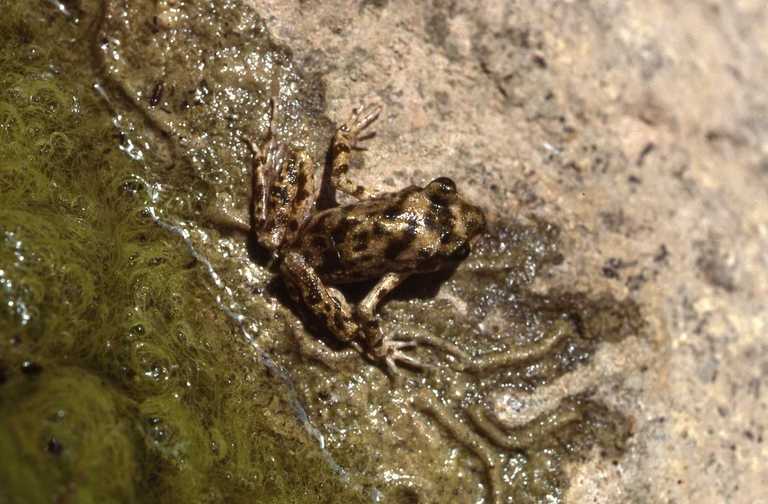
Midwife toads are a genus (Alytes) of frogs in the family Alytidae (formerly Discoglossidae), and are found in most of Continental Europe and Northwestern Africa. It has also been introduced to Great Britain. Characteristic of these toad-like frogs is their parental care; the males carry a string of fertilised eggs on their backs, hence the name "midwife". The female expels a strand of eggs, which the male fertilizes externally. He then wraps them around his legs to protect them from predators in the water. When they are ready to hatch, the male wades into shallow water, where he allows the tadpoles to leap out of their eggs. Five separate species of midwife toads are found across western Europe, northern Africa, and Mallorca.
Midwife toads can be found in the snows of the Pyrenees, living at heights of 5,000–6,500 feet in areas such as the Néouvielle massif. Unlike the thin tongue of many amphibians, the midwife's tongue is round and flattened; its former family name, Discoglossidae, means "round tongue". In parts of France, midwife toads live in sand dunes by the sea. They share this habitat with natterjack toads.
Excerpted from Wikipedia’s “Alytes” article, available under the CC BY-SA 4.0 licence.