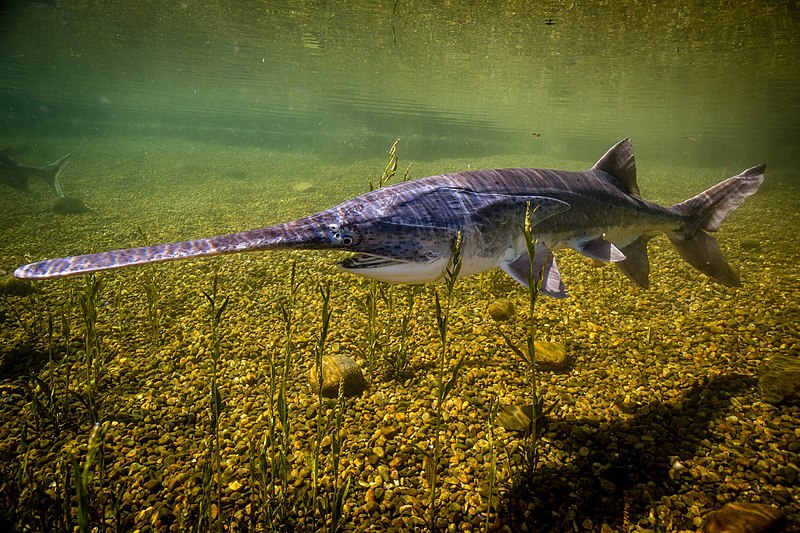
File:Paddlefish-USFWS-Fish-and-Aquatic-Conservation-2160x1440.jpg · Wikimedia Commons · See Wikimedia Commons
American paddlefish
Sign in to saveAlso known as paddlefish, Mississippi paddlefish, spoonbill, spoon-billed cats, Polyodon spathula, Paddlefish, duckbill cat
planktivorous freshwater fish in the Polyodontidae family native to North America
OverviewAI-generated
The American paddlefish, scientifically named *Polyodon spathula*, is a species within the family Polyodontidae. It belongs to the order Acipenseriformes, class Chondrostei, and phylum Chordata. The taxon is accepted under the authority of Walbaum, 1792, and is classified as a freshwater organism.
Common names for this species include Paddlefish, Poisson Spatule, Duckbill Cat, and Spadefish. Its parent taxon is *Polyodon*. The species is currently listed as Vulnerable on the IUCN Red List, a status assigned in 2022.
Synthesized by Vinony from 20 facts across 4 sources: Wikidata, WoRMS, IUCN Red List, Vinony graph. Generated from structured data (not the Wikipedia text) and checked against those facts — may still contain errors.
Species
VulnerableSpecies
- PhylumChordata
- ClassChondrostei
- OrderAcipenseriformes
- FamilyPolyodontidae
二名法 Polyodon spathula(Walbaum in Artedi, 1792) 匙吻鲟(学名:Polyodon spathula),又名美国匙吻鲟、鴨嘴鱘、及“密西西比河匙吻鲟”,是一种生活在密西西比河缓慢流动水域的匙吻鲟。它似乎已经从伊利湖及其支流灭绝。它们与鲟鱼密切相关。这种大型淡水鱼可以长到220厘米(7英尺),重达100公斤(220磅)。匙吻鲟的名字和学名来自其独特的吻部,呈扁平桨状,特别长。匙吻鲟被认为使用其桨型吻里的感应器检测猎物,以及在迁徙到产卵地时用以导航。匙吻鲟主要以浮游动物,也以甲壳类和双壳类生物为食。 匙吻鲟是目前世界上匙吻鲟科仅存的两属两种之一,另一种为生活在中国长江的白鲟,后者几近灭绝。 匙吻鲟在野外非常稀少,但在台湾地区有很多業者均有人工養殖。 参考资料 Polyodon spathula. IUCN Red List of Threatened Species 2006. International Union for Conservation of Nature. 2004. Database entry includes a lengthy justification of why this species is vulnerable Polyodon spathula. Integrated Taxonomic Information System. [30 January 2006] (英语). Froese, Rainer & Daniel Pauly, eds. (2005). Polyodon spathula in FishBase. 2005年10月版本 查 论 编 现存的鲟和白鲟种类 动物界 脊索动物门 脊椎动物亚门 硬骨魚纲 软骨硬鳞附类亚纲 鲟形目 鲟科鲟属 西伯利亞鱘(A. baerii baerii) 贝加尔鲟鱼(A. baerii baicalensis)(英语:Baikal sturgeon) 短吻鱘(A. brevirostrum) 达氏鲟(A. dabryanus) 湖鲟(A. fulvescens)(英语:Lake sturgeon) 俄羅斯鱘(A. gueldenstaedtii) 绿鲟(A. medirostris) 萨哈林岛鲟(A. mikadoi)(英语:Sakhalin sturgeon) 施氏鲟(A. multiscutatus) 意大利鲟(A. naccarii)(英语:Adriatic sturgeon) 裸腹鲟(A. nudiventris) 海湾鲟(A. oxyrinchus desotoi)(英语:Gulf sturgeon) 大西洋鲟(A. oxyrinchus oxyrinchus)(英语:Atlantic sturgeon) 波斯鲟(A. p
via IUCN
Wikidata facts
Show 7 more facts
- taxon rank
- species
- IUCN conservation status
- Vulnerable
- taxon name
- Polyodon spathula
- Commons category
- Polyodon spathula
- Commons gallery
- Polyodon spathula
- taxon common name
- Löffelstör
- short name
- P. spathula
Sources (1)
via Wikidata · CC0
~27 min read
Encyclopedic overview
The American paddlefish (Polyodon spathula), also known as a Mississippi paddlefish, spoon-billed cat, or spoonbill, is a species of ray-finned fish. It is the last living species of paddlefish (Polyodontidae). This family is most closely related to the sturgeons; together they make up the order Acipenseriformes, which are one of the most basal living groups of ray-finned fish. Fossil records of other paddlefish species date back 125 million years to the Early Cretaceous, with records of Polyodon extending back 65 million years to the early Paleocene. The American paddlefish is a smooth-skinned freshwater fish with an almost entirely cartilaginous skeleton and a paddle-shaped rostrum (snout), which extends nearly one-third its body length. It has been referred to as a freshwater shark because of its heterocercal tail or caudal fin resembling that of sharks, though it is not closely related. The American paddlefish is a highly derived fish because it has evolved specialised adaptations, such as filter feeding. Its rostrum and cranium are covered with tens of thousands of sensory receptors for locating swarms of zooplankton, its primary food source. The only other species of paddlefish that survived to modern times was the Chinese paddlefish (Psephurus gladius), last sighted in 2003 in the Yangtze River in China and considered to have gone extinct no later than 2010.
The American paddlefish is native to the Mississippi River basin and once moved freely under the relatively unaltered conditions that existed prior to the early 1900s. It commonly inhabited large, free-flowing rivers, braided channels, backwaters, and oxbow lakes throughout the Mississippi River drainage basin, and adjacent Gulf Coast drainages. Its peripheral range extended into the Great Lakes, with occurrences in Lake Huron and Lake Helen in Canada until about 1917. American paddlefish populations have declined dramatically primarily because of overfishing, habitat destruction, and pollution. Poaching has also been a contributing factor to its decline and is liable to continue to be so as long as the demand for caviar remains strong. Naturally occurring American paddlefish populations have been extirpated from most of their peripheral range, as well as from New York, Maryland, Virginia, and Pennsylvania. They have been reintroduced in the Allegheny, Monongahela and Ohio river systems in western Pennsylvania. However, their current range has been reduced to the Mississippi and Missouri River tributaries and Mobile Bay drainage basin. American paddlefish are currently found in twenty-two states in the U.S., and are protected under state, federal and international laws.
Excerpted from Wikipedia’s “American paddlefish” article, available under the CC BY-SA 4.0 licence.