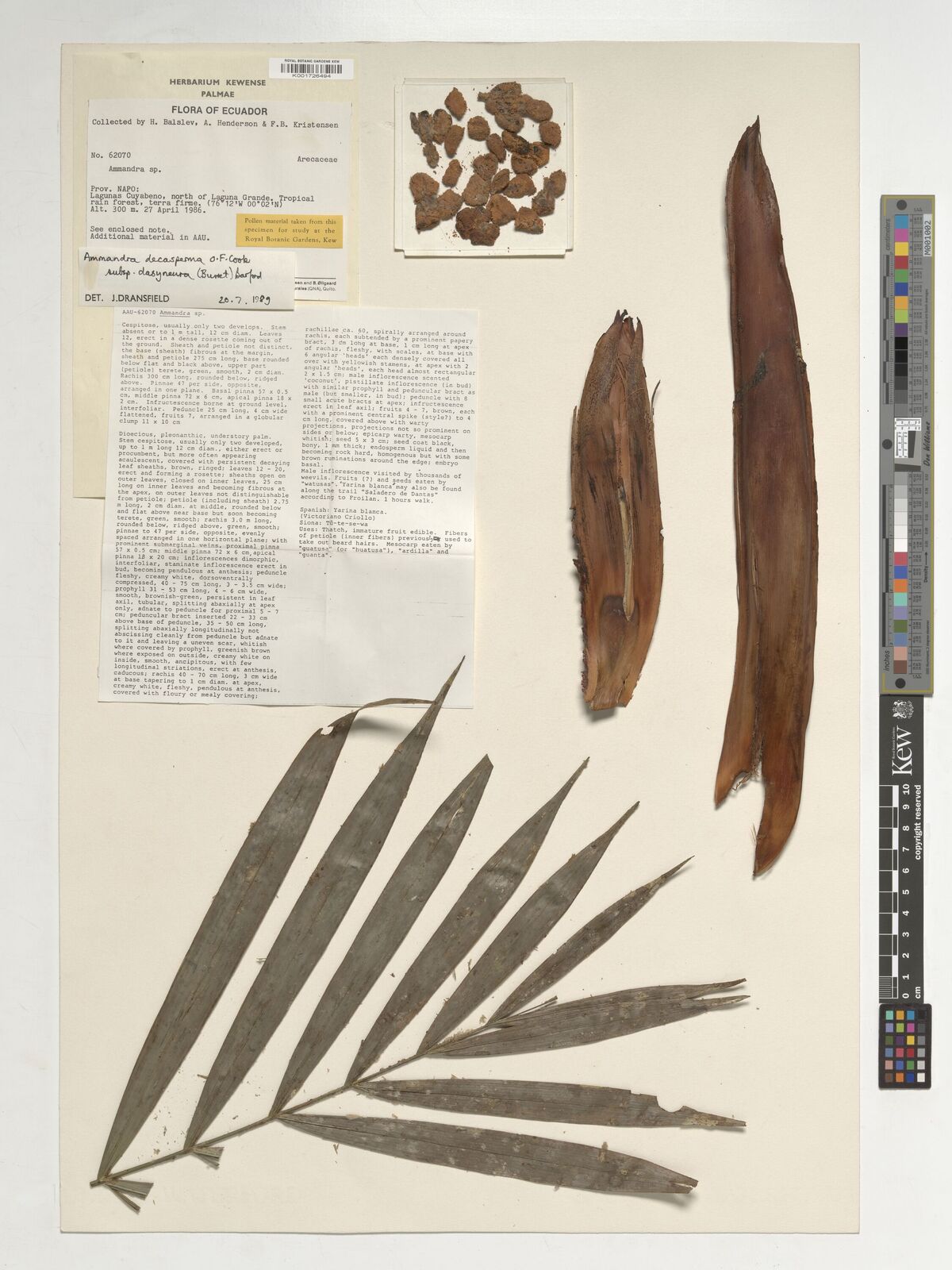
Ammandra decasperma · Kew POWO · Kew Plants of the World Online
Ammandra decasperma
Sign in to saveAmmandra is a monotypic genus of flowering plants in the palm family found in Colombia and Ecuador, where it is endangered. The sole species is Ammandra decasperma, although another species name has been proposed. It is a pinnate-leaved, dioecious palm whose seeds and petioles are used in button and basket making, respectively. It is commonly called ivory palm or cabecita.
Species
SPECIES
- KingdomPlantae
- PhylumTracheophyta
- ClassLiliopsida
- OrderArecales
- FamilyArecaceae
Common Name: Tagua, cabecillo, cabecita, palma cabeza
via GBIF · Kew POWO
Museum specimens
- Specimen records
- 22
- With media
- 36
- Family
- Arecaceae; Arecaceae; Arecaceae
- Collections
- UTEP, NY, US, MO
- Recorded in
- Colombia
~3 min read
Encyclopedic overview
6 sectionsContents
- Description
- Taxonomy
- Distribution and habitat
- Cultivation and uses
- References
- External links
Ammandra is a monotypic genus of flowering plants in the palm family found in Colombia and Ecuador, where it is endangered. The sole species is Ammandra decasperma, although another species name has been proposed. It is a pinnate-leaved, dioecious palm whose seeds and petioles are used in button and basket making, respectively. It is commonly called ivory palm or cabecita.
==Description== Ammandra decasperma grows in multi-headed clusters, the trunks usually remaining underground or prostrate upon it. Despite the negligible trunk size, the leaves reach over 6 m long, slightly arching, on 2 m petioles. The linear leaflets are dark green, 60–90 cm long, and emerge from the rachis in the same plane. In male plants, the inflorescence is a long spike covered in short branches of white to yellow flowers, the female's being much shorter and more compact. The round fruit grows in clusters of 3-6 and is covered in pointed warts, each fruit containing six or more kidney shaped seeds.
Excerpted from Wikipedia’s “Ammandra decasperma” article, available under the CC BY-SA 4.0 licence.
Gallery (2)
Available in 15 languages
- Español
- Français
- Deutsch
- 中文
- Português
- العربية
- Cebuano
- Croatian
- Egyptian Arabic
- Nederlands
- Polski
- Svenska
- Tiếng Việt
- Waray
via Wikidata sitelinks · CC0