File:Amyg.png · Wikimedia Commons · See Wikimedia Commons
amygdala
Sign in to saveAlso known as Amygdaloid, pl. amygdalae, pl. amygdalas
right|thumb|300px|Human brain in the coronal orientation. Amygdalae are shown in dark red.
Key facts
- Brain.Name
- Amygdala
- Brain.Latin
- corpus amygdaloideum
- Brain.Image
- amyg.png
- Brain.Caption
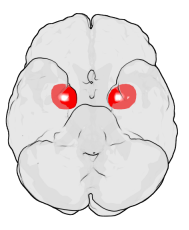
- Location of amygdalae in the human brain (view from below, anterior is at top)
- Brain.Image2
- Amigdale1.jpg
- Brain.Caption2
- Subdivisions of the amygdala
via Wikipedia infobox
Wikidata facts
- Part of
- limbic system
- Image
- Amyg.png
Show 4 more facts
- NCI Thesaurus ID
- C12440
- topic's main category
- Category:Amygdala
- Commons category
- Amygdala
- short name
- Amg
via Wikidata · CC0
~24 min read
Encyclopedic overview
16 sectionsContents
- Structure
- Hemispheric specializations
- <span id="Development"></span><span id="Sex distinction"></span>Development and sex distinction
- Function
- Connections
- Emotional learning
- Memory modulation
- Neuropsychological correlates of amygdala activity
- Social function
- Alcoholism
- Anxiety
- Psychological disorders
- See also
- References
- Further reading
- External links
right|thumb|300px|Human brain in the coronal orientation. Amygdalae are shown in dark red.
The amygdala (; : amygdalae or amygdalas; also '''') is a paired nuclear complex present in the cerebral hemispheres of vertebrates. It is considered part of the limbic system. In primates, it is located medially within the temporal lobes. It consists of many nuclei, each made up of further subnuclei. The subdivision most commonly made is into the basolateral, central, cortical, and medial nuclei together with the intercalated cell clusters. The amygdala has a primary role in the processing of memory, decision-making, and emotional responses (including fear, anxiety, and aggression). The amygdala was first identified and named by Karl Friedrich Burdach in 1822.
Excerpted from Wikipedia’s “amygdala” article, available under the CC BY-SA 4.0 licence.