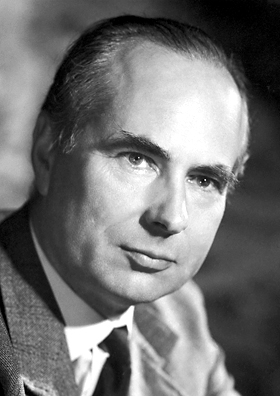
File:Andrew_Fielding_Huxley_nobel.jpg · Wikimedia Commons · See Wikimedia Commons
Andrew Huxley
Sign in to saveAlso known as Sir Andrew Huxley, Andrew Fielding Huxley, Sir Andrew Fielding Huxley, A. F. Huxley
English physiologist and biophysicist (1917–2012)
Andrew Huxley was an English scientist who made major discoveries about how nerves and muscles work at the microscopic level, fundamentally changing our understanding of human biology. His work earned him a Nobel Prize and remains influential in fields ranging from medicine to basic biological research.
AI-generated from the Wikipedia summary — may contain errors.
Person · Open Library
- Works
- 5
Top works
- Religion, law and language
- Thai law, Buddhist law
- New Light on Old Thai Law Texts
- Religion, Law and Tradition
- Thai Law
via Open Library + Wikidata
Nobel Prize
- The Nobel Prize in Physiology or Medicine1963
“for their discoveries concerning the ionic mechanisms involved in excitation and inhibition in the peripheral and central portions of the nerve cell membrane”
Shared · 1/3 portion
Wikidata facts
- Instance of
- human
- Given name
- Andreas
- Gender
- male
- Citizenship
- United Kingdom
- Place of birth
- Hampstead
- Place of death
- Cambridge
- Father
- Leonard Huxley
- Occupation
- biologist
- Educated at
- Imperial College School of Medicine
- Employer
- University College London
- Languages spoken
- English language
- Family
- Huxley family
- Noble title
- Knight Bachelor
- Field of work
- physiology
- Image
- Andrew huxley trinity.png
- Residence
- Grantchester
Show 11 more facts
- member of
- American Philosophical Society
- Commons category
- Andrew Huxley
- date of birth
- 1917-11-22
- date of death
- 2012-05-30
- cause of death
- disease
- name in native language
- Andrew Fielding Huxley
- maintained by WikiProject
- WikiProject Mathematics
- P8168
- Bogi Løkin
- P12749
- Atkins
- manner of death
- natural causes
- interested in
- physiology
Sources (15)
via Wikidata · CC0
~14 min read
Encyclopedic overview
Sir Andrew Fielding Huxley (22 November 1917 – 30 May 2012) was an English physiologist and biophysicist. He was born into the prominent Huxley family. After leaving Westminster School in central London, he went to Trinity College, Cambridge, on a scholarship, after which he joined Alan Hodgkin to study nerve impulses. Their eventual discovery of the basis for propagation of nerve impulses (called an action potential) earned them the Nobel Prize in Physiology or Medicine in 1963. They made their discovery from the giant axon of the Atlantic squid. Soon after the outbreak of the Second World War, Huxley was recruited by the British Anti-Aircraft Command and later transferred to the Admiralty. After the war he resumed research at the University of Cambridge, where he developed interference microscopy that would be suitable for studying muscle fibres.
In 1952, he was joined by a German physiologist Rolf Niedergerke. Together they discovered in 1954 the mechanism of muscle contraction, popularly called the "sliding filament theory", which is the foundation of our modern understanding of muscle mechanics. In 1960 he became head of the Department of Physiology at University College London. He was elected a Fellow of the Royal Society in 1955, and President in 1980. The Royal Society awarded him the Copley Medal in 1973 for his collective contributions to the understanding of nerve impulses and muscle contraction. He was conferred a Knight Bachelor by the Queen in 1974, and was appointed to the Order of Merit in 1983. He was a fellow of Trinity College, Cambridge, until his death.
Excerpted from Wikipedia’s “Andrew Huxley” article, available under the CC BY-SA 4.0 licence.
Gallery (2)
Available in 63 languages
- Español
- Français
- Deutsch
- 中文
- 日本語
- Русский
- Português
- Italiano
- العربية
- Armenian
- azb
- Bahasa Indonesia
- Bangla
- Basque
- Belarusian
- Bulgarian
- Catalan
- Central Kurdish
Show 44 more
- Croatian
- Czech
- Danish
- Egyptian Arabic
- Esperanto
- Estonian
- Finnish
- Galician
- Georgian
- Haitian Creole
- Hebrew
- Hungarian
- Icelandic
- Ido
- Irish
- Kazakh
- Latin
- Low German
- Macedonian
- Malay
- Mazanderani
- Nederlands
- Norwegian
- Occitan
- Polski
- Romanian
- Scots
- Serbian
- Serbian (Latin)
- simple
- Slovak
- Slovenian
- Svenska
- Swahili
- Türkçe
- Ukrainian
- Urdu
- Uzbek
- Welsh
- Western Panjabi
- Wu Chinese
- Yoruba
- فارسی
- 한국어
via Wikidata sitelinks · CC0