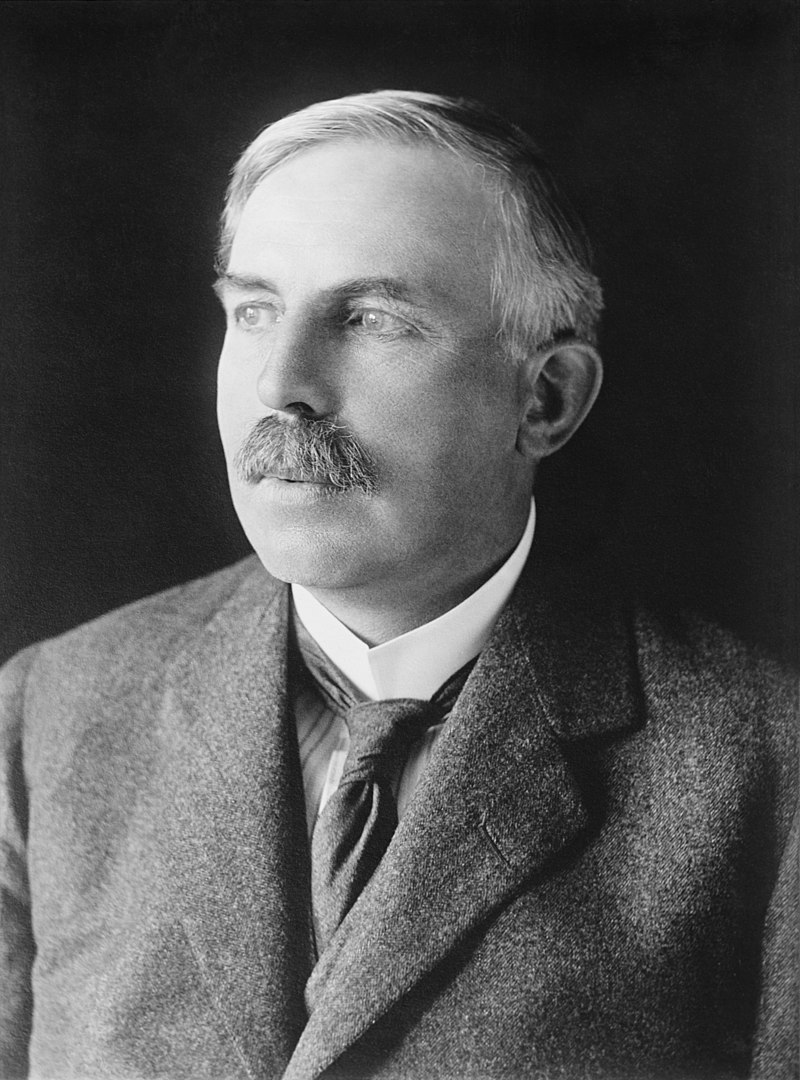
File:Sir_Ernest_Rutherford_LCCN2014716719_-_restoration1.jpg · Wikimedia Commons · See Wikimedia Commons
Ernest Rutherford
Sign in to saveAlso known as Ernest Lord Rutherford, E. Rutherford, Ernest Rutherford, primer barón Rutherford. de Nelson, Ernest, Lord Rutherford
New Zealand physicist (1871–1937)
OverviewAI-generated
Ernest Rutherford was a New Zealand nuclear physicist, chemist, and professor. He worked in the fields of physics, nuclear physics, chemistry, and radioactivity. His academic career included positions at the University of Canterbury, University of Cambridge, Trinity College, Victoria University of Manchester, McGill University, Cavendish Laboratory, and the University of Manchester. He held the academic degrees of Bachelor of Arts, Master of Arts, Bachelor of Science, and Doctor of Science.
Rutherford received the Nobel Prize in Chemistry, the Hector Medal, the Matteucci Medal, and the Copley Medal. He was a member of the Order of Merit, the Royal Society, the German Academy of Sciences Leopoldina, and the Pontifical Academy of Sciences. His doctoral advisors were Alexander William Bickerton and J. J. Thomson. He supervised doctoral students including Edward Victor Appleton, Robert William Boyle, Rafi Muhammad Chaudhry, and Alexander McAulay. Other students included Niels Bohr, Charles Galton Darwin, Pyotr Kapitsa, and Mark Oliphant.
He died in Cambridge in 1937 and is buried at Westminster Abbey. Rutherford wrote works such as *Discharge of electricity from glowing platinum*, *The cause and nature of radio activity*, *The new gas from radium*, *Radiations from radioactive substances*, and *Radio-activity*. He was recognized in collections by the Royal Society, the Nobel Laureates, the Nobel Chemistry, and the American Academy Arts Sciences.
Synthesized by Vinony from 33 facts across 4 sources: Wikidata, Open Library, Nobel Prize, Vinony collections. Generated from structured data (not the Wikipedia text) and checked against those facts — may still contain errors.
In the Vinony graph
Ernest Rutherford appears in Vinony's Nobel Prize in Chemistry collection — one of 198 entries. It also appears in Copley Medal.
Vinony's link graph records 1,129 inbound references to Ernest Rutherford, and connects out to alpha particle, Geiger–Marsden experiment and William Thomson, 1st Baron Kelvin.
It is catalogued under topics including 1871 births, 1937 deaths and 19th-century British physicists.
Vinony links it to 142 Wikipedia language editions.
Person · Open Library
- Born
- 1871
- Died
- 1937
- Works
- 18
Top works
- Discharge of electricity from glowing platinum
- The cause and nature of radio activity
- The new gas from radium
- Radiations from radioactive substances
- Radio-activity
via Open Library + Wikidata
Nobel Prize
- The Nobel Prize in Chemistry1908
“for his investigations into the disintegration of the elements, and the chemistry of radioactive substances”
Wikidata facts
- Instance of
- human
- Given name
- Ernest
- Family name
- Rutherford
- Gender
- male
- Citizenship
- New Zealand
- Place of birth
- Brightwater
- Place of death
- Cambridge
- Occupation
- university teacher
- Employer
- University of Manchester
- Languages spoken
- English language
- Native language
- English language
- Academic degree
- Doctor of Science
- Doctoral advisor
- J. J. Thomson
- Student of
- J. J. Thomson
- Doctoral student
- George Laurence
- Field of work
- radioactivity
- Image
- Ernest Rutherford LOC.jpg
- Residence
- New Zealand
Show 17 more facts
- place of burial
- Westminster Abbey
- Commons category
- Ernest Rutherford
- date of birth
- 1871-08-30
- date of death
- 1937-10-19
- member of
- Accademia Nazionale dei Lincei
- topic's main category
- Category:Ernest Rutherford
- Commons gallery
- Ernest Rutherford
- Erdős number
- 6
- student
- Otto Hahn
- nominated for
- Nobel Prize in Chemistry
- name in native language
- Ernest Rutherford
- on focus list of Wikimedia project
- Wikipedia:List of articles all languages should have
- writing language
- English language
- relative
- Ralph H. Fowler
- maintained by WikiProject
- WikiProject Mathematics
- P8168
- Sredska
- interested in
- physics
Sources (9)
via Wikidata · CC0
~25 min read
Encyclopedic overview
Ernest Rutherford, 1st Baron Rutherford of Nelson (30 August 1871 – 19 October 1937), was a New Zealand physicist and chemist who was a pioneering researcher in both atomic and nuclear physics. He has been described as "the father of nuclear physics" and "the greatest experimentalist since Michael Faraday." In 1908, he was awarded the Nobel Prize in Chemistry "for his investigations into the disintegration of the elements, and the chemistry of radioactive substances."
Rutherford's discoveries include the concept of radioactive half-life, the radioactive element radon, and the differentiation and naming of alpha and beta radiation. Together with Thomas Royds, Rutherford is credited with proving that alpha radiation is composed of helium nuclei. In 1911, he theorised that atoms have their charge concentrated in a very small nucleus. He arrived at this theory through his discovery and interpretation of Rutherford scattering during the gold foil experiment performed by Hans Geiger and Ernest Marsden. In 1912, he invited Niels Bohr to join his lab, leading to the Bohr model of the atom. In 1917, he performed the first artificially induced nuclear reaction by conducting experiments in which nitrogen nuclei were bombarded with alpha particles. These experiments led him to discover the emission of a subatomic particle that he initially called the "hydrogen atom", but later (more precisely) renamed the proton. He is also credited with developing the atomic numbering system alongside Henry Moseley. His other achievements include advancing the fields of radio communications and ultrasound technology.
Excerpted from Wikipedia’s “Ernest Rutherford” article, available under the CC BY-SA 4.0 licence.
Gallery (4)
Available in 142 languages
- Español
- Français
- Deutsch
- 中文
- 日本語
- Русский
- Português
- Italiano
- العربية
- हिन्दी
- Afrikaans
- Albanian
- Albanian
- Amharic
- Aragonese
- Armenian
- Assamese
- Asturian
Show 123 more
- Awadhi
- azb
- Azerbaijani
- Bahasa Indonesia
- Balinese
- Bangla
- Bashkir
- Basque
- bat_smg
- be_x_old
- Belarusian
- Bikol
- Bosnian
- Breton
- btm
- Bulgarian
- Buriat
- Burmese
- Catalan
- Central Kurdish
- Chechen
- Cornish
- Corsican
- Croatian
- Czech
- Danish
- Egyptian Arabic
- Esperanto
- Estonian
- Fiji Hindi
- Filipino
- Finnish
- Galician
- Georgian
- Greek
- Guarani
- Haitian Creole
- Hakka Chinese
- Hebrew
- Hungarian
- Icelandic
- Ido
- Iloko
- Interlingua
- Irish
- Javanese
- Kannada
- Kanuri
- Kara-Kalpak
- Kazakh
- Kurdish
- Kyrgyz
- Latin
- Latvian
- Limburgish
- Lithuanian
- Lombard
- Low German
- Luxembourgish
- Macedonian
- Malagasy
- Malay
- Malayalam
- Marathi
- Mazanderani
- Mingrelian
- Mongolian
- Nederlands
- Nepali
- Newari
- Northern Frisian
- Norwegian
- Norwegian Nynorsk
- Occitan
- Oromo
- Ossetic
- Pampanga
- Pashto
- Piedmontese
- Polski
- Punjabi
- Quechua
- Romanian
- Rusyn
- Sanskrit
- Santali
- Scots
- Scottish Gaelic
- Serbian
- Serbian (Latin)
- simple
- Sindhi
- Sinhala
- Slovak
- Slovenian
- Sundanese
- Svenska
- Swahili
- szy
- Tajik
- Tamil
- Tatar
- Telugu
- Tiếng Việt
- Türkçe
- Ukrainian
- Urdu
- Uzbek
- Veps
- Volapük
- Waray
- Welsh
- Western Frisian
- Western Panjabi
- Wu Chinese
- Yakut
- Yiddish
- Yoruba
- zh_min_nan
- zh_yue
- فارسی
- ไทย
- 한국어
via Wikidata sitelinks · CC0