Apollo and Daphne
Sign in to savemarble sculpture by Gian Lorenzo Bernini
Described at
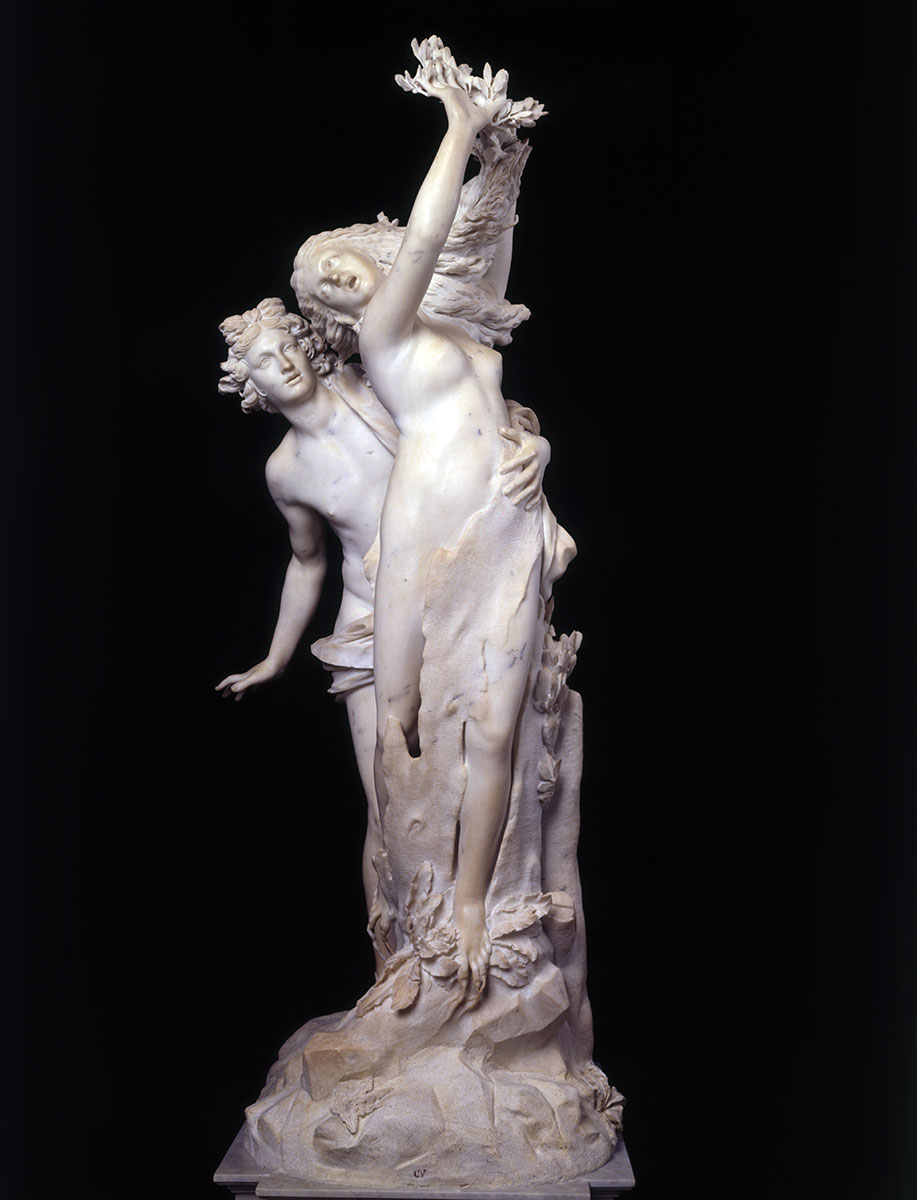
Apollo and Daphne - Bernini Gian Lorenzo
collezionegalleriaborghese.it →Apollo here is depicted in the act of running, with his right foot touching the ground and his left raised; the garment which covers his sides and left shoulder accompanies his movement. Having attained the goal of his chase, he places his left hand on Daphne’s body. At the god’s touch, the nymph immediately gives up her flight and with her raised arms and face attempts to turn around; yet her feet have already become roots and her hands and hair have been transformed into laurel branches and leaves. The subject of the sculpture group is the tale told by Ovid in the Metamorphoses : taking vengeance on Apollo, Cupid strikes him with a golden arrow that causes him to fall in love with the nymph Daphne, a follower of Diana. At the same time, Cupid shoots a dart of lead at the maiden, inducing her to reject the love of the god. Daphne begs her father Peneus, a river god, to change her appearance. The sculpture captures the culminating moment of her metamorphosis into a laurel tree. Bernini gives the subject the air of a theatrical performance, allowing the viewer to follow the transformation. The sculpture was originally placed on one side of the room adjacent to the chapel, where it rested on a lower pedestal than the current one: this arrangement increased the scenographic effect of the work and hence the emotional involvement of the observer. The sculpture captures the culminating moment of the maiden’s metamorphosis into a laurel tree. Bernini gives the subject the air of a theatrical performance, allowing the viewer to follow the transformation: having finally attained the goal of his chase, who is already undergoing the transformation of her feet into roots and her hands and hair into laurel branches and leaves. Apollo tries to grasp her, but his fingers find the bark of the tree rather than her body. From that moment, the tree became dear to the god, who wore a crown of its leaves around his head; the laurel wreath would in fact be considered an attribute of artists and poets. Documentation that has come down to us allows us to follow all the phases of the execution of the sculpture group, beginning with the purchase of the marble block on 2 August 1622: various instalments were then paid to the sculptor beginning in 1624; in March 1625, a payment was made to Agostino Radi for the base; in August of the same year, the work was finally brought to completion; and Bernini received the last payment on 24 November 1625. In all, the sculptor was paid 1,000 scudi for his efforts (Minozzi 1998, pp. 437-40, docs. 61-78). The documents indicate an interruption in the work for nearly a year, during which the sculptor turned his attention to the creation of the David (inv. no. LXXVII ), likewise commissioned by Cardinal Scipione Borghese. Together with other sources, these documents also inform us the work was placed in Room 3, as Bernini had wished: the sculpture was meant to occupy a position in front of the wall that bordered the chapel and the spiral staircase. Here it would focus the observer’s attention on Apollo’s right side and enable her to follow the final phase of the god’s chase, the moment in which his initial conviction of having triumphed is changed into an expression of amazement on his face, as he observed Daphne’s metamorphosis. Thus did Bernini manage to capture an instant in marble which is both narration and emotional experience. The group further demonstrates the sculptor’s extraordinary technical skill: his ability to carve fingers and toes that are being transformed into leaves and roots and hair that flows backwards; the delicate chiselling of the bark of the tree; and the various degrees of finishing to differentiate the surfaces of the garments from those of the skin of the two protagonists. His sagacious use of the traditional tools of the sculptor’s trade allowed him to render the tale in marble, a subject whose representation was hitherto believed to be possible only through the paintbrush. Analyses
Excerpt from a page describing this subject · 24,835 chars · not written by Vinony
Wikidata facts
- Instance of
- sculpture
- Part of
- Borghese Collection
- Country
- Italy
- Located in
- Rome
- Genre
- group of sculptures
- Based on
- Metamorphoses
- Main subject
- Apollo and Daphne
- Depicts
- Apollo and Daphne
- Movement
- Baroque
- Material used
- Carrara marble
- Creator
- Gian Lorenzo Bernini
- Collection
- Galleria Borghese
- Location
- Galleria Borghese
- Image
- Apollo and Daphne (Bernini) (cropped).jpg
- Height
- 243
Show 7 more facts
- Commons category
- Apollo and Daphne (Bernini)
- inception
- 1620-00-00
- commissioned by
- Scipione Borghese
- catalog code
- 5.4
- native label
- Apollo e Dafne
- described at URL
- www.collezionegalleriaborghese.it/opere/apollo-e-dafne
- inventory number
- CV
Sources (6)
via Wikidata · CC0