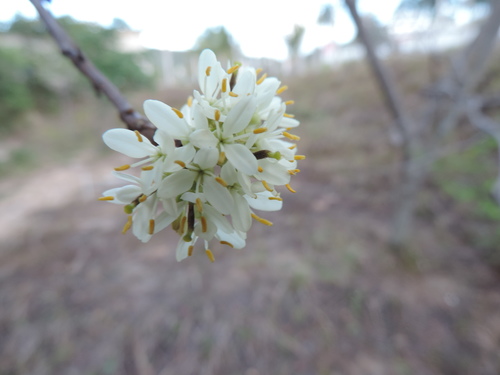
(c) Víctor de Paiva, some rights reserved (CC BY-NC-ND), uploaded by Víctor de Paiva · cc-by-nc-nd
Apuleia
Sign in to saveApuleia is a genus of flowering plants in the family Fabaceae. It belongs to the subfamily Dialioideae. The only species in the genus is Apuleia leiocarpa. It is a tree native to northern South America, from Colombia and Venezuela to Ecuador, Peru, Bolivia, Brazil, Paraguay, Uruguay, and northeastern Argentina.
In the Vinony graph
Vinony's link graph records 11 inbound references to Apuleia, and connects out to Uruguay, plant and Wikidata.
It is catalogued under topics including Dialioideae, Flora of Southern America and Monotypic Fabaceae genera.
Vinony links it to 7 Wikipedia language editions.
Species
GENUS
- KingdomPlantae
- PhylumTracheophyta
- ClassMagnoliopsida
- OrderFabales
- FamilyFabaceae
General: of Kajita et al. (2001), Apuleia is sister to a Petalostylis-Zenia
via GBIF · Kew POWO
Museum specimens
- Specimen records
- 121
- With media
- 30
- Family
- Fabaceae
- Collections
- UFERSA, F, MO, NY, UFPB, UFPE
- Recorded in
- Brasil, Venezuela, Brazil, Bolivia, Peru, Paraguay
Wikidata facts
- Instance of
- taxon
- Parent taxon
- Dialioideae
- Image
- Grapia.JPG
Show 6 more facts
- Commons category
- Apuleia
- taxon name
- Apuleia
- taxon rank
- genus
- topic's main category
- Category:Apuleia
- taxon common name
- 铁苏木属
Sources (1)
via Wikidata · CC0
~2 min read
Encyclopedic overview
5 sectionsContents
- Description
- Ecology
- Wood
- Taxonomy
- References
Apuleia is a genus of flowering plants in the family Fabaceae. It belongs to the subfamily Dialioideae. The only species in the genus is Apuleia leiocarpa. It is a tree native to northern South America, from Colombia and Venezuela to Ecuador, Peru, Bolivia, Brazil, Paraguay, Uruguay, and northeastern Argentina.
==Description== It has a flattened, wide, dense crown. It reaches in height, with a slightly tortuous and very long trunk, with fins at the base. Rhytidoma that splits into discs. Leaves imparipinadas composed, 05.11 leaflets long. It has small white flowers in clusters, blooming when the leaves fall. The legume fruit is long, with 2-3 seeds, which are and difficult to extract.
Excerpted from Wikipedia’s “Apuleia” article, available under the CC BY-SA 4.0 licence.
Gallery (3)
Available in 7 languages
via Wikidata sitelinks · CC0