
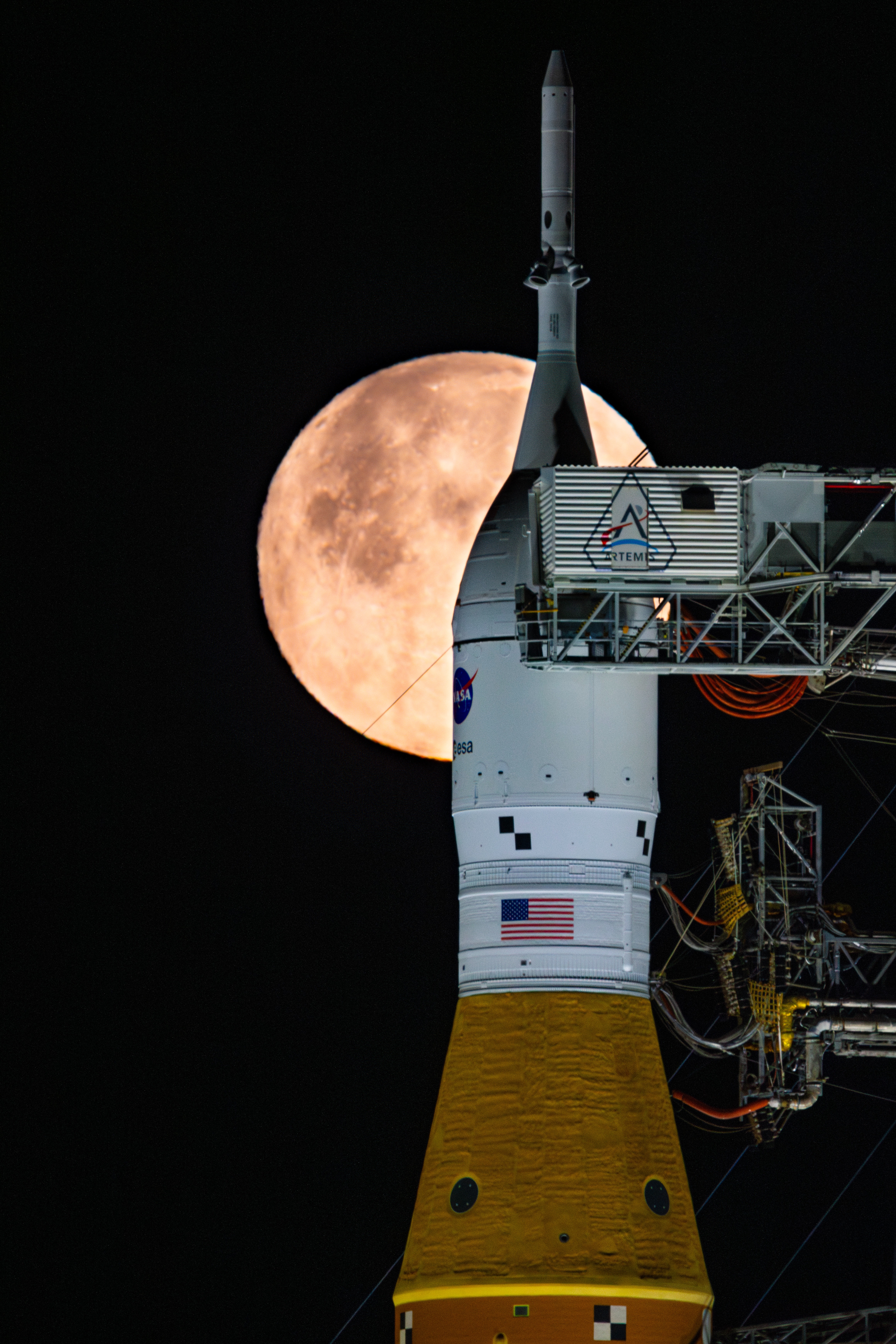
The Artemis program is NASA's plan to return astronauts to the Moon for the first time since the Apollo missions and to establish a permanent base there. It matters because it represents a major step forward in human space exploration and could serve as a stepping stone for future missions to Mars and beyond.
AI-generated from the Wikipedia summary — may contain errors.
Wikipedia views (30d)
113,990 totalvia Wikimedia Pageviews API
Official website
Moon to Mars | NASA's Artemis Program - NASA
Explore how NASA’s Artemis mission will return humans to the Moon, prepare for Mars, and shape the future of space exploration.
nasa.gov →NASA explores the unknown in air and space, innovates for the benefit of humanity, and inspires the world through discovery. Technicians inside the Payload Hazardous Servicing Facility at Kennedy Space Center in Florida install and test antennas on a solar array on Wednesday, March 20, 2024, for the agency’s Europa Clipper spacecraft. NASA’s future will continue to be a story of human exploration, technology, and science. We will go back to the Moon to learn more about what it will take to support human exploration to Mars and beyond. We will continue to nurture the development of a vibrant low-Earth orbit economy that builds on the work done to date by the International Space Station. NASA engineers will develop new technologies to improve air transport at home and meet the challenges of advanced space exploration. Our scientists will work to increase an understanding of our planet and our place in the universe. The Artemis II crew, from left: NASA astronauts Reid Wiseman and Christina Koch; CSA (Canadian Space Agency) astronaut Jeremy Hansen; and NASA astronaut Victor Glover pose for a group photo after viewing the Orion spacecraft in the well deck of the USS John P. Murtha, Saturday, April 11, 2026, in the Pacific Ocean off the coast of California. When NASA opened for business on October 1, 1958, it accelerated the work already started on human and robotic spaceflight, and over the last 65 years it has continued to push the boundaries of aeronautics and space exploration. Now NASA is preparing to take humankind farther than ever before, as it helps to foster a robust commercial space economy near Earth, and pioneers further human and robotic exploration as we venture into deep space. NASA’s Perseverance Mars rover took a selfie with the Ingenuity helicopter, seen here about 13 feet from the rover. This image was taken by the WASTON camera on the rover’s robotic arm on April 6, 2021, the 46th Martian day, or sol, of the mission. Jared “Rook” Isaacman is the 15th Administrator of the National Aeronautics and Space Administration. An entrepreneur and skilled pilot, Isaacman commanded Inspiration4, the first all-civilian orbital spaceflight aboard the Dragon spacecraft. The mission was a major milestone in commercial spaceflight. Matt Anderson is NASA’s deputy administrator. Anderson is a decorated Air Force command pilot in multiple aircraft with more than 5,000 flight hours, including more than 650 in combat. Throughout his 24-year Air Force career, he served on several senior U.S. Department of War staffs and commanded at multiple levels before retiring in 2021. Amit Kshatriya is NASA’s associate administrator. Kshatriya serves as the highest-ranking civil servant at the agency and as a senior advisor to the administrator. Kshatriya leads the agency’s 10 center directors, as well as the mission directorate associate administrators at NASA Headquarters in Washington. Align your talents with your passion and find out why NASA consistently is named a best place to work in the federal government. At NASA, you'll have an opportunity to work on unique and challenging projects that truly make an impact on humanity. Stay up-to-date on the latest news from NASA–from Earth to the Moon, the Solar System and beyond.
Read more on their site →Excerpt from the official site · 40,000 chars · not written by Vinony
Article · 中文
阿耳忒弥斯登月计划(英語:Artemis program)是一项機器人的和人類的國際合作探索月球计划,由美国国家航空航天局(NASA)领导,并有三個合作機構:欧洲空间局 (ESA)、日本宇宙航空研究開發機構 (JAXA) 、和加拿大太空局 (CSA),目标是重返月球並建立長期科研基地,并且最終登陆火星。如果成功,阿耳忒弥斯計劃將自1972年阿波羅17號(Apollo 17)任務以來首次在月球上重建人類存在。該計劃的主要組成部分是太空發射系統(SLS)、獵戶座飛船、月球門戶空間站、和商業載人著陸系統,包括星艦人類登陸系統(HLS)。 該計劃的長期目標是在月球上建立一個永久基地,並促進人類前往火星的任務。 阿耳忒弥斯登月计划是政府航天機構和私營航天公司的合作,受《阿尔忒弥斯协定》和支持合同的約束。 截至2022年7月,已有21個國家簽署了協定, 包括傳統的美國太空合作夥伴,如欧洲空间局以及加拿大、日本和英國的機構,和新興的太空強國,如巴西、韓國、和阿拉伯聯合酋長國 。 阿耳忒弥斯計劃於2017年特朗普執政期間正式成立; 然而,它的許多組件,如獵戶座飛船,是在之前的星座計劃(2005-2010年)和取消之後開發的。獵戶座飛船的首次發射和首次使用太空發射系統最初定於2016年,但計劃於2022年作為无人的阿耳忒弥斯1號任務發射,搭載機器人和人體模型。 按照計劃,阿提米絲2號載人發射將於2024年進行,阿提米絲3號載人登月計劃將於2025年進行,阿提米絲4號將於2027年與月球門戶對接,之後每年將登陸月球。 然而,一些觀察家指出,由於美国国家航空航天局(NASA)對承包商管理不善,該計劃的成本和時間表可能會超支和延遲。 其中,阿提米絲3號将会第一位女性和第一位有色人种送至月球,也是首次多國合作登月。
Abstract from DBpedia / Wikipedia · CC BY-SA
Gallery (14)
Available in 66 languages
- Español
- Français
- Deutsch
- 中文
- 日本語
- Русский
- Português
- Italiano
- العربية
- हिन्दी
- Afrikaans
- Aragonese
- Asturian
- Azerbaijani
- Bahasa Indonesia
- Bangla
- Basque
- Belarusian
Show 47 more
- Bhojpuri
- Bosnian
- Breton
- Bulgarian
- Catalan
- Central Kurdish
- Chuvash
- Croatian
- Czech
- Esperanto
- Estonian
- Finnish
- Galician
- Greek
- Hebrew
- Hungarian
- Irish
- Kazakh
- Kurdish
- Latin
- Lithuanian
- Macedonian
- Malay
- Malayalam
- Nederlands
- Norwegian
- Pashto
- Polski
- Punjabi
- Romanian
- Sicilian
- simple
- Sinhala
- Slovak
- Slovenian
- Svenska
- Tiếng Việt
- Toki Pona
- Türkçe
- Ukrainian
- Urdu
- Welsh
- Western Panjabi
- zh_yue
- فارسی
- ไทย
- 한국어
via Wikidata sitelinks · CC0