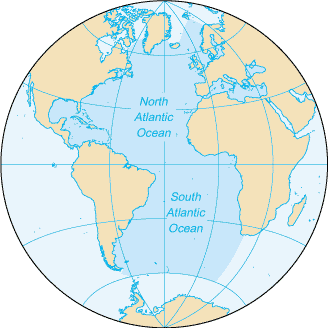
File:Atlantic_Ocean_-_en.png · Wikimedia Commons · See Wikimedia Commons
Oceano Atlântico
Sign in to saveAlso known as Atlantic, Atlantic Sea, Great Western Ocean, Oceanus, the Atlantic, Atlantick, Atlantick Ocean, Atlantick Sea
oceano do planeta Terra
OverviewAI-generated
The Atlantic Ocean is an ocean that is part of the World Ocean and Earth. It is named after Atlas. The body of water is located in international waters and has a coordinate location of 0, -30. It includes the North Atlantic Ocean and the South Atlantic Ocean as parts. The Atlantic Ocean shares borders with the Baetic Depression, North Africa, and the Indian Ocean.
The Atlantic Ocean has an area of 106460000 and a volume of 305811900. Its vertical depth is 8605, and its width is 5000. The lowest point is the Milwaukee Deep. The basin country includes Iceland, Norway, Sweden, and Finland. The demonym for the region is Atlantic.
Synthesized by Vinony from 26 facts across 4 sources: Wikidata, PubMed, Vinony graph, Geo. Generated from structured data (not the Wikipedia text) and checked against those facts — may still contain errors.
Research
14,213 papers- A review on the diversity and distribution of athecate dinoflagellates in South Atlantic and in the Atlantic sector of the Southern Ocean: Research insights and gaps.ReviewAnais da Academia Brasileira de Ciencias · 2024Werlang CC, Souza MS, Mendes CRBDOI: 10.1590/0001-3765202420230746
- Stanford University from across the Atlantic Ocean: an Italian Medical Student research experience.European journal of nuclear medicine and molecular imaging · 2023Ragaini EMDOI: 10.1007/s00259-022-06033-y
- Plastic pollution in islands of the Atlantic Ocean.ReviewEnvironmental pollution (Barking, Essex : 1987) · 2018Monteiro RCP, Ivar do Sul JA, Costa MFDOI: 10.1016/j.envpol.2018.01.096
- New species and records of Heterospio (Annelida, Longosomatidae) from continental shelf, slope and abyssal depths of the Atlantic Ocean, Pacific Ocean, Indian Ocean and adjacent seas.ReviewZootaxa · 2023Blake JA, Maciolek NJDOI: 10.11646/zootaxa.5260.1.1
- Invasive species in the Northeastern and Southwestern Atlantic Ocean: A review.ReviewMarine pollution bulletin · 2017Castro MC, Fileman TW, Hall-Spencer JMDOI: 10.1016/j.marpolbul.2016.12.048
- Monitoring pelagic Sargassum in the Atlantic Ocean from space: Principles and practices.ReviewHarmful algae · 2025Hu C, Barnes BB, Qi L et al.DOI: 10.1016/j.hal.2025.102840
- Fading bioluminescence of the tropical Atlantic Ocean.Luminescence : the journal of biological and chemical luminescence · 2022Piontkovski SA, Serikova IMDOI: 10.1002/bio.4188
- Remote subsurface ocean temperature as a predictor of Atlantic hurricane activity.Proceedings of the National Academy of Sciences of the United States of America · 2018Scoccimarro E, Bellucci A, Storto A et al.DOI: 10.1073/pnas.1810755115
via PubMed
Wikidata facts
- Instance of
- ocean
- Part of
- World Ocean
- Named after
- Atlas
- Demonym
- Atlantic
- Located in
- international waters
- Area
- 106460000
- Elevation
- 0
- Shares border with
- Baetic Depression
- Image
- Atlantic Ocean.png
- Width
- 5000
Show 12 more facts
- Commons category
- Atlantic Ocean
- topic's main category
- Category:Atlantic Ocean
- Commons gallery
- Atlantic Ocean
- lowest point
- Milwaukee Deep
- category for people who died here
- Category:Deaths in the Atlantic Ocean
- volume as quantity
- 305811900
- vertical depth
- 3646
- on focus list of Wikimedia project
- Wikipedia:Vital articles/Level/4
- category for the water basin
- Category:Drainage basins of the Atlantic Ocean
- basin country
- Canada
- topic has template
- Template:Atlantic Ocean
- tributary
- Amazon
Sources (6)
via Wikidata · CC0
Article · Português
O oceano Atlântico é o segundo maior oceano em extensão, com uma área de aproximadamente 106 400 000 km², cerca de um quinto da superfície da Terra. É o oceano que separa a Europa e a África a Leste, da América, a Oeste. Seu nome deriva de Atlas, uma divindade da mitologia grega. É por isso que, às vezes, o oceano Atlântico é referido como "mar de Atlas". A menção mais antiga sobre seu nome é encontrada em Histórias, de Heródoto, por volta de 450 a.C.. Antes de os europeus descobrirem outros oceanos, o termo "oceano" foi sinônimo de todas as águas que circundam a Europa Ocidental e que os gregos acreditavam ser um grande rio que circundava toda a Terra. Esta denominação desapareceu, no entanto, na Idade Média, altura em que se utilizava o nome de "mar Ocidental" ou "mar do Norte" (que hoje designa uma parte do Atlântico, o mar do Norte). O responsável pelo reaparecimento do nome "Atlântico", foi o geógrafo Mercator ao colocá-lo no seu célebre mapa do mundo em 1569. A partir deste momento a nomenclatura da idade média foi gradualmente sendo substituída por este nome, que subsistiu até os nossos dias. O oceano Atlântico apresenta uma forma semelhante à letra S. Sendo uma divisão das águas marítimas terrestres, o Atlântico é ligado ao oceano Ártico (que em algumas vezes é referido como sendo apenas um mar do Atlântico), a norte, ao oceano Pacífico, a sudoeste, e ao oceano Índico, a sudeste, e ao oceano Antártico, a sul. (Alternativamente, ao invés do oceano Atlântico ligar-se com o oceano Antártico, pode-se estabelecer a Antártida como limite sul do oceano, sob outro ponto de vista). A linha do Equador divide o oceano em Atlântico Norte e Atlântico Sul. Com um terço das águas oceânicas mundiais, o Atlântico inclui mares como o Mediterrâneo, o mar do Norte, o Báltico e o mar das Caraíbas (Caribe).
Abstract from DBpedia / Wikipedia · CC BY-SA
Gallery (12)
On the map
Available in 248 languages
- Español
- Français
- Deutsch
- 中文
- 日本語
- Русский
- Português
- Italiano
- العربية
- हिन्दी
- Abkhazian
- abstract
- Achinese
- Adyghe
- Afrikaans
- Akan
- Albanian
- Albanian
Show 229 more
- Amharic
- Angika
- Aragonese
- Aramaic
- Armenian
- Arpitan
- Assamese
- Asturian
- Avaric
- Awadhi
- azb
- Azerbaijani
- Bahasa Indonesia
- Balinese
- Bambara
- Bangla
- Banjar
- Bashkir
- Basque
- bat_smg
- Bavarian
- be_x_old
- Belarusian
- Betawi
- Bhojpuri
- Bikol
- blk
- Bosnian
- Breton
- Bulgarian
- Buriat
- Burmese
- Catalan
- cdo
- Cebuano
- Central Kurdish
- Chechen
- Cherokee
- Chuvash
- Cornish
- Corsican
- Crimean Tatar
- Croatian
- Czech
- Danish
- dty
- Egyptian Arabic
- eml
- Esperanto
- Estonian
- Extremaduran
- Faroese
- Fiji Hindi
- Filipino
- Finnish
- fiu_vro
- Friulian
- Fula
- Galician
- Gan Chinese
- gcr
- Georgian
- Gilaki
- Gorontalo
- gpe
- Greek
- Guarani
- Gujarati
- Haitian Creole
- Hakka Chinese
- Hausa
- Hawaiian
- Hebrew
- Hungarian
- hyw
- Iban
- Icelandic
- Ido
- Igbo
- Iloko
- Inari Sami
- Ingush
- Interlingua
- Interlingue
- Irish
- Jamaican Creole English
- Javanese
- Kabardian
- Kabyle
- Kannada
- Kanuri
- Kara-Kalpak
- Karachay-Balkar
- Kazakh
- kbp
- kge
- Khmer
- Komi-Permyak
- Kotava
- Kurdish
- Kyrgyz
- Ladino
- Lao
- Latin
- Latvian
- Lezghian
- Ligurian
- Limburgish
- Lingala
- Lingua Franca Nova
- Lithuanian
- lld
- Lojban
- Lombard
- Low German
- Lower Sorbian
- Luxembourgish
- Macedonian
- Maithili
- Malagasy
- Malay
- Malayalam
- Maltese
- Manipuri
- Manx
- Marathi
- Mari
- Mazanderani
- Minangkabau
- Mingrelian
- Mirandese
- Moksha
- Mongolian
- Moroccan Arabic
- nds_nl
- Neapolitan
- Nederlands
- Nepali
- Newari
- Northern Frisian
- Northern Sami
- Northern Sotho
- Norwegian
- Norwegian Nynorsk
- Obolo
- Occitan
- Old English
- olo
- Oromo
- Ossetic
- Pampanga
- Pangasinan
- Papiamento
- Pashto
- Picard
- Piedmontese
- Polski
- Punjabi
- Quechua
- roa_tara
- Romanian
- Romansh
- Rusyn
- Samoan
- Sanskrit
- Santali
- Sardinian
- Saterland Frisian
- Scots
- Scottish Gaelic
- Serbian
- Serbian (Latin)
- Shona
- Sicilian
- Silesian
- simple
- Sindhi
- Sinhala
- Slovak
- Slovenian
- Somali
- Southern Sotho
- Standard Moroccan Tamazight
- Sundanese
- Svenska
- Swahili
- Tachelhit
- Tajik
- Tamil
- Tatar
- Telugu
- Tibetan
- Tiếng Việt
- Tok Pisin
- Toki Pona
- Türkçe
- Turkmen
- Tuvinian
- Tyap
- Udmurt
- Ukrainian
- Upper Sorbian
- Urdu
- Uyghur
- Uzbek
- Venetian
- Veps
- Volapük
- Walloon
- Waray
- Welsh
- West Flemish
- Western Frisian
- Western Mari
- Western Panjabi
- Wolof
- Wu Chinese
- Yakut
- Yiddish
- Yoruba
- Zaza
- Zeelandic
- zh_classical
- zh_min_nan
- zh_yue
- Zhuang
- فارسی
- ไทย
- 한국어
via Wikidata sitelinks · CC0