In the Vinony graph
Vinony's link graph records 99 inbound references to Atlas Slave, and connects out to New Sacristy, Michelangelo and Florence.
It sits within the topics 16th-century sculptures, Marble sculptures in Italy and Nude sculptures in Italy.
Vinony links it to 9 Wikipedia language editions.
Described at
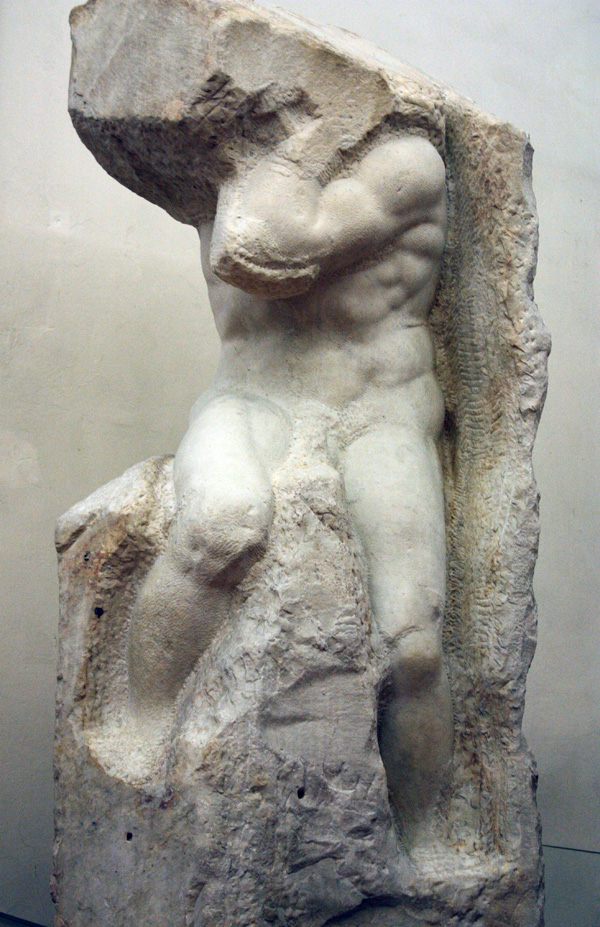
Michelangelo's Prisoners or Slaves at the Accademia Gallery
Michelangelo's Slaves or Prisoners are exceptional in showing the master's approach to creating sculpture: to chip away the excess of marble as the powerful figures inside that were already contained within.
accademia.org →As you admire the Prisoners from different angles, one can notice Michelangelo’s love and understanding of the human anatomy. The Prisoners’ heads and faces are the least-developed parts, but they are to communicate with their poses, known as the classic “ contrapposto ” (counter pose). The Slaves are standing with most of their weight on one foot so that their shoulders and arms twist off-axis from the hips and legs. This precise pose gives the Prisoners a more dynamic and powerful appearance , transmitting motion and emotion. All the unfinished statues at the Accademia reveal Michelangelo’s approach and concept of carving. Michelangelo believed the sculptor was a tool of God, not creating but simply revealing the powerful figures already contained in the marble. Michelangelo’s task was only to chip away the excess, to reveal. He worked often for days on end without sleep, keeping for days his boots and clothes, as reported in Vasari’s chronicles about Michelangelo’s passion and talent. One can clearly recognize the grooves from mallet and pointed chisel on the marble surface used in this initial stage. Unlike most sculptors, who prepared a plaster cast model and then marked up their block of marble to know where to chip, Michelangelo mostly worked free hand, starting from the front and working back. These figures emerged from the marble “as though surfacing from a pool of water”, as described in Vasari’s “ Lives of the Artists ”. The method was to take a figure of wax, lay it in a vessel of water and gradually emerge it, noticing the most prominent parts. Just so, the highest parts were extracted first from the marble. This piece is one of the most powerful and expressive works among the Slaves. It is the first statue one finds on the left along the corridor, the least outlined of the four Prisoners. The figure feels like it is writhing and straining, trying to imminently explode out of the marble block that holds it. The latent power one feels is extraordinary. Michelangelo is famous for saying that he worked to liberate the forms imprisoned in the marble. He saw his job as simply removing what was extraneous. This endless struggle of man to free himself from his physical constraints is a metaphor of the flesh burdening the soul. It is interesting to note the various marks left alongside the block of marble, above all at the back of the unfinished sculpture. Across from the Awakening Slave is the so called, “Young Slave.” The figure is more clearly defined, but seems almost bound within himself, burying his face in his left arm and hiding the right one around the hips. The contrapposto pose is quite exaggerated by the narrowness of the block of stone and by the slightly bent knees. The profound study of human anatomy is highlighted in the left elbow and the careful lines of the bent biceps and triceps. His face, which is just beginning to emerge, seems so youthful by comparison with his musculature. Michelangelo always chiseled out the image front to back: it clearly shows within the Young Slave, which appears to be emerging from the rock that shows the rough tracks of the large tooth chisels. The third statue on the left of the corridor, is the “Bearded Slave” the most finished of the four Slaves. The figure is almost free, only his hands and part of his arm, probably planned to hold a cloth, are unfinished. The face is covered by a thick, curly beard and the thighs are bound by straps of cloth. The torso is finely modeled, revealing Michelangelo’s deep knowledge of anatomy. Down the corridor on the left is the “Atlas Slave.” The male nude seems to be carrying a huge weight on his head. Hence he is named after Atlas, the primordial Titan who held up the entire world on his shoulders. His head has not emerged from the stone, leading the slave to support and push such a heavy weight, which threatens to compress him. The force of weight pushing down, and that pushing back up, create a vigorous tension. There is no feelin
Excerpt from a page describing this subject · 8,936 chars · not written by Vinony
Wikidata facts
- Instance of
- statue
- Part of
- Tomb of Pope Julius II
- Genre
- nude
- Movement
- Italian Renaissance
- Material used
- marble
- Creator
- Michelangelo
- Collection
- Galleria dell'Accademia
- Location
- Galleria dell'Accademia
- Image
- Michelangelo - Atlas.jpg
- Height
- 277
Show 4 more facts
- inception
- 1530-01-01
- Commons category
- Atlas by Michelangelo Buonarroti
- catalog code
- S15f
Sources (2)
via Wikidata · CC0