File:Top_of_Atmosphere.jpg · Wikimedia Commons · See Wikimedia Commons
atmosphere
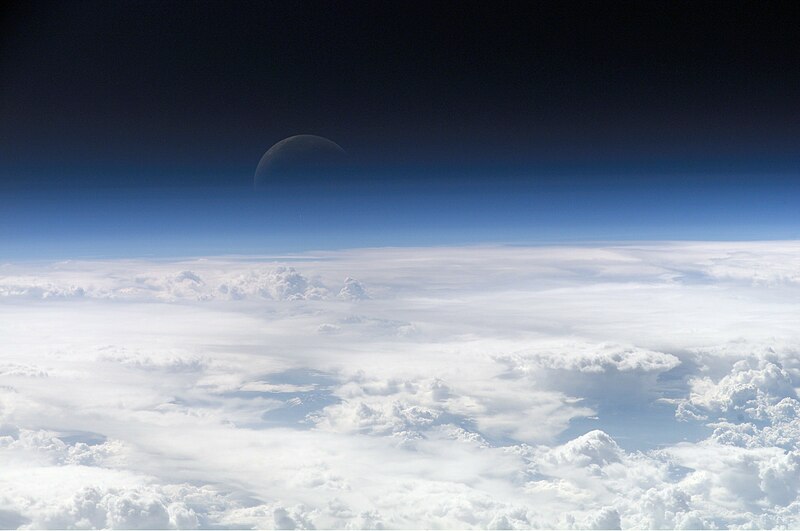
Sign in to savethumb|upright=1.5|The atmospheric gases around Earth Rayleigh scattering|scatter blue light (shorter wavelengths) more than light toward the red end (longer wavelengths) of the [[visible spectrum; thus, a blue glow over the horizon is seen when observing Earth from outer space. The Moon is visible in the background.]]
Earth's atmosphere is the layer of gases that surrounds our planet, which scatters blue light more than red light—an effect that creates the blue glow visible from space. This atmospheric layer matters because it affects how light behaves around Earth, influencing what we see when observing our planet from outer space.
AI-generated from the Wikipedia summary — may contain errors.
Research
924,761 papers- Organic synthesis in the study of terpene-derived oxidation products in the atmosphere.ReviewNatural product reports · 2023Upshur MA, Bé AG, Luo J et al.DOI: 10.1039/d2np00064d
- Modified atmosphere packaging of fruits and vegetables.ReviewCritical reviews in food science and nutrition · 1989Kader AA, Zagory D, Kerbel ELDOI: 10.1080/10408398909527490
- Evolution of the atmosphere.ReviewProceedings of the Geologists' Association. Geologists' Association · 1998Nunn JFDOI: 10.1016/s0016-7878(98)80001-1
- Lightning-Driven Pyrite Oxidation Under Archean Atmosphere Conditions.Astrobiology · 2024Long ALS, Baidya AS, Stüeken EEDOI: 10.1089/ast.2024.0074
- Microplastic aging and adsorption in the atmosphere, and their associated impacts on various spheres of the earth: A review.ReviewChemosphere · 2025Shekhar S, Sarkar SDOI: 10.1016/j.chemosphere.2025.144256
- An Archean atmosphere rich in sulfur biomolecules.Proceedings of the National Academy of Sciences of the United States of America · 2025Reed NW, Christensen CM, Surratt JD et al.DOI: 10.1073/pnas.2516779122
- No thick carbon dioxide atmosphere on the rocky exoplanet TRAPPIST-1 c.Nature · 2023Zieba S, Kreidberg L, Ducrot E et al.DOI: 10.1038/s41586-023-06232-z
- Lidar.Applied optics · 1970Collis RTDOI: 10.1364/AO.9.001782
via PubMed
Wikidata facts
- Part of
- astronomical object
- Image
- Top of Atmosphere.jpg
Show 9 more facts
- topic's main category
- Category:Atmosphere
- Commons gallery
- Atmosphere
- has effect
- atmospheric pressure
- different from
- firmament
- studied by
- atmospheric physics
- has characteristic
- atmospheric phenomenon
- Commons category
- Atmosphere
- exact match
- purl.obolibrary.org/obo/ENVO_01000267
- described by source
- Granat Encyclopedic Dictionary
via Wikidata · CC0
~29 min read
Encyclopedic overview
16 sectionsContents
- Occurrence and compositions
- Origins
- Compositions
- Exoplanets
- Atmospheres in the Solar System
- Conditions
- Structure
- Terrestrial planets
- Gas giants
- Circulation
- Escape
- Terrain
- Fields of study
- See also
- References
- External links
thumb|upright=1.5|The atmospheric gases around Earth Rayleigh scattering|scatter blue light (shorter wavelengths) more than light toward the red end (longer wavelengths) of the [[visible spectrum; thus, a blue glow over the horizon is seen when observing Earth from outer space. The Moon is visible in the background.]]
An atmosphere is a layer of gases that envelop an astronomical object, held in place by the gravity of the object. The name originates . An object acquires most of its atmosphere during its primordial epoch, either by accretion of matter or by outgassing of volatiles. The chemical interaction of the atmosphere with the solid surface can change its fundamental composition, as can photochemical interaction with the Sun. A planet retains an atmosphere for longer durations when the gravity is high and the temperature is low. The solar wind works to strip away a planet's outer atmosphere, although this process is slowed by a magnetosphere. The further a body is from the Sun, the lower the rate of atmospheric stripping.
Excerpted from Wikipedia’s “atmosphere” article, available under the CC BY-SA 4.0 licence.
Gallery (12)
Available in 136 languages
- Español
- Français
- Deutsch
- 中文
- 日本語
- Русский
- Português
- Italiano
- العربية
- हिन्दी
- Afrikaans
- Albanian
- Albanian
- ami
- Angika
- Aragonese
- Armenian
- Asturian
Show 117 more
- azb
- Azerbaijani
- Bahasa Indonesia
- Bangla
- Basque
- be_x_old
- Belarusian
- Bhojpuri
- Bikol
- Bosnian
- Breton
- Bulgarian
- Burmese
- Catalan
- cdo
- Cebuano
- Central Kurdish
- Chechen
- Chuvash
- Croatian
- Czech
- Danish
- Egyptian Arabic
- Esperanto
- Estonian
- Filipino
- Finnish
- Galician
- Ganda
- gcr
- Georgian
- Greek
- Guarani
- Gujarati
- Hakka Chinese
- Hebrew
- Hungarian
- Icelandic
- Ido
- Ingush
- Interlingua
- Irish
- Kabyle
- Kannada
- Kashmiri
- Kazakh
- Khmer
- Kurdish
- Kyrgyz
- Ladino
- Latin
- Latvian
- Limburgish
- Lithuanian
- Lombard
- Luxembourgish
- Macedonian
- Malagasy
- Malay
- Malayalam
- Maltese
- Manx
- Marathi
- Minangkabau
- Mingrelian
- Mongolian
- Moroccan Arabic
- Neapolitan
- Nederlands
- Norwegian
- Norwegian Nynorsk
- nrm
- Old English
- Oromo
- Ossetic
- Pashto
- Polski
- Punjabi
- Romanian
- Sanskrit
- Saterland Frisian
- Scots
- Scottish Gaelic
- Serbian
- Serbian (Latin)
- Shona
- Sicilian
- simple
- Sindhi
- Sinhala
- Slovak
- Slovenian
- Svenska
- Swahili
- Tajik
- Tamil
- Telugu
- Tiếng Việt
- Toki Pona
- Türkçe
- Udmurt
- Ukrainian
- Urdu
- Waray
- Welsh
- Western Panjabi
- Wolof
- Wu Chinese
- Yakut
- Yiddish
- Yoruba
- zh_min_nan
- zh_yue
- Zulu
- فارسی
- ไทย
- 한국어
via Wikidata sitelinks · CC0