Category
page 1Gases

gas
thumb|Suspended particulates indicate the movement of the surrounding gas.

atmosphere
thumb|upright=1.5|The atmospheric gases around Earth Rayleigh scattering|scatter blue light (shorter wavelengths) more than light toward the red end (longer wavelengths) of the [[visible spectrum; thus, a blue glow over the horizon is seen when observing Earth from outer space. The Moon is visible in the background.]]

plasma
state of matter consisting of ionized gas

vacuum
thumb|300x300px|Vacuum pump and bell jar for vacuum experiments, used in science education during the early 20th century, on display in the Schulhistorische Sammlung ('School Historical Museum'), [[Bremerhaven, Germany]]
breathing
thumb|upright=1.4|Real-time magnetic resonance imaging of the human thorax during breathing
thumb|upright=1.4|X-ray video of a female American alligator while breathing
Breathing (respiration or ventilation) is the rhythmic process of moving air into (inhalation) and out of (exhalation) the lungs to enable gas exchange with the internal environment, primarily to remove carbon dioxide and take in oxygen.
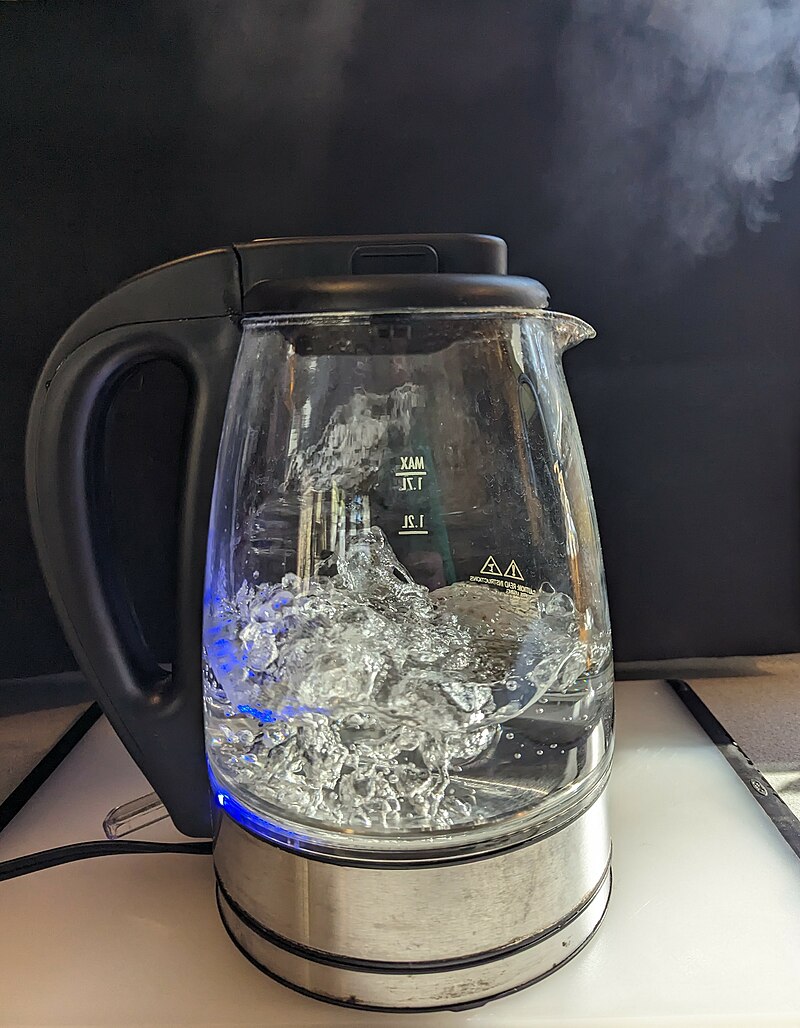
boiling point
temperature at which a substance changes from liquid into vapor

evaporation
thumb|right|Aerosol of microscopic water droplets suspended in the air above a cup of hot tea after the water vapor has sufficiently cooled and condensed. Water vapor is an invisible gas, but the clouds of condensed droplets refract and scatter the sunlight and are thus visible.
thumb|Droplets of water vapor in a pan.
thumb|right|280px|Demonstration of evaporative cooling. When the sensor is dipped in ethanol and then taken out to evaporate, the instrument shows progressively lower temperature as the ethanol evaporates.
thumb|Rain evaporating after falling on hot pavement

airship
thumb|A modern airship, Zeppelin NT D-LZZF in 2010
thumb|The LZ 129 Hindenburg|LZ 129 Hindenburg was the largest airship ever built and was destroyed in 1937.
thumb|120px|upright|Dirigible airships compared with related aerostats, from the Brockhaus and Efron Encyclopedic Dictionary, 1890–1907
An airship, dirigible balloon or dirigible is a type of aerostat (lighter-than-air) aircraft that can navigate through the air flying under its own power. Aerostats use buoyancy from a lifting gas that is less dense than the surrounding air to achieve the lift needed to stay airborne.

vapor
thumb|An ampule of nitrogen oxide vapor: brown [[nitrogen dioxide and colorless dinitrogen tetroxide, in equilibrium]]
In physics, a vapor (American English) or vapour (Commonwealth English; see spelling differences) is a substance in the gas phase at a temperature lower than its critical temperature, which means that the vapor can be condensed to a liquid by increasing the pressure on it without reducing the temperature of the vapor. A vapor is different from an aerosol. An aerosol is a suspension of tiny particles of liquid, solid, or both within a gas.

boiling
thumb|right|Rolling boil of water in an electric kettle

sublimation
transition of a substance directly from the solid to the gas state
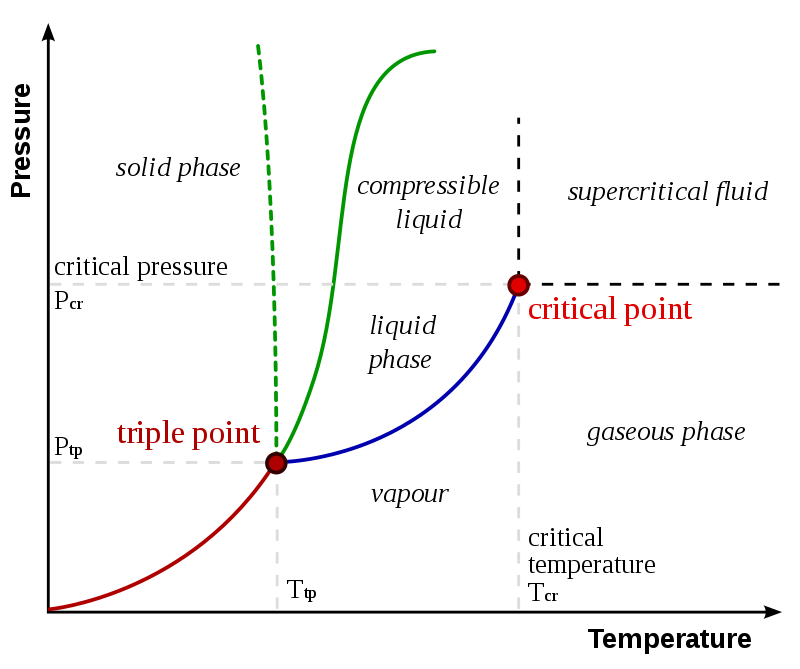
triple point
thermodynamic point where three matter phases exist

adsorption
thumb|Brunauer, Emmett, and Teller's #BET|model of multilayer adsorption is a random distribution of molecules on the material surface.

dew point
temperature at which air becomes saturated with water vapour

propylene
Propylene, also known as propene, is an unsaturated organic compound with the chemical formula . It has one double bond, and is the second simplest member of the alkene class of hydrocarbons. It is a colorless gas with a faint petroleum-like odor.
standard temperature and pressure
reference values for temperature and pressure

critical point
temperature and pressure point where phase boundaries disappear
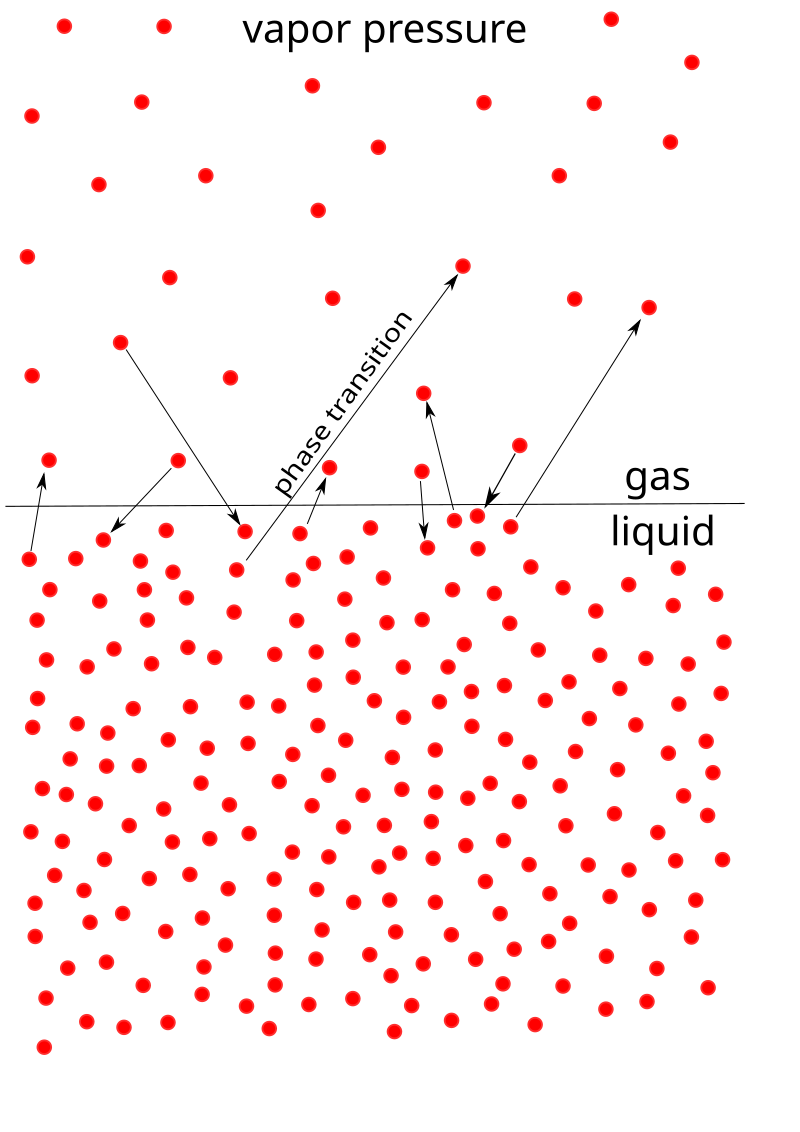
vapor pressure
pressure exterted by a vapor in thermodynamic equilibrium
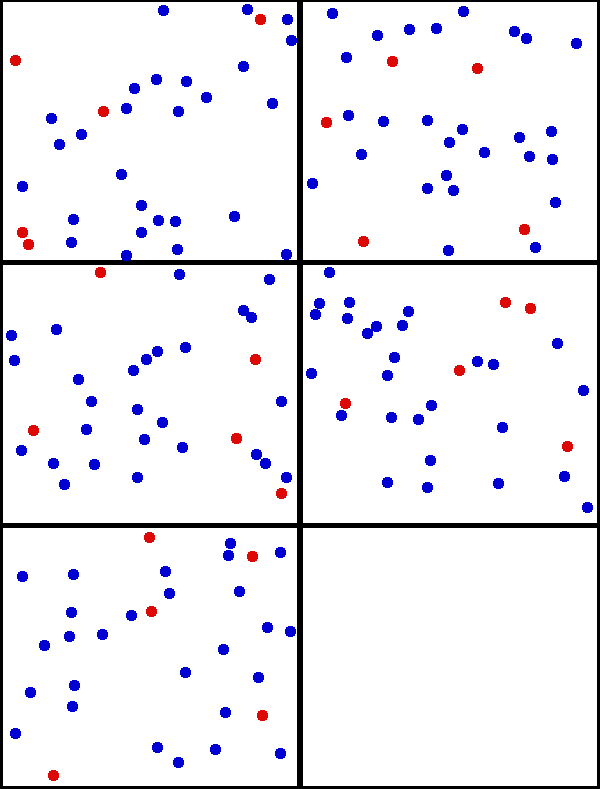
kinetic theory
mathematical model explaining macroscopic properties of gases in microscopic terms

phase diagram
chart used to show conditions at which physical phases of a substance occur

partial pressure
hypothetical pressure of gas if it alone occupied the volume of the mixture at the same temperature

cyclopropane
Cyclopropane is the cycloalkane with the molecular formula (CH2)3, consisting of three methylene groups (CH2) linked to each other to form a triangular ring. The small size of the ring creates substantial ring strain in the structure. Cyclopropane itself is mainly of theoretical interest, but many cyclopropane derivatives are of commercial or biological significance.

absorption
physical or chemical process

antihydrogen
thumb|right|upright=1.2|Antihydrogen consists of an antiproton and a [[positron]]
thumb|right|upright=1.2|Simplified model of an antihydrogen atom in ground state
Maxwell–Boltzmann distribution
specific probability distribution function, important in physics

steam
thumb|Liquid phase eruption of Castle Geyser in [[Yellowstone Park]]
---No%2C1%20%E3%80%90%20Pictures%20taken%20in%20Japan%20%E3%80%91.jpg)
silane
Silane (Silicane) is an inorganic compound with chemical formula . It is a colorless, pyrophoric gas with a sharp, repulsive, pungent smell, somewhat similar to that of acetic acid. Silane is of practical interest as a precursor to elemental silicon. Silanes with alkyl groups are effective water repellents for mineral surfaces such as concrete and masonry. Silanes with both organic and inorganic attachments are used as coupling agents. They are commonly used to apply coatings to surfaces or as an adhesion promoter.
gas exchange
process by which gases diffuse through a membrane
exhaust gas
emitted as a result of the combustion of fuels such as natural gas, gasoline, petrol, biodiesel blends, diesel fuel, fuel oil, or coal
real gas
non-hypothetical gas whose molecules occupy space and have interactions
1-butyne
1-Butyne is an organic compound with the formula . It is a terminal alkyne. The compound is a common terminal alkyne substrate in diverse studies of catalysis. It is a colorless combustible gas. In 2017, was produced in the USA.
Joule–Thomson effect
temperature change of a real gas when undergoing a throttled expansion without heat transfer
inert gas
gas which does not undergo chemical reactions under given conditions
supercritical fluid
state of matter

cyclopropene
Cyclopropene is an organic compound with the formula . It is the simplest cycloalkene. Because the ring is highly strained, cyclopropene is difficult to prepare and highly reactive. This colorless gas has been the subject for many fundamental studies of bonding and reactivity. It does not occur naturally, but derivatives are known in some fatty acids. Derivatives of cyclopropene are used commercially to control ripening of some fruit.
volatility
tendency of a substance to vaporize
sulfur monoxide
chemical compound
fluoromethane
Fluoromethane, also known as methyl fluoride, Freon 41, Halocarbon-41 and HFC-41, is a non-toxic, liquefiable, and flammable gas at standard temperature and pressure. It is made of carbon, hydrogen, and fluorine. The name stems from the fact that it is methane (CH4) with a fluorine atom substituted for one of the hydrogen atoms. It is used in semiconductor manufacturing processes as an etching gas in plasma etch reactors.
volcanic gas
gases given off by active volcanoes
clathrate hydrate
crystalline solid containing molecules caged in a lattice of frozen water

ketene
Ethenone is the formal name for ketene, an organic compound with formula or . It is the simplest member of the ketene class. It is an important reagent for acetylations.

effusion
thumb|250px|The image on the left shows effusion, whereas the image on the right shows Molecular diffusion|diffusion. Effusion occurs through an orifice smaller than the mean free path of the particles in motion, whereas diffusion occurs through an opening in which multiple particles can flow through simultaneously.|alt=
inertness
chemical property of low reactivity
air
classical element in philosophy and cosmology
germanium tetrafluoride
chemical compound
disulfur monoxide
chemical compound
marsh gas
gas produced naturally within marshes, swamps and bogs
monatomic gas
Monatomic Gas
tetrafluorohydrazine
Tetrafluorohydrazine or perfluorohydrazine, , is a colourless, nonflammable, reactive inorganic gas. It is a fluorinated analog of hydrazine.
gas generator
apparatus for producing a gaseous substance
air compressor
devicecompresor
gas thermometer
thermometer that measures temperature by the variation in volume or pressure of a gas
chloryl fluoride
chemical compound
trimethylborane
Trimethylborane (TMB) is a toxic, pyrophoric gas with the formula B(CH3)3 (which can also be written as Me3B, with Me representing methyl).

aerometer
thumb|Using an aeromerer
An aerometer is an instrument designed to measure the density (among other parameters) of the air and some gases.
Oxygen bar
establishment that sells oxygen for on-site recreational use
gas leak
unintended escape of gas from a pipeline or other containment
compressed hydrogen
gaseous state of the element hydrogen kept under pressure
trace gas
gas
selenoyl fluoride
chemical compound